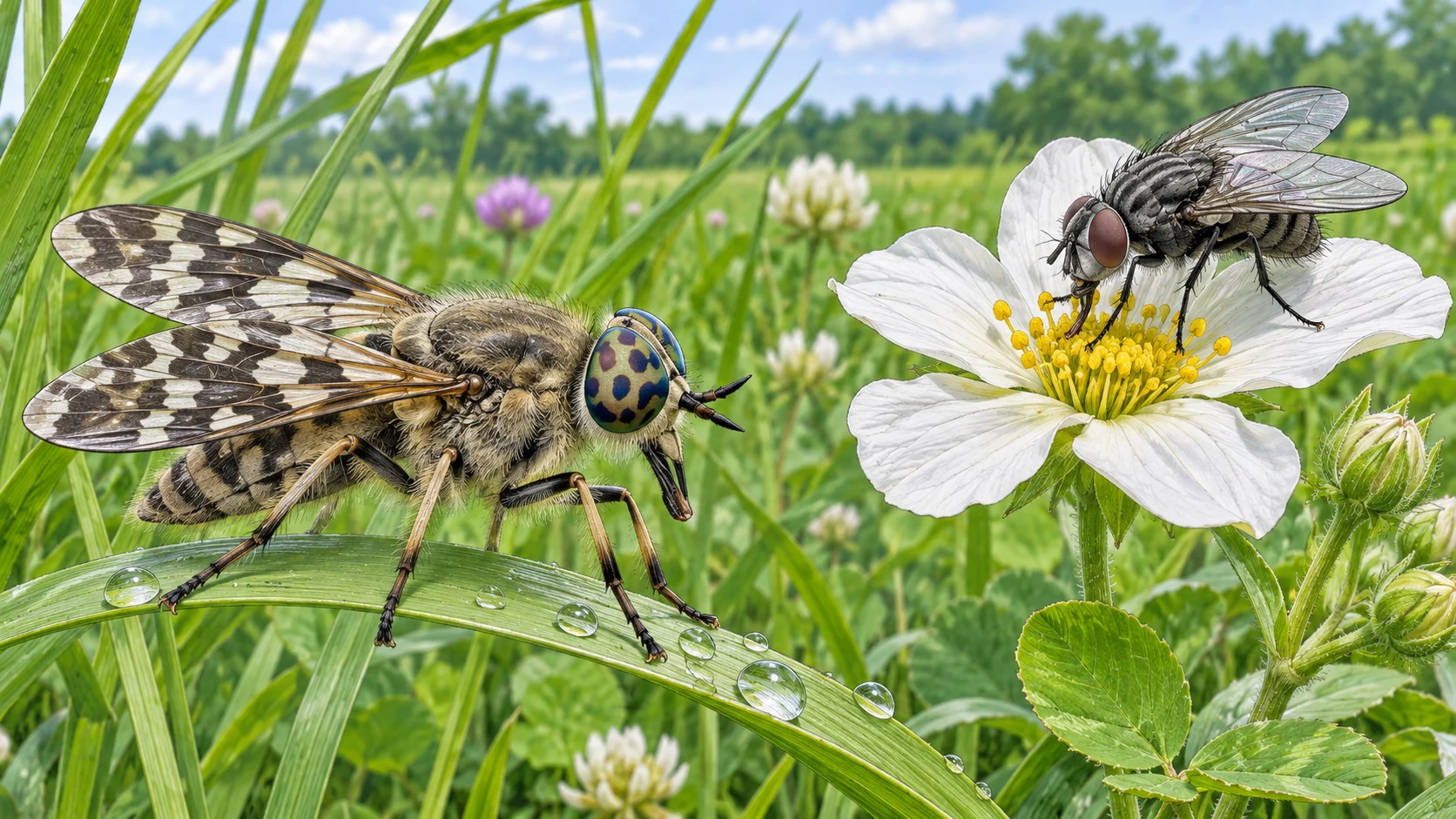
House flies are small, dull gray insects that cannot bite, while deer flies are often yellowish brown or dark, with patterned wings, conspicuously colored eyes, and females capable of delivering painful bites. A house fly typically has four dark stripes along its thorax and clear wings. Many deer flies have dark bands across their wings and gold or green eyes marked with darker spots.
The difference becomes particularly noticeable outdoors. A fly repeatedly circling someone’s head while walking along a wooded trail may be a deer fly, especially if it attempts to bite. A gray fly landing on food or moving around a kitchen is more consistent with a house fly. Both insects are true flies, but they belong to different families and have different feeding habits. Their appearance, behavior, and surroundings provide several ways to distinguish them.
House Fly vs. Deer Fly: Quick Comparison
|
Feature |
House fly |
Deer fly |
|---|---|---|
|
Scientific identification |
Musca domestica |
Primarily Chrysops species |
|
Family |
Muscidae |
Tabanidae |
|
Typical adult length |
About 5–8 mm |
Often 7–13 mm |
|
Body color |
Dull gray, sometimes yellowish along the abdomen |
Yellowish brown, gray, or darker, often patterned |
|
Thorax |
Four dark lengthwise stripes |
Variable markings, sometimes with darker stripes |
|
Wings |
Usually clear, without broad dark bands |
Often have conspicuous dark bands or patches |
|
Eyes |
Large, usually reddish |
Often gold, green, or iridescent, with darker markings |
|
Biting |
Does not bite |
Females bite; males do not |
|
Mouthparts |
Soft, sponging |
Females have cutting mouthparts for blood feeding |
|
Common setting |
Homes, garbage areas, and animal facilities |
Wooded trails, wetlands, yards, and outdoor animal habitats |
|
Larval habitat |
Moist manure, garbage, and decaying organic matter |
Wet soil, mud, and aquatic or semiaquatic environments |
Size alone is not enough to distinguish them. Some deer flies are only slightly larger than house flies, and individual measurements overlap. Wing patterns and eye markings are generally more useful.
How Their Bodies Look Different
House flies have a familiar gray appearance. Their thorax, the section immediately behind the head, bears four narrow dark stripes running lengthwise. The abdomen is generally grayish, sometimes with yellowish areas along the sides.
These markings are useful for recognizing the appearance of a house fly, particularly when the insect is resting and can be examined from above.
Deer flies have a more variable appearance. Many are yellowish brown or gray with darker markings across the thorax and abdomen. Some have noticeable bands or patches that create a contrasting pattern, rather than the relatively uniform gray appearance of a house fly.
Their heads can also appear proportionally broader because of their large compound eyes. Deer flies are sturdy insects, although they are not necessarily much longer than house flies.
The typical adult features of deer flies include their patterned wings and large, often brightly colored eyes. These features are more distinctive than their overall body color.
A brown or gray fly should therefore not be identified from color alone. Examining the wings and eyes is particularly helpful when its size falls within the range of both insects.
The Dark Wing Bands Are an Important Deer Fly Clue
One of the clearest differences is the appearance of the wings.
House flies generally have transparent wings without the bold dark bands associated with many deer flies. Their wing veins may be visible in a close photograph, but the wing membrane itself usually looks clear.
Many deer flies have dark patches or transverse bands across their wings. Depending on the species, the markings may form a broad dark area through the middle of each wing, with clearer sections toward the base or tip.
These patterns can be seen when the insect rests with its wings spread slightly apart. They may also be visible during flight, although movement makes the details harder to judge.
The dark wing markings characteristic of many deer flies are especially useful when distinguishing them from the common house fly.
Not every deer fly has precisely the same wing pattern. The position, shape, and darkness of the markings vary among species. A photograph showing both wings is more informative than a partial view of one wing.
For a suspected deer fly, look for a combination of dark wing bands, a patterned body, and unusually prominent eyes. A house fly normally lacks that combination.
Deer Flies Often Have Gold or Green Eyes With Dark Spots
Eye appearance is another strong identification feature.
House flies have large compound eyes that usually appear reddish or reddish brown. The eyes occupy much of the head, but they generally lack the striking gold-and-green patterns characteristic of many deer flies.
Deer flies often have iridescent eyes with green, gold, or other reflective colors. Dark spots, irregular patches, or distinctive patterns may be visible across the eye surface.
Some individuals have eyes that appear almost jewel-like in direct sunlight. The appearance can change considerably with the viewing angle and lighting.
The eye patterns of deer flies in the genus Chrysops provide a useful identification clue, especially when the wings are partly hidden.
However, eye color is not an absolute test. Species vary, and the bright patterns of living flies may fade after death. A preserved or dried specimen can therefore look less distinctive than a living insect.
A close photograph of the head, combined with a view of the wings, is usually more useful than relying on eye color alone.
House Flies Cannot Bite, but Female Deer Flies Can
The feeding behavior of these insects is fundamentally different.
House flies have sponging mouthparts that allow them to consume liquid food and material softened by digestive fluids. They lack the cutting structures needed to penetrate intact human skin.
Although house flies may repeatedly land on people, common house flies do not bite humans. Their contact can be irritating, but they cannot obtain blood by cutting the skin.
Female deer flies possess specialized mouthparts that slice into the skin. They then take up blood from the resulting wound. Their bites are often immediately painful and may cause localized swelling, redness, or itching.
Male deer flies do not take blood meals. They obtain nourishment from plant-derived sugars, including nectar. Females also use sugary food sources, but blood meals support egg production in many species.
The cutting mouthparts and blood-feeding behavior of female deer flies explain why a deer fly bite feels very different from an ordinary house fly landing on the skin.
A painful bite is an important clue, but it does not identify the insect by itself. If the fly was not observed clearly, another biting insect may have been responsible.
Why Deer Flies Circle People’s Heads
Deer flies are primarily outdoor insects, and females seeking blood meals can be persistent around people and other mammals. They use visual cues, including movement and contrast, to help locate potential hosts.
Someone walking along a wooded trail may notice a fly repeatedly circling their head or following them for a short distance. Deer flies commonly approach the upper body, including the head and neck, although they can bite other exposed areas.
Their flight is fast and maneuverable, making them difficult to examine while airborne. They may approach, move away when disturbed, and return to attempt another landing.
House flies can also circle people or repeatedly land on exposed skin. However, they are not pursuing a blood meal. They may be investigating moisture, sweat, or other substances on the skin.
The reasons house flies repeatedly land on people are therefore different from the host-seeking behavior of female deer flies.
A fly circling someone’s head is not automatically a deer fly. The observation becomes more persuasive when the insect has dark wing bands, patterned eyes, and attempts to bite.
Where You Are More Likely to Encounter Each Species
House flies are common around buildings, garbage containers, exposed food, and animal facilities. They can enter houses through open doors, damaged screens, and other accessible openings.
Their larvae develop in suitable moist organic material, including manure, decaying vegetation, and household garbage. This explains why adult house flies are frequently associated with places where food and waste accumulate.
Deer flies are more closely associated with outdoor habitats containing wet ground or nearby water. Wooded trails, marshy areas, stream margins, and damp fields are common settings for encounters.
Their immature stages develop in aquatic or semiaquatic habitats rather than ordinary household garbage. Adults can travel away from those habitats, however, so finding a deer fly in a residential yard does not establish that it developed on the property.
A useful distinction is whether the insect appears to be seeking food or a host. House flies are commonly noticed around food, garbage, and household surfaces. Female deer flies are more likely to attract attention by persistently approaching people or animals outdoors.
A house fly entering through an open door may later gather near a window. A deer fly can also enter a building accidentally, but it is not a typical indoor kitchen fly.
The ways house flies enter residential buildings help explain why indoor sightings are much more characteristic of house fly activity than deer fly activity.
Can You Identify a Deer Fly From Its Bite Alone?
A deer fly bite is often sharp and immediately noticeable. The insect cuts the skin rather than inserting a narrow feeding tube, and a small amount of bleeding may occur.
The bite can leave a painful, itchy, or swollen area. Reactions vary, and some people experience more pronounced local swelling than others.
Nevertheless, a bite mark cannot reliably identify the insect. Different biting insects can produce similar reactions, and the appearance of the skin does not reveal the species responsible.
If the insect remains nearby, its wings and eyes provide more useful evidence. A medium-sized fly with dark wing bands and brightly patterned eyes is consistent with a deer fly, particularly when it has been observed biting outdoors.
The characteristic appearance and biting habits of deer flies support using both physical features and behavior rather than the skin reaction alone.
For an uncomplicated bite, gently washing the area and using a cold compress may help with local discomfort. Seek medical care for worsening redness, increasing pain, fever, or other concerning symptoms. Difficulty breathing, throat swelling, or faintness after a bite requires emergency medical attention.
What If a Fly Looks Like a House Fly but Keeps Biting?
The most important observation is whether the insect actually pierces the skin.
A true house fly cannot bite, so a painful puncture caused by a house-fly-like insect indicates that it is not the common house fly.
A suspected deer fly should be examined for dark patches across the wings and conspicuously patterned eyes. Its body may also be yellowish brown or darker rather than uniformly gray.
If those features are absent, the insect should not be identified as a deer fly solely because it bites. Other flies can resemble house flies, and their mouthparts, markings, and behavior differ.
The broader issue of flies that resemble house flies but bite requires identifying the actual insect rather than assuming every painful encounter involves the same species.
A photograph taken while the fly is resting is especially useful. Capture the wings from above and the head from the front or side, if possible, without risking another bite.
Do Deer Flies Gather Around Windows Like House Flies?
Both insects may approach windows after entering a building, but their usual indoor presence differs.
House flies commonly move toward bright windows and may repeatedly fly against the glass while attempting to escape. This behavior is familiar in kitchens and other occupied rooms.
Deer flies are predominantly outdoor insects. An individual may enter through an open door or window and subsequently become trapped indoors, but persistent indoor populations are not characteristic of their usual development.
Finding one deer fly against a window does not indicate that it is breeding inside the home. Its larvae generally require wet outdoor habitats rather than the organic waste commonly used by house flies.
The tendency of house flies to gather around windows can therefore create a misleading similarity. Window behavior alone does not distinguish the insects.
When a fly is resting against glass, examine its wing markings and eyes. Those characteristics are considerably more informative than the fact that it is trying to escape.
Questions About House Flies and Deer Flies
Are deer flies bigger than house flies?
Deer flies are often somewhat larger and more robust, but their sizes overlap. Many deer flies measure approximately 7–13 mm, while house flies are commonly around 5–8 mm. Dark wing markings and patterned eyes are better identifying features than size alone.
Do all deer flies have striped wings?
Many familiar deer flies have conspicuous dark bands or patches across their wings. The exact pattern varies by species, and some markings are less obvious than others. A clear view of both wings helps establish whether the insect matches a typical deer fly.
Can male deer flies bite?
Male deer flies do not take blood meals and lack the female’s blood-feeding behavior. Female deer flies use cutting mouthparts to obtain blood, while males feed on plant-derived sugars.
Why would a deer fly appear in my backyard?
A deer fly may have traveled from suitable outdoor habitat nearby. Wooded areas, wetlands, and damp ground can be associated with their activity, but adults are capable of moving away from their developmental sites. A backyard sighting does not prove that larvae are developing on the property.
The Most Reliable Way to Tell Them Apart
A house fly is typically dull gray, with four dark stripes on its thorax, clear wings, and nonbiting mouthparts. A deer fly is often yellowish brown or darker, with conspicuous dark wing markings and large eyes that may show gold, green, or darker patterns.
Their behavior adds useful context. House flies commonly visit food and waste around buildings. Female deer flies may persistently approach people and animals outdoors and inflict painful bites. For a fly that appears to be a deer fly, prioritize the wing pattern and eye markings rather than its size or the location where it was found. When those features agree with the insect’s biting behavior, the identification becomes much more convincing.