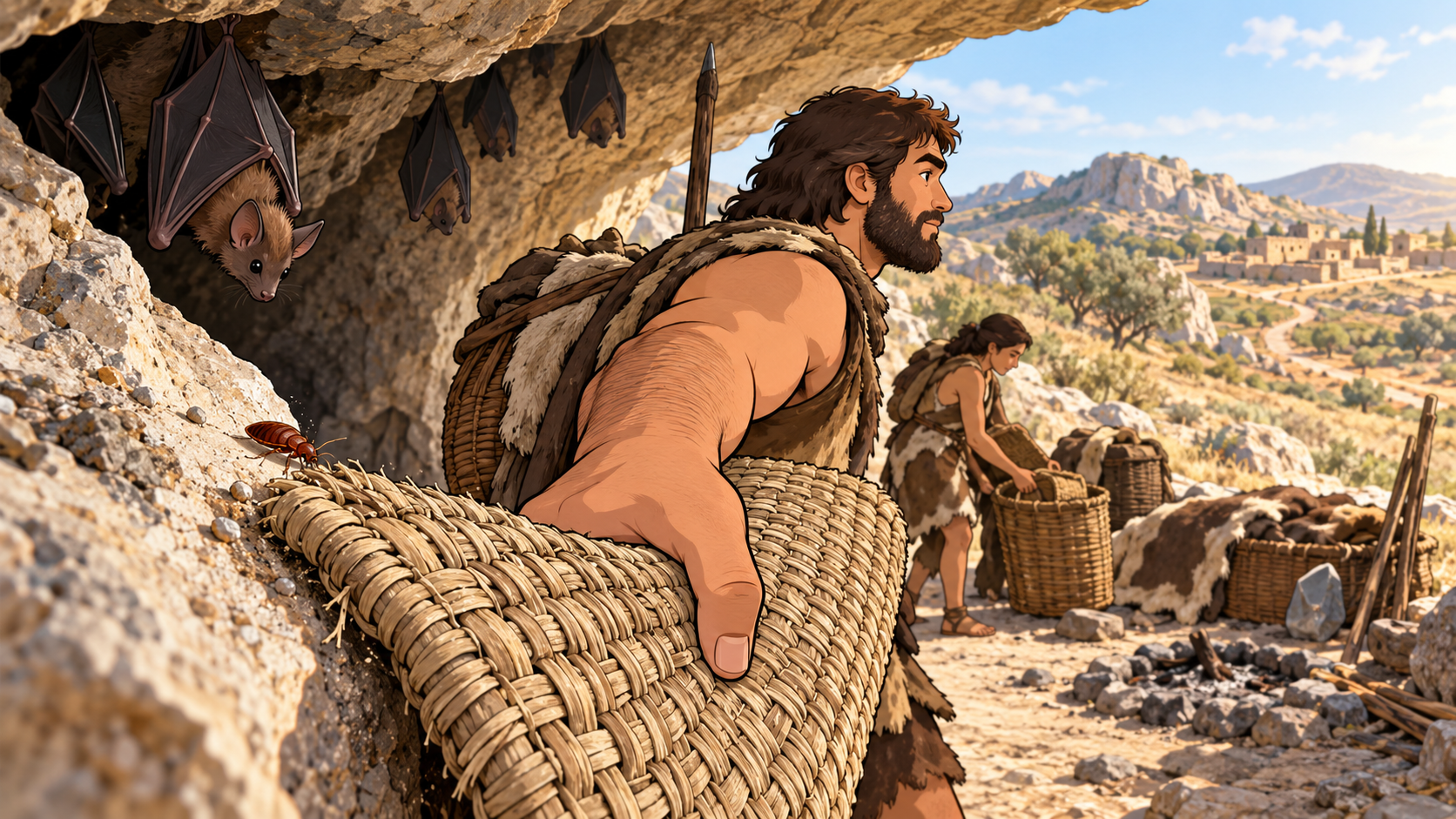
Bed bugs were bothering people long before modern bedrooms, hotels, or apartment buildings existed. Archaeology has produced actual remains of the common bed bug from ancient Egypt, while even older Cimex fossils have been recovered from a cave in North America.
The oldest confirmed archaeological evidence of the common bed bug, Cimex lectularius, associated with people comes from Tell el-Amarna in ancient Egypt and dates back at least 3,550 years. Even older Cimex remains, dating from about 5,100 to almost 11,000 years ago, have been found at Oregon’s Paisley Caves, although those belonged to other species and represent probable rather than proven contact with humans.Those discoveries answer a slightly different question from the evolutionary origin of bed bugs themselves. The insects are far older than the archaeological record of their association with people.
Ancient Egypt Gives Us the Oldest Confirmed Cimex lectularius Record
The strongest archaeological evidence for the common bed bug comes from Tell el-Amarna, the ancient Egyptian city associated with Pharaoh Akhenaten.
In 1999, Eva Panagiotakopulu and Paul Buckland reported Cimex lectularius remains recovered there. Their paper in Antiquity concluded that bed bugs had been troubling humans for at least 3,550 years.
That is considerably stronger evidence than simply finding an ancient written reference that might describe a biting insect. The researchers had physical specimens identifiable as the same species responsible for most temperate-region bed bug infestations today.
It doesn’t mean Egypt was where C. lectularius originated. It means ancient Egypt currently provides an important, securely identified archaeological record showing that the species was already associated with humans thousands of years ago.
The deeper evolutionary history is a different question, which is why we’ve covered why bed bugs exist separately rather than using a 3,550-year-old archaeological find as the beginning of the species itself.
Much Older Cimex Remains Were Found in Oregon
A second archaeological discovery pushes the record of the genus Cimex much farther back, but it needs to be kept separate from the Egyptian finding.
Researchers examining material from the Paisley Five Mile Point Caves in south-central Oregon recovered 14 fossil or subfossil cimicids. One specimen dated to roughly 5,100 calibrated years before present, while the other 13 ranged from about 9,400 to almost 11,000 years old.
Nine specimens could be identified to species. They belonged to Cimex antennatus, Cimex latipennis, and Cimex pilosellus. The remaining five were too fragmentary for a confident species identification.
None of the identified specimens was Cimex lectularius.
The researchers nevertheless described the Paisley Caves material as the oldest known remains of the genus in probable contact with humans. The caves contain extensive evidence of ancient human occupation, making the association particularly interesting.
“Probable contact” is the important qualification. The fossils establish that these Cimex species occupied the same cave environment used by early people. They do not prove that those insects routinely fed on the humans living there.
The Oregon Bugs and the Common Bed Bug Are Different Species
The Egyptian and Oregon discoveries therefore shouldn’t be combined into a single timeline for Cimex lectularius.
The Egyptian remains are the common bed bug itself. The identifiable Oregon specimens belong to three other Cimex species. They provide an older archaeological record for the genus, not an older North American record of C. lectularius.
Those Oregon species are associated primarily with bats. Their discovery shows that Cimex bugs were present in North America thousands of years before the common bed bug became historically established there.
This distinction also prevents a misleading conclusion: the Paisley Caves discovery doesn’t show that modern household bed bug infestations in North America descend from those ancient cave specimens.
Common Bed Bugs Reached North America Much Later
Historical reviews place the establishment of Cimex lectularius in North America much later, during European colonization.
A scientific review of bed bug classification, evolution, and dispersal dates the origin of North American C. lectularius infestations to early European colonists in the 17th century. By the early 20th century, bed bugs had become extremely common in North America.
That gives the continent two very different histories involving the genus Cimex. Ancient native Cimex species were present thousands of years earlier, while the common bed bug associated with modern household infestations became established after European settlement.
Neither story identifies North America as the evolutionary birthplace of bed bugs.
There Isn’t a Single Country We Can Call the Birthplace of Bed Bugs
Archaeological evidence can tell us where bed bugs were present at a particular point in history. It cannot necessarily tell us where the species first evolved.
Finding C. lectularius in Egypt 3,550 years ago establishes that the common bed bug was there by that time. It doesn’t establish that the species originated in Egypt.
Modern evolutionary research pushes the story much farther into the past. Genetic evidence indicates that the family Cimicidae predates humans by tens of millions of years, while research into C. lectularius suggests a much more complicated host history than the simple story that bed bugs began with human civilization.
For that reason, ancient Egypt is better described as the location of the oldest well-established archaeological record of C. lectularius, not automatically the place where bed bugs originated.
Bed Bugs Became Uncommon in the 20th Century, but They Never Disappeared
By the first half of the 20th century, bed bugs were widespread household pests. Their fortunes changed dramatically after powerful synthetic insecticides became widely available in the 1940s and 1950s.
Populations fell so sharply in many economically developed countries that bed bugs became uncommon for decades. They were not eradicated worldwide, however.
The reversal became obvious in the late 1990s. A review of the resurgence found that the modern upsurge appeared to begin at roughly the same time in Europe, the United States, and Australia.
No single factor completely explains the comeback. Modern reviews identify insecticide resistance as a major contributor, alongside increased travel and shortcomings in pest management. Research on U.S. populations has documented very high resistance to commonly used pyrethroid insecticides, helping explain why methods that once suppressed bed bugs became less reliable.
Our examination of why bed bugs are becoming resistant to pesticides covers that modern part of their history separately.
Their History Explains Why Bed Bugs Aren’t a Sign of a Dirty Home
Thousands of years of bed bug history also undermine one persistent misconception. Bed bugs haven’t followed humans because particular civilizations, cities, or households were unusually dirty.
They are blood-feeding insects that benefit from living close to suitable hosts and from being transported with human belongings. Modern homes simply provide another version of the close association between shelter and host that has allowed them to live alongside people for millennia.
That is also why sanitation alone doesn’t prevent an infestation. The factors involved in what attracts bed bugs to a home have much more to do with access to hosts and opportunities for introduction than whether a home meets some arbitrary standard of cleanliness.
Questions About the History of Bed Bugs
What is the oldest known common bed bug ever found?
The best-established archaeological evidence for Cimex lectularius comes from Tell el-Amarna in Egypt and shows that the species was associated with humans at least 3,550 years ago.
Were bed bugs in North America before Europeans arrived?
Other species of Cimex certainly were. Fossils from Oregon’s Paisley Caves date back as far as almost 11,000 years. The identified specimens were C. antennatus, C. latipennis, and C. pilosellus, however, not the common bed bug C. lectularius responsible for most modern household infestations.
Did bed bugs originate in Egypt?
The archaeological record doesn’t establish that. Egypt provides the oldest confirmed ancient record of C. lectularius associated with humans, but finding a species at an archaeological site doesn’t prove that it evolved there.
When did common bed bugs reach North America?
Historical reviews associate C. lectularius in North America with European colonization beginning in the 17th century. This was much later than the ancient native Cimex species documented at Paisley Caves.
Did bed bugs ever completely disappear?
No. Their numbers fell dramatically in many economically developed countries during the mid-20th century, but they were never globally eradicated. Populations resurged internationally beginning around the late 1990s, with insecticide resistance, travel, and pest-management factors all implicated.
2 thoughts on “Where Did Bed Bugs Originally Come From?”