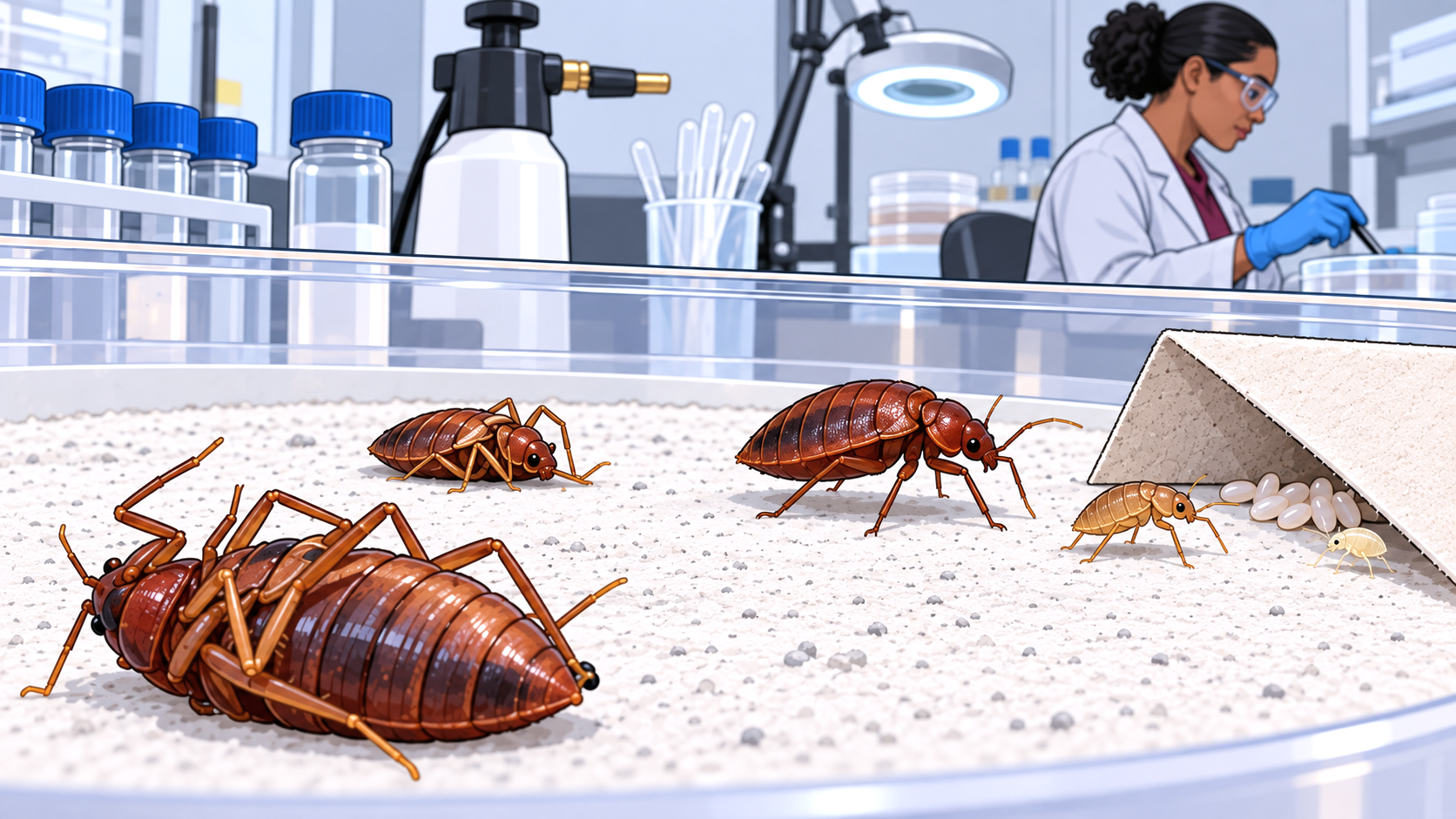
Yes. Bed bugs have developed substantial resistance to several insecticides, particularly pyrethroids. In one documented population, the resistance ratio reached 1,235,000-fold for permethrin and 370,000-fold for deltamethrin compared with a susceptible strain. Resistance develops through selection, as susceptible bugs die while less-susceptible survivors reproduce and pass resistance traits into later generations.
How Bed Bug Pesticide Resistance Develops
The evolutionary mechanism is straightforward. When a bed bug population encounters a pesticide, the most susceptible insects are more likely to die. Bugs that are naturally less susceptible have a greater chance of surviving and reproducing.
Repeat that process and the population can gradually become harder to kill with the same pesticide. Continued pesticide exposure can leave less-susceptible bed bugs behind to breed, reducing the pesticide’s relative effectiveness over time.
This is one reason repeatedly spraying the same product isn’t a good response when treatment appears to be failing. More pesticide doesn’t automatically overcome resistance, and repeated spraying can contribute to resistance while still failing to eliminate the infestation.
The important distinction is that individual bed bugs don’t decide to adapt after being sprayed. Selection changes the population across generations because bugs already carrying traits that help them survive contribute disproportionately to later generations.
Bed Bugs Have More Than One Resistance Mechanism
Pyrethroid resistance isn’t built around one biological trick. Bed bugs can resist insecticides through several mechanisms, and multiple mechanisms can occur within the same field population.
One is penetration resistance. Resistant bed bugs can have a thicker cuticle, slowing an insecticide’s movement through the insect’s outer covering. Research comparing resistant bed bugs has found greater cuticle thickness associated with longer knockdown times.
Another is metabolic resistance. Bed bugs can have increased activity or expression of detoxification systems that help process insecticides before enough of the chemical reaches its intended target. Cytochrome P450 monooxygenases, glutathione S-transferases, esterases, and other systems have been implicated in bed bug resistance.
Then there is target-site resistance, including knockdown resistance, or kdr. Pyrethroids act on voltage-gated sodium channels in the insect nervous system. Mutations affecting those channels can make the insect substantially less sensitive to the chemical.
These mechanisms don’t have to occur separately. Field populations have been found carrying multiple resistance mechanisms simultaneously, which helps explain why resistance can become much more complicated than simply finding a slightly tougher bug.
Our guide to why bed bugs are so hard to kill covers the other biological and practical factors that make an infestation difficult to eliminate.
How Extreme Bed Bug Resistance Can Get
This is where the numbers become difficult to ignore.
One published review of resistance testing reported a field-derived Sydney strain with resistance ratios of approximately 1,235,000 for permethrin and 370,000 for deltamethrin compared with a susceptible strain. In the same data, the resistance ratio was about 250 for bendiocarb and 2.6 for both pirimiphos-methyl and imidacloprid.
Those numbers do not mean a homeowner should apply 1.235 million times more permethrin. Absolutely not. Pesticides must be applied only as their labels direct.
A resistance ratio is a laboratory comparison of susceptibility between populations. In this case, it demonstrates an enormous difference between how the resistant and susceptible strains responded to particular insecticides. It isn’t an application-rate instruction.
That’s probably the most important context to put beside a number this dramatic. Resistance can be extreme without making a higher pesticide dose either appropriate or safe.
Resistance Isn’t Equal Across Every Pesticide
The Sydney results also show why “bed bugs are resistant to pesticides” is too broad to be useful on its own.
Resistance can differ dramatically by active ingredient, chemical class, and bed bug population. Even within one set of results, permethrin and deltamethrin produced enormous resistance ratios while other tested insecticides produced far smaller ones.
More recent research continues to show substantial variation. A 2023 study of 13 field-collected common bed bug populations in the United States found very high deltamethrin resistance in seven populations, while only one showed high resistance to the tested neonicotinoids. The same research also found large differences in how field populations responded to combination sprays.
That variation matters outside the laboratory. A product working poorly against one population doesn’t establish that every bed bug population everywhere will respond identically. Resistance can vary between communities and can only be confirmed for a particular population through laboratory testing.
So we wouldn’t diagnose pesticide resistance simply because one treatment failed. Poor coverage, missed hiding places, untreated eggs, insufficient follow-up, or incorrect application can also produce treatment failure.
Researchers Have Watched Resistance Increase Over Time
Resistance isn’t only visible when researchers compare a modern field population with an old susceptible laboratory strain. It has also been tracked over time.
A tropical bed bug population from Kandy, Sri Lanka, was studied years apart. Between 2002 and 2016, the time required to knock down half the population increased 2.7-fold for deltamethrin and 15.1-fold for permethrin.
That study involved the tropical bed bug, Cimex hemipterus, rather than the common bed bug, Cimex lectularius. We think that species distinction is important because resistance findings shouldn’t be casually transferred from one species to another.
What the study does demonstrate directly is that insecticide susceptibility within a bed bug population can change substantially over time under selection pressure.
Resistance Is Written Into the Bed Bug’s Biology
The genetic side of resistance makes the evolutionary process less abstract. In the common bed bug, mutations in voltage-gated sodium-channel genes have been associated with pyrethroid resistance. Resistant populations can also show increased expression of genes associated with metabolic detoxification and the cuticle. Modern genomic work continues to identify metabolic, penetration, and target-site mechanisms associated with insecticide resistance.
That doesn’t mean every resistant population carries exactly the same genetic changes. Different populations can arrive at resistance through different combinations of mechanisms.
In fact, that’s one reason resistance is such an awkward problem to simplify. “Resistant to pyrethroids” describes the outcome. It doesn’t necessarily tell you which combination of biological defenses produced it in that particular population.
A Synergist Can’t Necessarily Undo Every Resistance Mechanism
Some pesticide formulations use synergists intended to interfere with metabolic processes that would otherwise help an insect detoxify an insecticide.
The limitation becomes obvious once you consider how many resistance mechanisms a bed bug can carry. Blocking one metabolic pathway doesn’t automatically reverse a thicker cuticle or a changed pesticide target in the nervous system.
This is why we’d be careful with the idea that adding a synergist somehow makes pyrethroid resistance disappear. A resistant population may be protected by several mechanisms simultaneously.
The larger lesson is more useful than focusing on one additive: bed bug resistance can be layered. A treatment strategy built around defeating only one mechanism may still encounter the others.
Pyrethroid Resistance Can Even Affect a Physical Treatment at Low Exposure
One of the more surprising findings involves desiccant dust.
Desiccants don’t kill bed bugs through the same nerve-targeting mechanism as pyrethroids. Instead, they damage the protective outer layer of the insect, causing it to lose moisture and die. That physical mode of action makes desiccants valuable where conventional insecticide resistance is a concern.
However, researchers tested a pyrethroid-resistant common bed bug strain against silica gel and found an interesting wrinkle. At the tested label rate, the silica gel produced 100% mortality in both resistant and susceptible strains. But when researchers experimentally reduced the silica gel to half the label rate, the resistant strain survived about 50% longer than the susceptible strain.
The researchers linked that mild tolerance to resistance mechanisms that included cuticle thickening.
This does not mean bed bugs have developed conventional resistance to properly applied desiccants. Nor does it justify changing a product’s application rate yourself. The useful point is narrower: biological traits selected by one control pressure can sometimes affect susceptibility to another method in ways that aren’t immediately obvious.
Always use a pesticide product exactly according to its current label.
Different Modes of Action Still Matter
Fortunately, pyrethroids aren’t the only pesticide option registered for bed bugs.
Current registered bed bug pesticides include several classes with different modes of action, including pyrethrins, pyrethroids, desiccants, biochemicals, pyrroles, neonicotinoids, and insect growth regulators. Using pesticides with different modes of action can help reduce the likelihood of resistance developing.
Chlorfenapyr is an interesting example. It’s a pyrrole and works very differently from pyrethroids. It must first be activated inside the insect before disrupting cellular functions.
But we’d stop short of calling any pesticide class “resistance-proof.” Resistance is a population-level biological phenomenon, and susceptibility can change. What matters for a homeowner is not trying to outsmart that process by improvising pesticide combinations or increasing doses.
Instead, the treatment plan should avoid depending entirely on one chemical attack.
Pesticides Should Be One Part of Bed Bug Control
The practical response to resistance is integrated pest management, not a chemical arms race.
A comprehensive bed bug strategy uses pesticides as only one part of a broader control plan. Depending on the infestation, that can include inspection, monitoring, laundering, heat treatment for appropriate belongings, encasements, interceptors, vacuuming, registered desiccants, and correctly selected pesticides.
This approach has another advantage. Not every failed treatment is resistance. A pesticide can fail because it never reached the bugs, because eggs survived, because important hiding places were missed, or because treatment wasn’t followed up correctly. Several different problems can make bed bug treatments fail.
That’s why repeatedly spraying more of the same product is such a poor diagnostic tool. You don’t know whether you’re overcoming resistance, missing the insects entirely, or simply adding more pesticide without solving the original problem.
If a pesticide treatment repeatedly fails despite correct label use and a thorough treatment plan, that’s a good point to stop experimenting and consider professional help.
Other Questions About Bed Bug Pesticide Resistance
Can bed bugs be resistant to one pesticide but susceptible to another?
Yes. Resistance varies by population, active ingredient, and mode of action. A bed bug population that is highly resistant to one pyrethroid isn’t automatically equally resistant to every pesticide registered for bed bug control.
Does pesticide resistance mean a product’s EPA registration is meaningless?
No. Registration and resistance answer different questions. A registered bed bug product has supporting efficacy data for its labeled use, but real-world effectiveness can still depend on whether the particular bed bug population is resistant, along with application quality, infestation extent, preparation, and whether all life stages are addressed.
Does buying a newer or more expensive pesticide avoid resistance?
Not necessarily. Price and product age don’t determine susceptibility. The active ingredients and their modes of action matter much more, along with the resistance characteristics of the particular bed bug population.
Can resistance decrease after pesticide exposure stops?
Resistance traits can carry biological costs in some insects, but whether a particular bed bug population will lose meaningful resistance, and how quickly that would happen, depends on the resistance mechanism and population. It isn’t something a homeowner can rely on as a control strategy.
Can I use extra pesticide to overcome a resistant population?
No. Never exceed the application rate or frequency permitted by the product label. Extreme laboratory resistance ratios are measurements of biological susceptibility, not instructions to increase pesticide doses.
8 thoughts on “Why Are Bed Bugs Becoming Resistant to Pesticides?”