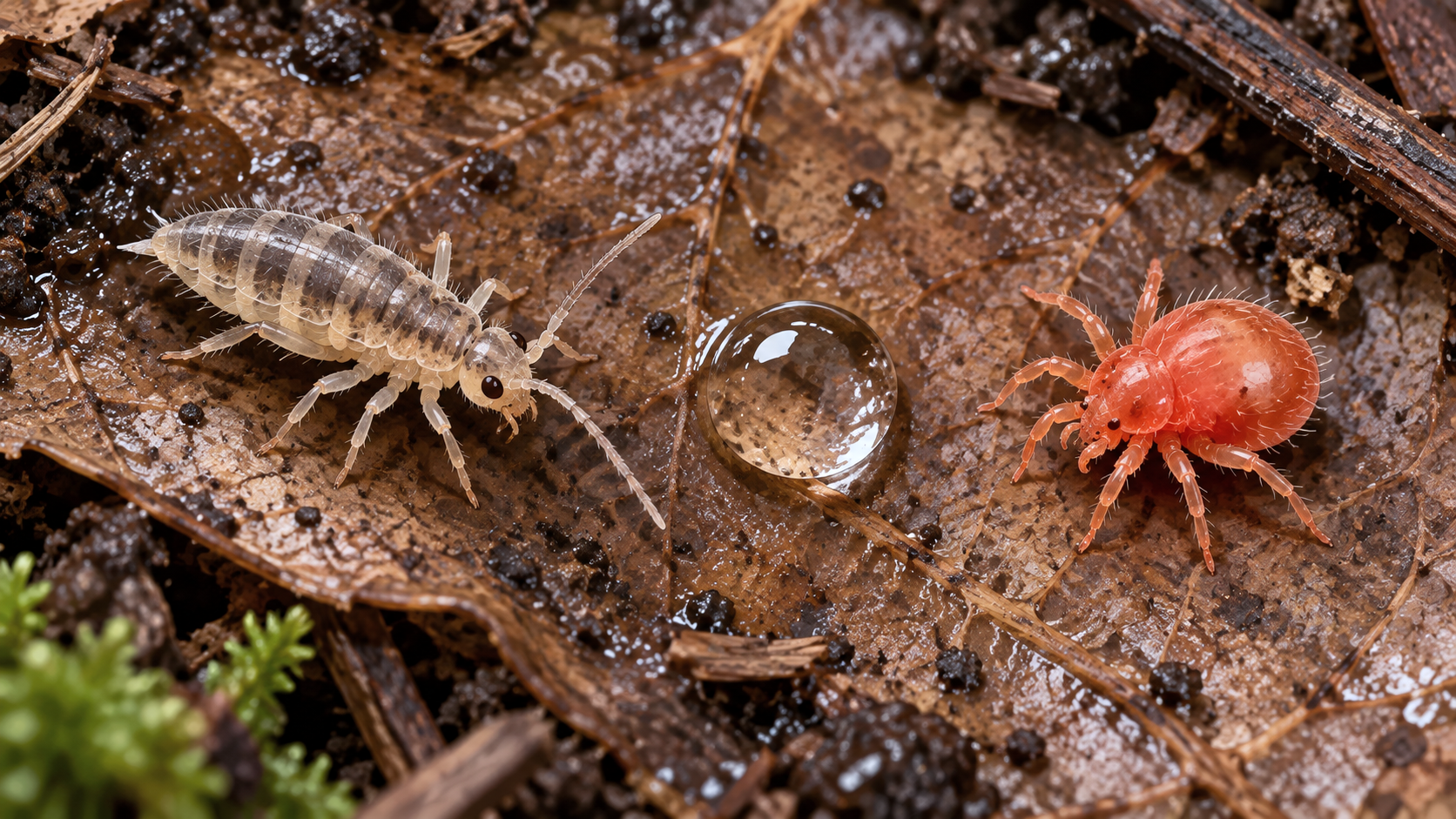
Springtails and mites can both look like moving specks, especially around houseplants and damp areas. The quickest distinction is movement and body structure. Springtails commonly jump and have six legs with visible antennae. Mites crawl rather than jump, lack antennae, and most adult mites have eight legs. Their exact appearance varies considerably by mite group.
That last point matters because “mite” is a broad label. Spider mites, clover mites, predatory mites and soil-dwelling mites can look and behave differently. Instead of trying to match every tiny creature to one generic picture of a mite, look for the few structural differences that separate mites from springtails.
Springtails vs. Mites at a Glance
| Feature | Springtails | Mites |
|---|---|---|
| Arthropod group | Collembola | Arachnids |
| Typical size | Most household types about 1–2 mm | Many are 1–2 mm or smaller |
| Adult legs | 6 | Usually 8 |
| Antennae | Present | Absent |
| Jump | Most species can | No |
| Fly | No | No |
| Body shape | Elongated or globular | Commonly oval or rounded |
| Common houseplant clue | Numerous jumpers in damp soil | Crawlers on foliage or in soil, depending on species |
| Plant damage | Usually little or none | Depends on the mite species |
| Webbing | No | Some spider mites produce webbing |
Size and color are weak starting points here. Both groups contain animals small enough to require magnification for a confident identification, and both include pale, brownish and darker forms. Movement and anatomy tell you considerably more.
A Jumping Speck Strongly Favors a Springtail
Movement gives this comparison its easiest shortcut. Most springtails possess a forked appendage beneath the abdomen called a furcula. When released, it propels the animal away from a disturbance. That is why springtails can suddenly jump even though they have no wings.
Mites do not jump or fly. They move by walking, although their small size can make that movement difficult to follow without magnification. Some mites can also disperse on air currents, which should not be confused with powered flight.
So when a tiny speck repeatedly springs away as you approach it, springtail moves well ahead in the identification. It is not an absolute test because some soil-dwelling springtails have a reduced or absent furcula and cannot jump. Still, a clear jump separates springtails from mites far more effectively than comparing color.
Count Legs and Look for Antennae When They Stay Still
A hand lens can settle cases where movement does not. Springtails are six-legged hexapods. They also have a distinct pair of antennae, which can be quite noticeable on elongated springtails.
Mites belong to the arachnid group rather than the insects. Most adult mites have eight legs and no antennae. The distinction sounds simple, but there is a catch when examining immature specimens. Mite larvae commonly have six legs, so leg count alone can mislead you if you happen to be looking at the youngest stage. Some specialized mites also depart from the usual eight-legged adult form.
Antennae provide a useful second check. Mites have sensory appendages called pedipalps near the mouth, but these are not antennae. When you can clearly see a pair of antennae extending from a distinct head, the specimen fits a springtail much better.
Body shape can help as well. Many mites are oval or rounded. Springtails include both elongated forms and globular species, so a round body by itself does not solve the identification. In fact, globular springtails are recognized mite look-alikes, which is exactly where magnification becomes worthwhile.
Damp Soil Points Toward Springtails, but It Does Not Rule Out Mites
Houseplant soil creates one of the easiest places to confuse these animals. Springtails favor moisture and commonly occur in overwatered potting media, where they feed largely on fungi and decaying organic material. They often become conspicuous after watering disturbs the soil.
Finding tiny arthropods in soil does not automatically make them springtails, though. Some mites are detritivores that consume fungi, algae, bacteria and decomposing plant material. Others are predators of tiny organisms. Therefore, soil can support mites without the plant having a mite-feeding problem.
This is where movement becomes particularly useful. A crowd of tiny creatures springing across wet potting mix fits springtails in potted plants extremely well. Creatures that remain on the surface and crawl need closer examination before you call them springtails.
Plant Damage Can Separate Springtails From Spider Mites
The comparison changes when the mystery specks are concentrated on foliage rather than in soil. Spider mites commonly feed on the undersides of leaves. Their feeding can produce fine stippling, which appears as numerous tiny pale dots across affected foliage. Some spider mite species also produce fine silk webbing.
Springtails generally do not create that combination. Household springtails mainly act as scavengers, and damage to indoor plants is rare. A few springtail species can feed on living plant tissue, so “springtails never damage plants” would be too broad. However, stippled foliage with mites underneath the leaves and fine webbing is a much better fit for spider mites.
Webbing deserves special attention because it can save you from trying to identify a nearly microscopic animal by body shape alone. Springtails do not produce spider-mite webbing. When fine silk accompanies tiny crawling mites and stippled leaves, the evidence has moved well beyond a generic “small bug on my plant.”
Our broader guide to whether springtails are harmful to plants covers the less common situations where springtail feeding itself becomes relevant.
Red Specks on Walls May Be Clover Mites
Not every springtail-versus-mite mystery involves a houseplant. Tiny moving dots on windowsills, walls, curtains or other indoor surfaces can turn out to be clover mites.
Clover mites are extremely small and can range from reddish or brown to dark green. One of their most distinctive features under magnification is an unusually long front pair of legs. They develop outdoors on plants but can enter buildings in large numbers, particularly around windows and other openings. When crushed, clover mites can leave a rusty-red stain.
Springtails create a different indoor pattern. They are strongly associated with moisture and often appear around bathrooms, basements, plumbing leaks and other damp locations. A recurring indoor springtail problem therefore gives you a reason to look for excess moisture, while red crawling specks entering around windows deserve closer inspection for clover mites.
The stain is not a reason to crush an unknown specimen just to test it. A phone macro photo or hand lens can preserve the features you need for identification instead.
Color Alone Is Especially Unreliable
A red speck might make you think “mite,” while a dark speck might look more like a springtail. Neither assumption is dependable enough for identification.
Mites occur in a wide range of colors, including near-white, yellowish, tan, brown, orange, red and purplish forms. Springtails also have considerable color variation. Many household species are gray, brown or black, but white and brightly colored springtails occur as well.
That overlap is why our guide to springtail colors treats color as supporting evidence rather than a standalone test. For this comparison, a visible jump, antennae, leg arrangement, location and any plant symptoms carry much more weight.
Use the Clue That Matches Where You Found Them
For tiny animals in wet potting soil, disturb the surface gently and watch what happens. Repeated jumping strongly supports springtails. If the animals only crawl, use magnification and look for antennae and body structure instead of guessing from their size.
On plant foliage, turn the leaves over. Fine stippling, tiny crawling mites and webbing support a spider-mite identification. Around windows and walls, especially when the specks are reddish, consider clover mites rather than assuming every small indoor arthropod associated with plants is a springtail.
The useful lesson is that “mite” should not be the fallback name for anything too small to identify. Different mite groups occupy different places and leave different evidence. When the clues do not fit either side of this comparison, the wider guide to bugs that look like springtails is the better next step.
Other Questions About Springtails and Mites
Are springtails a type of mite?
No. Springtails belong to Collembola, while mites are arachnids in the subclass Acari. They are separate groups of arthropods even though some species overlap in size and habitat.
Can springtails and mites live in the same plant pot?
Yes. Moist potting media can support springtails as well as soil-dwelling mites. Seeing both in one container does not mean either group is necessarily feeding on the plant, since many soil inhabitants consume fungi, microbes, decaying material or other small organisms.
Can mites jump like springtails?
No. Mites crawl rather than jump. A tiny animal that visibly launches itself from the surface is therefore not behaving like a mite. Most springtails can make that jump using the furcula beneath the abdomen.
Does every mite on a houseplant need to be removed?
No. Mites include plant feeders, predators and species that consume decomposing material or microorganisms. Identifying the mite and checking the plant for corresponding damage is more useful than treating every mite as a plant pest.
Can you see springtails and mites without a microscope?
Many springtails can be seen with the naked eye as tiny moving specks, although magnification makes their features much easier to examine. Some mites are also visible as specks, while others are extremely difficult to distinguish without magnification. A hand lens can reveal the legs, antennae and body shape needed for a better comparison.
2 thoughts on “Springtails vs. Mites: How to Tell Them Apart”