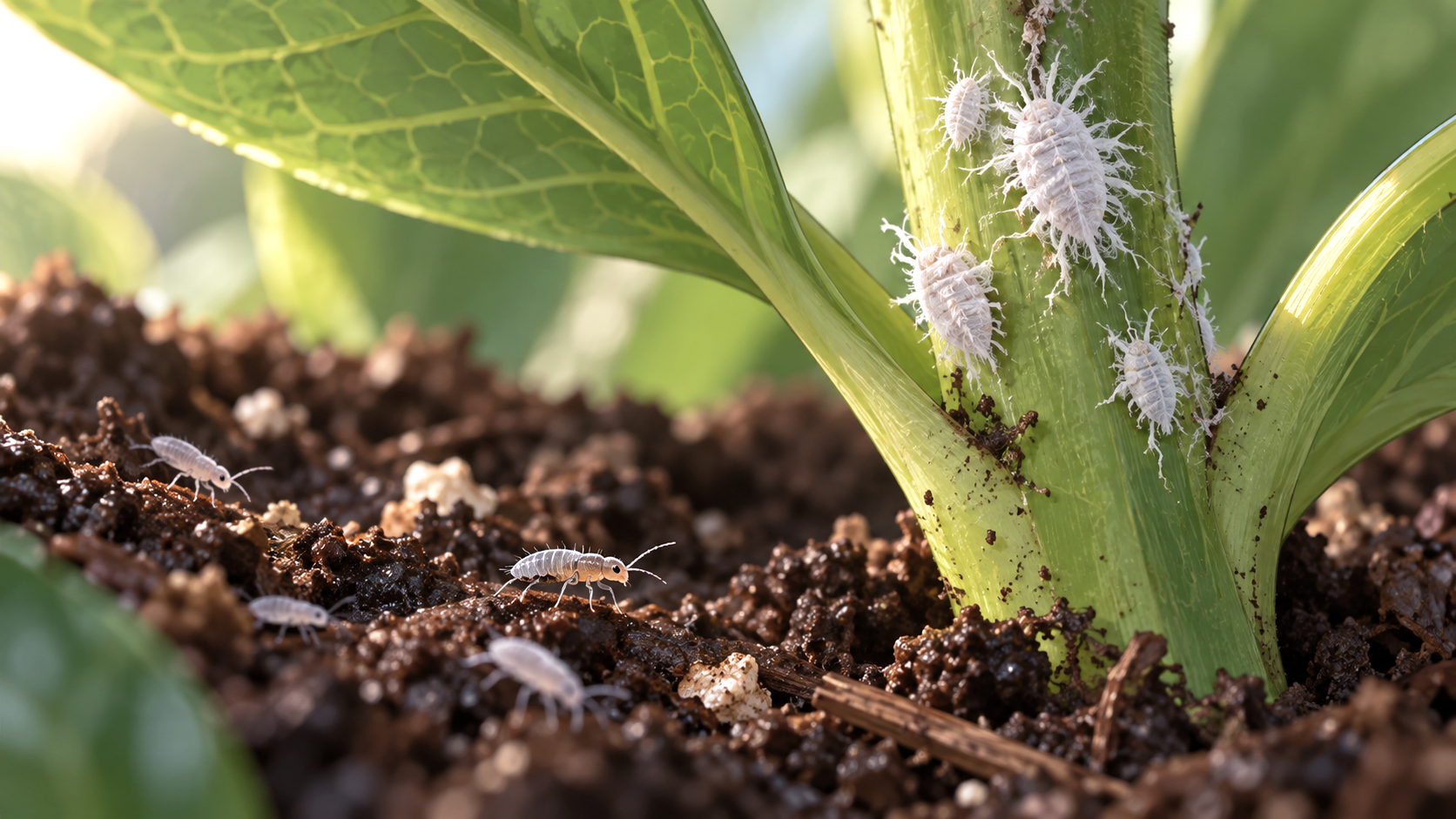
Springtails and mealybugs can both turn up around houseplants, but they look and behave very differently. Mealybugs are larger, white insects covered in powdery or cottony wax and usually sit on leaves and stems. Springtails are much smaller, lack the waxy coating, and are usually found moving or jumping across damp potting soil.
Springtails vs. Mealybugs at a Glance
| Feature | Springtails | Mealybugs |
|---|---|---|
| Typical appearance | Tiny, slender or sometimes rounded | Oval, soft-bodied and cottony |
| Common color | White, gray, brown, black and other colors | White because of waxy covering |
| Size | Most household types are about 1–2 mm | Around 3/16 inch for common houseplant mealybugs |
| Movement | Crawl, and many species jump | Crawl slowly |
| Usually found | Damp soil and other moist areas | Leaves, stems, leaf joints and sometimes roots |
| Waxy coating | No | Yes |
| Honeydew | No | Yes |
| Typical plant impact | Usually little or none | Sap feeding can weaken plants |
The easiest mistake is to focus on color. A white springtail and a white mealybug may both appear as pale specks around the same plant, but color is about where the resemblance ends. Where the animal is sitting and what its body looks like provide much better identification clues.
The White Waxy Coating Is the Fastest Mealybug Clue
Mealybugs have one feature springtails simply do not: a conspicuous waxy covering. Their bodies are coated with white, powdery wax, often accompanied by waxy tufts or filaments around the edges. Larger groups can resemble tiny pieces of cotton caught between leaves and stems.
That appearance is quite different from what springtails look like. Springtails have visible body segments, antennae and six legs. Their forms range from slender and elongated to more rounded, globular species, but they do not surround themselves with the cottony wax associated with mealybugs.
White springtails can still create confusion at a glance, especially against dark potting mix. However, springtails occur in many colors, including gray, brown and black. Mealybugs get their characteristic white appearance from the wax covering their bodies rather than simply having pale body coloration.
Springtails Are Usually Much Smaller Than Mealybugs
Size gives you another quick separation. Most springtails that wander into homes are only about 1 to 2 millimeters long, although springtails as a group include species outside that range.
Common houseplant mealybugs are considerably easier to see. Adult mealybugs are about 3/16 inch long, or close to 5 millimeters. Combined with their white wax and marginal filaments, that larger body can make them look surprisingly conspicuous once you know where to inspect.
Size should still be used alongside other clues because immature mealybugs are smaller than mature ones. A hand lens can help when the animals are too small to examine comfortably. The waxy body, plant location and movement will usually tell you more than trying to estimate a millimeter measurement by eye.
Where You Find Them on the Plant Matters
Location is one of the most useful clues in the springtails vs. mealybugs comparison. Springtails are strongly associated with moisture. Around houseplants, they commonly occupy damp potting mix and become especially noticeable after watering. That is why springtails in potted plants often seem to appear suddenly when the soil surface gets wet.
Mealybugs usually draw your attention higher on the plant. Check the undersides of leaves, along veins, where leaves meet stems, and around other protected plant parts. Cottony wax in those locations is a strong mealybug clue. Some mealybugs can also occur below the soil surface or infest roots, so finding white material near the base of a plant should not automatically be dismissed as harmless debris.
This gives us a practical identification rule. Tiny active specks moving across wet potting soil fit springtails much better. Cottony insects attached to leaves or tucked into stem joints fit mealybugs. When the insects are around the roots, appearance becomes more important because location alone no longer separates them.
Jumping Points Toward Springtails
Movement can settle the identification quickly when appearance is difficult to judge. Many springtails possess a forked appendage called a furcula beneath the abdomen. Releasing it against the surface launches the animal into the air, producing the sudden movement behind the springtail name.
A springtail may therefore disappear from your view as soon as you disturb the soil. Our guide to how springtails jump explains why such a tiny animal can cover so much distance in a single movement. Springtails are also completely wingless, so a springtail cannot fly.
Mealybugs do not move that way. Newly hatched mealybugs, called crawlers, can move around the plant, while later stages are generally much less mobile. Seeing a white insect slowly crawling along a stem is therefore quite different from disturbing a tiny soil-dwelling animal and watching it spring away.
Not every springtail jumps, so failure to jump does not automatically make a mystery insect a mealybug. The waxy covering and plant location remain stronger evidence when the animal stays put.
Sticky Leaves Point Toward Mealybugs, Not Springtails
Sometimes the plant gives away the answer before you get a good look at the insect. Mealybugs have piercing-sucking mouthparts and feed on plant sap. They also excrete honeydew, a sticky substance that can accumulate on leaves and objects beneath an infested plant.
That honeydew can support the growth of black sooty mold. Mealybug feeding can also cause yellowing, stunting and dieback when an infestation becomes damaging.
Springtails have a very different relationship with most houseplants. They commonly feed on fungi, decaying roots and other organic material in the growing medium, and rarely damage indoor plants. They do not produce the sticky honeydew associated with mealybugs.
For identification, sticky residue is therefore more useful than a yellow leaf by itself. Many unrelated problems can make a plant yellow or wilt. Honeydew combined with cottony white insects on the plant provides a much more specific trail toward mealybugs.
Root Mealybugs Are the Harder Comparison
The comparison gets less obvious when the mealybugs are below the soil line. Some mealybugs infest roots, placing them in the same general area where you might already expect to find springtails.
The animals themselves still look different. Root-associated mealybugs retain the characteristic waxy appearance of the group, while springtails remain small, active animals without a cottony covering. Springtails are also strongly associated with damp growing media because moisture supports the fungi and decaying organic matter they commonly feed on.
This is where we would stop relying on the simple rule that “soil means springtails.” Remove the pot carefully and inspect the roots when persistent white material appears below the surface. Cottony or waxy insects clustered around roots need to be treated as a possible plant pest rather than assumed to be harmless springtails in soil.
Confirm Which Pest You Have Before Doing Anything Else
For a quick identification, start with the plant rather than chasing individual insects. Check leaf joints and stems for white cottony material, then examine the soil surface. Sticky honeydew and wax-covered insects on plant tissue strongly favor mealybugs. Tiny animals moving through damp soil, particularly ones that jump when disturbed, favor springtails.
That distinction matters because the two problems have different causes. A large springtail population around a pot often points to persistently moist growing media, and reducing excess moisture can reduce their numbers. Springtails rarely harm plants, so their presence alone does not justify treating the plant as though sap-feeding insects are attacking it.
Mealybugs require a different response because they actually feed on the plant. An infested houseplant should also be separated from other plants while you decide how to manage it, since mobile mealybug crawlers can spread to additional plants. Getting the identification right first prevents a moisture-associated springtail population and a genuine mealybug infestation from being treated as the same problem.
Other Questions About Springtails and Mealybugs
Can a houseplant have springtails and mealybugs at the same time?
Yes. Finding one does not exclude the other because they use different resources and can occupy different parts of the same potted plant. Inspect both the growing medium and the foliage rather than assuming every small creature belongs to the first pest you identify.
Are the white cottony patches mealybug eggs?
Female mealybugs can produce cottony wax associated with egg laying, but cottony material on a plant can also contain the insects themselves. Look closely for individual oval insects and waxy filaments rather than identifying the infestation from a patch of white material alone.
Can mealybugs hide on the pot itself?
Yes. Mealybugs can occur on the outside of pots as well as on the plant. When checking an infested plant, inspect crevices, the pot rim and protected areas rather than limiting the search to visible leaves.
Can springtails spread from one houseplant to another?
Springtails can occur in multiple pots when suitable damp conditions exist. Their presence across several plants does not mean they are spreading through the collection in the same plant-feeding pattern as mealybugs. Persistent moisture in several pots can independently provide suitable springtail habitat.
Should I throw away a plant because I found springtails?
Finding springtails alone is not a reason to discard a houseplant. They rarely damage indoor plants, and their abundance is often connected to excessive moisture. Check the plant’s watering conditions and confirm that the insects really are springtails before deciding what action is warranted.