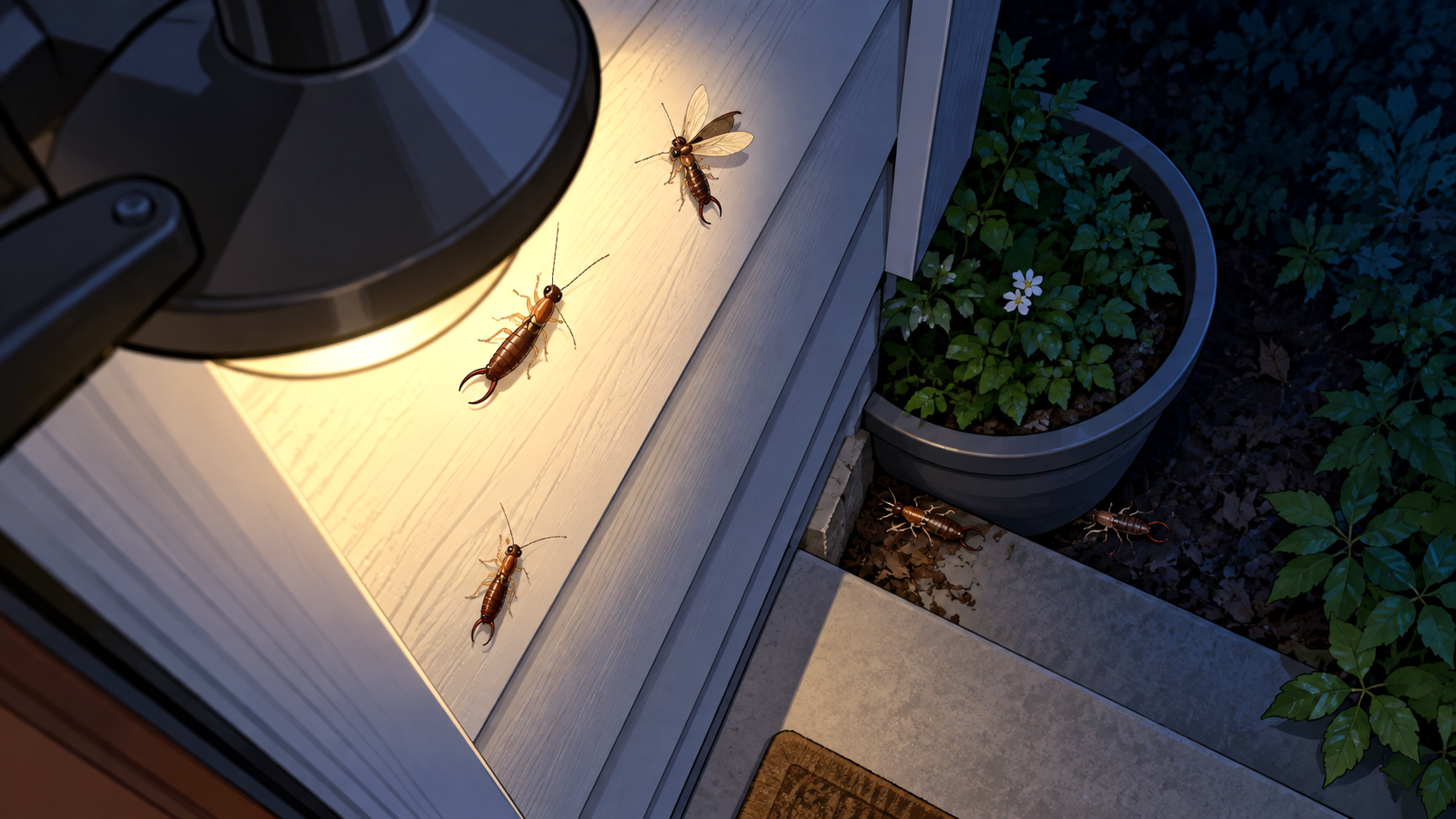
Earwig behavior around light seems contradictory at first. During the day, these insects squeeze into dark, protected hiding places. Yet after sunset, you may find them around a brightly illuminated porch, garage or doorway. Both observations can be true.
Some earwigs are attracted to artificial light at night, and outdoor lighting can contribute to earwig activity around a home. However, the response is not identical across every earwig species, and lighting is only one part of the reason earwigs may gather near a building.
Why Would an Earwig Come Toward Light If It Hides in Darkness?
The apparent contradiction disappears once we separate two different behaviors.
Earwigs are primarily nocturnal. European earwigs spend the day sheltered in dark, tight and moist locations, then become active after dark. That daytime preference for shelter does not mean an active earwig must avoid every source of artificial light it encounters at night. Our guide to whether earwigs are nocturnal looks more closely at that daily activity cycle.
Artificial light can attract earwigs while they are already moving around after dark. Outdoor lighting is recognized as one factor that can bring earwigs toward buildings, and changing the type of exterior lighting is among the measures recommended when they repeatedly appear around a home.
There is also variation among species. The striped earwig (Labidura riparia), for example, is specifically known to become a nuisance when attracted to lights. That is one reason it is safer to say earwigs can be attracted to light rather than assume every species responds to a light source in exactly the same way.
The Color of Your Outdoor Light Can Make a Difference
If earwigs consistently gather around one exterior fixture, you do not necessarily need to leave that part of your property in darkness.
The type of bulb offers another option. Current pest-management guidance recommends replacing white exterior lights with yellow ones because yellow lights are less attractive to earwigs.
This distinction makes the lighting itself more useful diagnostically. Imagine that earwigs repeatedly appear around a white porch light but are scarce elsewhere along the same wall. The fixture may be helping concentrate active insects at that particular spot.
Switching to a less attractive light can reduce that effect. It does not guarantee that earwigs will disappear from the property, however, because the conditions supporting them during the rest of the day may still be present.
Your Porch Light May Be Only Half the Story
The illuminated area is where you notice the earwigs. Their daytime hiding place may be somewhere completely different.
Earwigs seek protected shelter during daylight and favor dark, tight and moist places. Mulch, leaf litter, boards, dense vegetation, garden objects and other sheltered areas can provide suitable hiding locations. Excess moisture can make areas around a structure more favorable as well.
An earwig can spend the day concealed in one of those places, emerge after dark and later turn up around an outdoor light. In that situation, the bulb did not create the earwig population. It influenced where some active insects ended up.
This is why a lighting change works best when you also consider what attracts earwigs around a property. A damp, heavily sheltered strip of landscaping immediately beneath a porch light combines daytime refuge with nighttime illumination.
The two conditions are worth addressing separately. Lighting concerns what happens after the insects become active. Moisture and shelter help explain why so many earwigs were close enough to reach the light in the first place.
A Light Beside the Door Can Put Earwigs in the Wrong Place
Where the light is located can matter almost as much as whether it attracts insects.
Earwigs primarily get around by crawling. European earwigs have wings but rarely fly, so an earwig around an illuminated entrance may spend much of its time moving across the ground, wall or doorway rather than circling the bulb like a strongly flying insect.
Now consider a bright exterior fixture mounted immediately beside a door. If earwigs are being drawn toward that illuminated area, they also end up close to the threshold, door frame and other potential openings.
That does not mean the porch light is literally pulling earwigs through the door. They can enter homes for several reasons, particularly when exterior conditions become unsuitable. Once they are gathered close to a structure, however, cracks and gaps provide opportunities for accidental entry.
If the insects keep appearing indoors near the same entrance, inspect the building as well as the light. Our guide to why earwigs get inside houses covers those entry conditions in more detail.
What If Earwigs Keep Gathering Around Your Outdoor Lights?
Start by looking at the pattern rather than immediately treating the insects. Is the activity concentrated beneath one bright white fixture? Does that fixture remain illuminated throughout the night? Are there damp leaves, mulch, dense plants, flowerpots or other potential hiding places immediately below it?
If lighting appears to be part of the problem, replacing white exterior bulbs with yellow ones is a simple first change. You can also turn off unnecessary outdoor lighting when it is not needed.
Then examine the ground around the affected area. Removing boards, accumulated leaves and other unnecessary hiding material reduces the protected places earwigs can use during the day. Keeping excess water away from the structure can make the immediate area less favorable as well.
Finally, address the route indoors if that is where the problem is occurring. Seal accessible cracks, maintain door sweeps and reduce favorable hiding places close to entrances. Indoor pesticide applications are not recommended simply to stop invading earwigs because they do little to prevent additional insects from entering.
That combination is more useful than blaming the bulb alone. The light can help explain where you see earwigs at night, while shelter, moisture and entry points help explain why they remain around the property and occasionally get inside.
Other Questions About Earwigs and Light
Do earwigs like sunlight?
Their daytime behavior suggests almost the opposite. Earwigs characteristically shelter in dark, protected places while the sun is up and become active at night. Attraction to an artificial light after dark should not be confused with seeking bright sunlight during the day.
Will turning off my porch light get rid of earwigs?
Not necessarily. It can remove one factor attracting earwigs toward that location, but it does not eliminate nearby moisture, shelter or food. If many earwigs live around the building, some may continue appearing even without the light.
Are yellow lights guaranteed to keep earwigs away?
No. Yellow exterior lights are less attractive to earwigs than white lights, but they are not an earwig barrier. Treat the lighting change as one part of prevention rather than a guarantee that no earwig will approach the area.
Why do I find earwigs near lights only at night?
Earwigs are primarily nocturnal, so nighttime is when they leave daytime shelters and become much more active. That puts moving earwigs in a position to respond to exterior lighting that would be irrelevant while they were concealed during the day.
Does seeing earwigs around a porch light mean they are infesting my house?
No. Outdoor activity around a light does not establish that earwigs are living inside the building. If you are also finding them indoors, inspect doors, cracks and other potential entry points and consider how to keep earwigs out of the house.
One thought on “Are Earwigs Attracted to Light?”