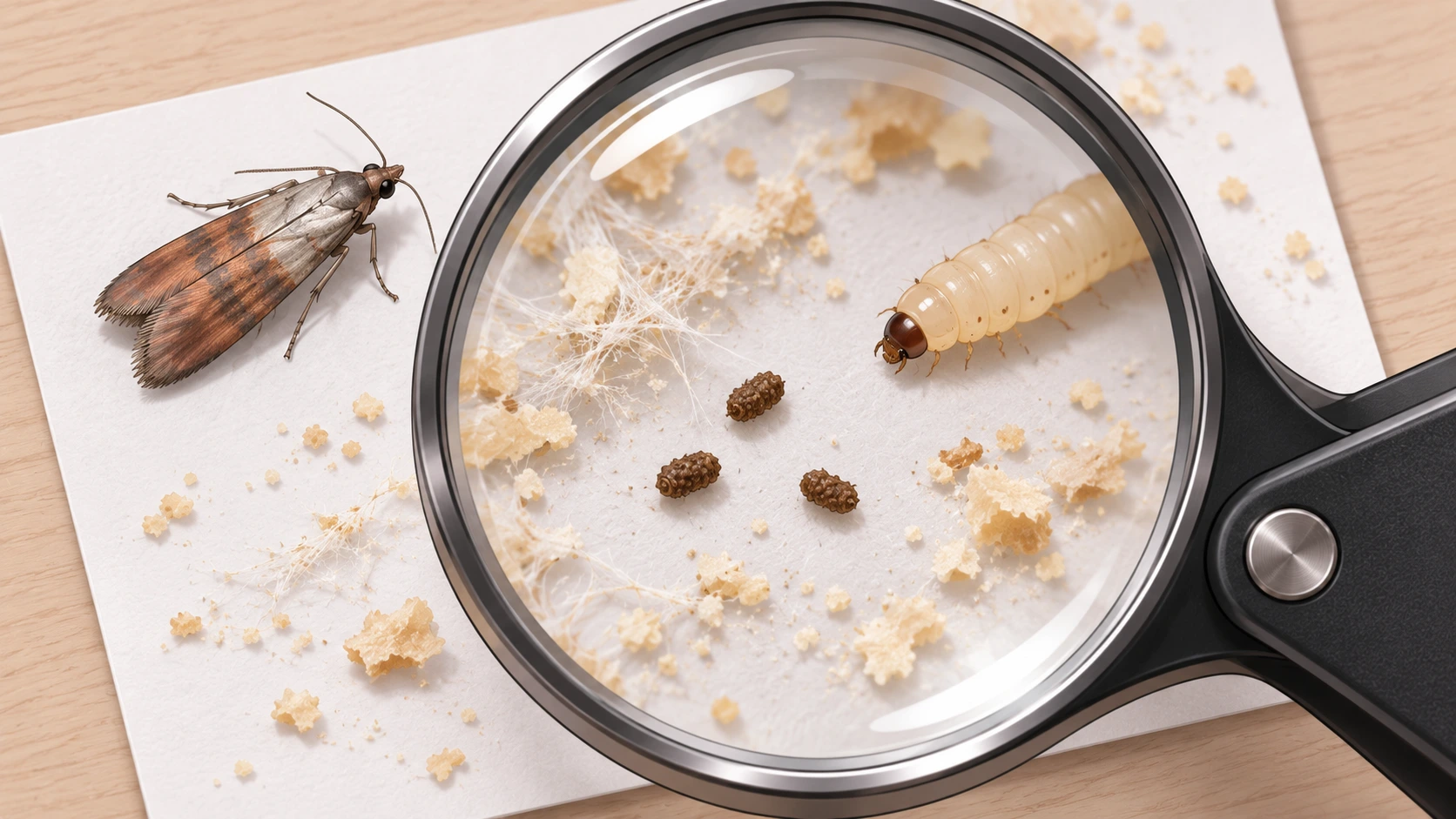
Indian meal moth poop, called frass, consists of tiny particles of waste left by the caterpillars as they feed. It can look like fine grains, small pellets or coarse dust mixed with the food they are eating. Depending on the material and lighting, the particles may appear tan, brownish, grayish or darker.
You are more likely to notice frass mixed with silk threads and food crumbs than to find a neat pile of individual droppings. In cereal, flour, nuts, dried fruit or birdseed, the waste may be caught among food particles that look similar.
There is no dependable household identification rule based on frass color or a single pellet measurement. A few dark specks in a cupboard do not prove that Indian meal moths are present.
The strongest evidence comes from the combination of frass, silk webbing and actual larvae associated with a susceptible stored product. The appearance of the waste is useful, but its location and surrounding evidence are even more important.
What Is Indian Meal Moth Frass?
Frass is the entomological term for insect excrement. In Indian meal moths, Plodia interpunctella, the waste found in infested food is produced primarily by the feeding larvae.
The larvae are caterpillars. As they consume stored food, they digest part of it and pass the remaining waste through their digestive systems. The resulting particles accumulate in or around the material where feeding occurs.
Indian meal moth larvae also produce silk as they move through food. Their waste may become entangled in those threads alongside loose food fragments and shed larval skins.
This combination is documented in stored-grain pest guidance describing frass, silk and cast skins as material associated with Indian meal moth infestations.
The waste is not the same thing as a moth egg, cocoon or shed skin. Those are separate biological materials that may occur in the same package.
Recognizing these differences prevents ordinary debris from being interpreted as several distinct signs of infestation when only one type of material has actually been observed.
What Does the Poop Look Like Up Close?
At close range, Indian meal moth frass may have a granular or pellet-like appearance. Some particles can look like tiny crumbs or coarse ground material.
The individual particles are generally small enough to be overlooked when mixed with flour, cereal dust or other finely divided foods. A person opening an infested package may notice a change in its texture before recognizing anything as insect waste.
The Ohio State University Indianmeal moth fact sheet describes the material as fecal pellets occurring alongside larvae, webbing and cast skins.
That description supports identifying frass as pellet-like waste, but it does not provide a fixed, species-specific measurement suitable for distinguishing it from every other kind of pantry debris.
The particles may not all be identical in appearance. Material produced by larvae at different stages and mixed with different foods can be difficult to compare directly.
For an ordinary pantry inspection, a magnifying glass or a clear close-up photograph may help reveal a granular texture. Even then, the appearance alone seldom identifies the insect responsible.
What Color Is Indian Meal Moth Poop?
Indian meal moth frass does not have one reliably diagnostic color.
Its appearance can be influenced by the material consumed and by food dust or other particles mixed with it. In pale products, darker waste may stand out. In brown or finely ground products, the frass may blend into the surrounding material.
It can therefore be reasonable to describe suspicious particles as tan, brown, grayish or dark, provided the description reflects what is actually visible.
What is not reasonable is claiming that all Indian meal moth droppings must be black.
The commonly repeated idea that every Indian meal moth infestation produces recognizable black dots is too simplistic. The visible debris may include frass, pieces of food, small dark fragments and other material.
Similarly, a pale particle is not automatically harmless food dust, and a dark particle is not automatically an insect dropping.
A color observation becomes more useful when it is tied to other evidence. Brownish granules embedded in silk around a feeding caterpillar are more suspicious than an isolated brown grain on an otherwise clean shelf.
How Big Are Indian Meal Moth Droppings?
Frass is small compared with a mature Indian meal moth caterpillar, but the size of individual waste particles is not a reliable identification measurement for homeowners.
Published pest descriptions generally emphasize the presence of frass and its association with larval feeding, rather than prescribing a unique diameter for each pellet.
We would avoid treating an unsupported claim such as “every dropping is exactly one millimeter long” as a scientific identification standard.
Particle size can also be difficult to judge when waste is coated in flour, caught in silk or mixed with food crumbs.
A few grains of debris photographed on a countertop may appear large because of camera magnification. Conversely, frass mixed into a coarse food can be almost invisible.
The useful question is whether the particles are associated with evidence of insect activity, not whether one speck meets an arbitrary size threshold.
If only loose specks are present, their dimensions may be recorded, but they should not be used alone to assign the material to Plodia interpunctella.
Where Would You Find Indian Meal Moth Frass?
The most meaningful place to find frass is inside material where the larvae are feeding.
Indian meal moth larvae develop in susceptible stored products such as cereal, flour, grains, nuts, dried fruit, seeds, dry pet food and birdseed. Their feeding can leave waste in the product and among the silk threads produced as they move.
The Canadian Grain Commission’s description of Indianmeal moth infestation identifies frass, silk, cast skins and pupal remains as signs associated with affected commodities.
You may find suspicious material in the upper portion of a package, around the surface where food particles have clumped, or near folds and edges containing silk and debris. These are places worth examining, not exclusive locations for frass.
Frass can also become dislodged when a package is moved or opened. Material spilled onto a shelf does not necessarily show precisely where the insects were originally feeding.
The types of food Indian meal moth larvae use help determine where an inspection is most relevant. A dark spot on an unrelated household surface is much less informative than suspicious pellets mixed with webbed grain or animal feed.
Why Frass Is Often Mixed With Silk
Indian meal moth larvae produce silken threads while moving and feeding through stored products.
Those threads can hold fine debris in place. Frass and food particles may become trapped among the silk rather than falling as loose pellets.
This is why an infested package may contain irregularly bound material instead of an obvious collection of droppings.
Larvae produce silk throughout the materials they infest, and the resulting threads can make food particles stick together.
When you examine the material closely, you may see several components at once: fine waste, food dust and thin strands connecting otherwise loose pieces of food.
The silk can make small particles easier to notice because it collects them in one area. It can also make identification harder because individual pellets become mixed with material that looks similar.
Frass is the waste. Silk is a separate secretion produced by the larva. Their appearance together is useful evidence, but they should not be treated as the same substance.
The Indian meal moth webbing identification guide deals with the structure and appearance of silk in more detail.
Frass vs. Food Dust: How Can You Tell the Difference?
This is one of the most difficult practical questions because both can consist of fine, irregular particles.
Flour, cereal, spices, crushed seeds and dry pet food naturally produce dust and crumbs. Handling a package can create fine debris even when no insect has been feeding inside it.
Frass is more suspicious when it occurs with other evidence that would not ordinarily be produced by food handling, particularly living caterpillars or persistent silk threads.
Consider a bag of cereal containing loose powder at the bottom. That may simply be cereal dust. If another area contains fine granules caught in silk with a larva moving through the material, insect waste becomes a much stronger possibility.
The distinction is based on the whole observation, not on a claim that food dust always has one shape and frass always has another.
| What you find | What it may mean | How confidently it identifies frass |
|---|---|---|
| Loose powder at the bottom of cereal packaging | Ordinary crushed cereal or other debris | Very low |
| Isolated dark specks on a pantry shelf | Food fragments, general debris or insect material | Very low |
| Tiny pellets mixed into an otherwise normal-looking dry product | Possible insect waste, but also food particles | Low |
| Granular debris caught in silk inside stored food | Consistent with feeding by a silk-producing insect larva | Moderate |
| Granular waste, silk and visible caterpillars in the same material | Strong evidence of an active insect infestation | High for insect activity, but not necessarily for the exact moth species |
The table is a practical evidence guide, not a laboratory test. Even the strongest combination does not establish Indian meal moth as the species unless the insect itself can be identified.
Can You Tell Indian Meal Moth Poop From Other Insect Droppings?
Not reliably from an isolated particle.
Other insects that develop in stored products can also leave fine waste or feeding debris. Some caterpillars from related moth species produce silk as well, which means the combination of frass and webbing is not unique to Indian meal moths.
The original food material can make matters more confusing. Dark seed fragments, broken grain hulls and coarse flour may resemble insect waste when viewed without context.
We recommend treating frass as supporting evidence rather than a species-specific fingerprint.
If you find a clearly identifiable adult Indian meal moth alongside larvae and waste in stored food, the evidence is much stronger than the droppings alone. A suitable insect specimen can establish the identity that the debris cannot.
The Indian meal moth larva identification guide is useful when a caterpillar is present, while the adult identification guide covers the distinctive wing pattern.
Do not assume that every dark dot in the kitchen has the same source. A few loose specks may not be enough to establish that an insect was responsible at all.
Is It Poop, an Egg or a Shed Skin?
Different materials associated with insect activity can look similar when they are very small.
Frass is waste that has passed through a feeding larva. It may appear granular or pellet-like, with no obvious recognizable body structure.
An egg is a developmental stage containing an embryo. Indian meal moth eggs are small and pale, but their biological structure is different from fecal material.
A shed skin is the remains of a larva’s outer covering after molting. When sufficiently intact, it may show a body-like form rather than a collection of separate waste grains.
Food fragments can resemble any of these when broken into tiny pieces, especially in a blurry photograph.
The safest approach is not to identify every light fleck as an egg or every dark granule as poop. A close examination may resolve some of the confusion, but ambiguous material should remain unidentified.
The appearance of Indian meal moth eggs and the recognition of shed larval skins address those materials separately.
The purpose here is to recognize that waste, eggs and cast skins can coexist without being interchangeable evidence.
Do Adult Indian Meal Moths Leave the Same Droppings?
The characteristic frass associated with an Indian meal moth food infestation is produced by its feeding caterpillars.
Adult Indian meal moths are short-lived and normally do not feed. They do not continue consuming the stored food and producing the same kind of feeding-related contamination.
University of Georgia’s stored-product pest guidance confirms that adults do not feed and identifies larvae as the stage responsible for the visible feeding evidence.
This is relevant when a homeowner finds small moths on kitchen walls but no affected products.
The adults’ presence does not imply that they have been eating food and depositing frass on the wall. The waste of greatest diagnostic interest is found where their larvae have fed.
A moth resting above a cupboard also does not establish that suspicious dots below it are Indian meal moth droppings.
The evidence must connect the particles to actual larval activity before that conclusion becomes reasonable.
What If You Find Tiny Black Specks but No Moths?
Start with the possibility that the specks are ordinary debris or material from another source.
An isolated dark grain does not have enough distinctive characteristics to identify Indian meal moth frass. Even several specks in one area may be ambiguous.
Look at the surrounding context without spreading the material. Are the specks inside a stored product or scattered on an unrelated shelf? Is there silk holding food particles together? Is a living caterpillar visible?
A close photograph of the original material can help preserve the arrangement of the particles and any nearby strands or insects. Photographing everything after it has been brushed into a pile removes much of that context.
If no supporting insect evidence is present, do not label the particles as Indian meal moth poop with certainty.
When there are repeated sightings of adult moths or fresh signs in stored products, the Indian meal moth source-tracing guide provides a more focused investigation than interpreting a few isolated specks.
An identifiable specimen remains the stronger basis for distinguishing Indian meal moths from other stored-product insects.
Does Finding Frass Mean an Infestation Is Still Active?
Frass establishes past feeding activity only when it has been correctly identified as insect waste. It does not contain a timestamp.
Old pellets can remain in a package or storage space after the larvae that produced them have moved away or completed development.
Fresh frass found beside a living larva is much more useful evidence of current feeding. Continued production of waste in the same stored material may also support ongoing activity, provided the observations are reliable.
A package containing frass but no visible larvae could represent earlier activity, concealed insects or material left after development has ended. You cannot choose among those explanations from the waste alone.
This is particularly important when evaluating a previously affected area. A dusty speck that was overlooked during cleaning should not automatically be treated as proof of a newly established infestation.
The broader signs of an Indian meal moth infestation include evidence that can help determine whether insects are still present.
Frass is one piece of that assessment, not a complete activity test.
What Should You Do When Frass Is Found in Food?
If you find convincing evidence of insect waste inside a stored food product, avoid treating the product as clean merely because the visible particles can be removed.
Frass commonly occurs alongside other insect contamination, including silk and cast skins. Picking out a few suspicious pellets does not establish that the remainder is unaffected.
The extent of contamination and appropriate handling of affected food are separate questions, but a product with confirmed active insect infestation should not simply be returned to normal storage.
For an ordinary household pantry, identifying and removing the infested source is the relevant next step. Do not spray pesticide onto food or food-contact surfaces to deal with a few particles of suspected frass.
If the debris remains unidentified, it is reasonable to examine the packaging, preserve a useful photograph and look for a specimen before concluding which pest caused it.
For the broader implications of waste and other insect material in food, the Indian meal moth damage guide handles contamination and product assessment separately.
The Bottom Line
Indian meal moth poop is larval frass, typically visible as very small granular or pellet-like waste mixed with food dust and other debris. Its apparent color and texture can vary, and it may be trapped in silk produced by feeding caterpillars.
Frass is most meaningful when found within susceptible stored food alongside larval activity. A few dark or tan specks on their own are not a reliable sign of Indian meal moths, and they cannot identify the species responsible.
Look for a connection between the material, silk and an identifiable insect. That combination provides a stronger basis for recognizing an infestation than attempting to diagnose a moth from isolated droppings.