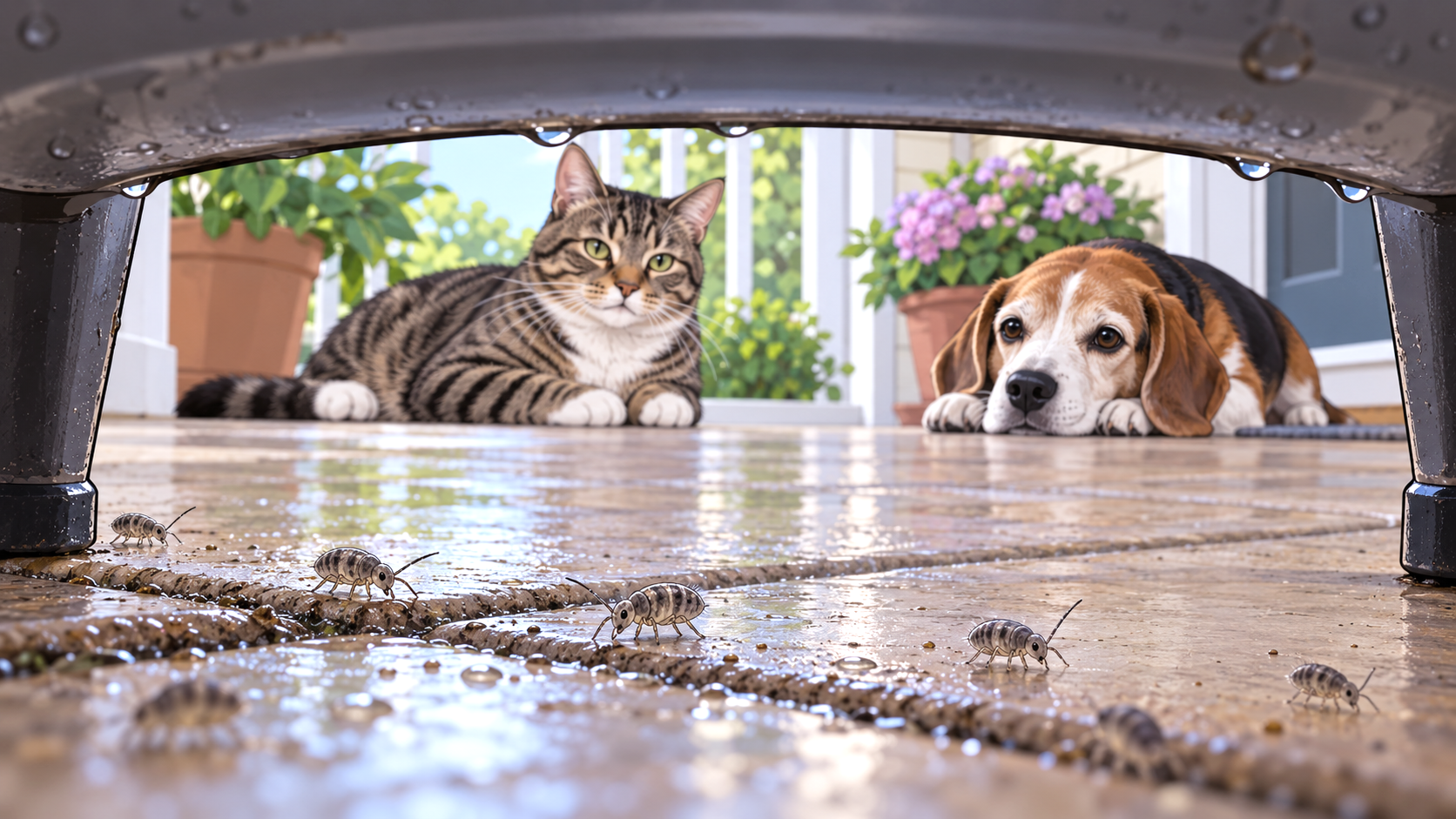
A cat staring at tiny bugs jumping around a houseplant or a dog sniffing at them on a damp patio creates an obvious concern. Pets investigate small moving things with their noses, paws, and mouths, so the question is not only whether springtails can attack them. It is also whether ordinary contact with these arthropods poses a danger.
Springtails are not harmful to cats or dogs. They do not bite or sting pets, and they are not parasites of dogs or cats. Springtails are considered harmless to larger animals, so finding them around a pet does not mean the animal is infested. The bigger concern can be what you use to control the springtails.
Springtails Do Not Bite Cats or Dogs
Springtails cannot bite cats or dogs. They also cannot sting them. These tiny arthropods are harmless to people and animals, despite the impressive jumping behavior that often gets them noticed.
Their normal diet has nothing to do with pets. Most springtails live in moist environments where they feed on fungi, algae, bacteria, decaying plant material and other organic matter. The great majority develop in soil, which is why damp gardens, mulch, leaf litter and potting soil are far more relevant to them than an animal’s fur or skin.
A springtail may still jump onto a dog or cat accidentally. Its furcula, a forked structure beneath the body, allows many species to launch themselves when disturbed. That jump is an escape mechanism rather than an attack, as we explain in our guide to how springtails jump.
Springtails Cannot Infest Your Pet’s Fur
Springtails are not fleas. That sounds obvious once you know the two animals, but a tiny jumping speck disappearing into a dog’s coat can make the distinction much less obvious in the moment.
Fleas are adapted to use animals as hosts. Adult cat fleas have mouthparts adapted for piercing skin and sucking blood, and cats and dogs are their primary hosts in homes. Springtails have a completely different lifestyle. They do not feed on blood or establish populations in pet fur.
That means finding a springtail on your cat or dog is incidental. The animal may have picked it up while lying on damp ground, exploring vegetation, or investigating an area where springtails were abundant. A springtail landing in fur does not turn the pet into a host.
Movement alone is therefore a poor way to identify the bug. Our springtails versus fleas guide covers the physical differences because this is one identification mistake worth getting right. Fleas can cause itching, dermatitis and other problems in pets, while springtails do not bite at all.
What If a Cat or Dog Eats Springtails?
Cats and dogs sometimes eat insects and other small arthropods they find moving around the home or yard. A springtail is small enough that a pet could swallow one while investigating it.
Springtails themselves are described as harmless to larger animals. They are not venomous attackers, blood-feeding parasites, or biting pests. An ordinary encounter with springtails is therefore very different from exposure to a pest capable of injuring a pet.
However, what surrounds the springtail can matter more than the arthropod. A pet investigating springtails may also encounter potting soil, compost, moldy organic material, standing water, pesticides, fertilizers, or other substances in the same location. Those exposures have to be judged on their own rather than assuming that any illness following the encounter came from the springtails.
If a cat or dog becomes ill after eating something outdoors or around a treated area, contact a veterinarian and explain everything the animal may have contacted or swallowed. That gives the veterinarian much more useful information than focusing only on the tiny jumping animals that happened to be visible.
Springtails Around Pet Bowls and Water Are Usually a Moisture Clue
Springtails have a strong association with moisture. Consequently, pet owners sometimes notice them around water bowls, damp mats, leaking containers, patios, basements, or other places where water remains available.
The location can make it look as though the springtails are interested in the pet’s food or the animal itself. Usually, the surrounding conditions provide the better explanation. Springtails occur in areas with high moisture and organic debris, and indoor populations commonly appear around plumbing leaks and other damp locations.
Clean up spilled water and keep the surrounding floor dry rather than treating the pet. If springtails repeatedly return to the same area, look for a persistent source of moisture nearby. Our guide to what attracts springtails explains why damp conditions can make one part of a home much more suitable for them than another.
Seeing a few springtails around a water bowl is therefore not evidence that they are feeding on your dog or cat. The water is the more useful clue.
Houseplants Can Put Springtails and Pets in the Same Place
Indoor plants create another common meeting point. Springtails often live in damp potting soil and become particularly noticeable after watering. A cat investigating the pot or a dog sniffing spilled soil can then encounter them at very close range.
Their presence in the pot usually reflects the soil environment. Springtails there act mainly as scavengers that consume decaying roots and fungi, and they rarely damage indoor plants. Our article on springtails in potted plants covers that situation separately.
The practical mistake is treating the pet because springtails were seen nearby. Instead, confirm that the tiny animal really is a springtail and inspect the potting mix. Allowing the soil surface to dry appropriately between waterings can make it less favorable to large springtail populations without turning a harmless soil arthropod into a pet-health problem.
Be More Careful With Springtail Treatments Than With the Springtails
This is the part of the question we think deserves the most attention from pet owners. A harmless pest does not automatically make every method used against it harmless.
Pesticides can expose pets through ingestion, skin contact, or inhalation. The risk depends on both the pesticide and the animal’s exposure to it. Cats and dogs also behave differently from people, since they may walk across treated surfaces, lick their paws, chew objects, or investigate products stored close to the floor.
When a pesticide is necessary, pets should be kept away from the treatment area according to the product label. Food bowls, water bowls, toys and bedding should also be protected from exposure. Never assume a household pesticide is safe for a pet simply because it is available for indoor use.
Springtails rarely justify aggressive indoor chemical treatment anyway. Moisture control is the most effective approach to household springtails. Fixing leaks, drying persistently wet areas and correcting excess humidity attack the conditions supporting the population rather than unnecessarily increasing a pet’s exposure to pest-control products.
Homemade mixtures deserve the same caution. Household substances are not automatically pet-safe pesticides simply because they came from a kitchen or bathroom cabinet. We would rather address the moisture problem than introduce an unnecessary chemical exposure while trying to eliminate an arthropod that poses little direct threat to the animal.
Make Sure the Bug on Your Pet Really Is a Springtail
The biggest practical risk in this situation may be misidentification.
Springtails are tiny, and jumping makes people immediately think of fleas. Yet jumping alone cannot identify either animal. Fleas have a body compressed from side to side and are adapted for living with animal hosts, while springtails have a softer body and belong in moisture-rich environments.
If the animal is repeatedly scratching, biting at its coat, losing fur, or developing irritated skin, do not dismiss those signs because springtails happen to be present elsewhere in the house. Fleas can cause itching, skin irritation and dermatitis in cats and dogs. A veterinarian can evaluate unexplained symptoms, while an identifiable arthropod sample can help determine whether you actually have springtails or something else.
Our guide to bugs that look like springtails is useful when the identification is uncertain. Once you know you are actually dealing with springtails, the pet itself is not where the infestation needs to be addressed.
Deal With the Springtail Habitat, Not the Cat or Dog
Finding springtails around a pet calls for an environmental check rather than treatment of the animal. Look at where the springtails keep appearing. Damp houseplant soil, a leaking pipe, wet basement material, persistent condensation, or moisture around an exterior foundation can all provide suitable habitat.
For indoor populations, reducing moisture often removes the reason springtails can persist. Our broader guide on how to get rid of springtails covers control in detail, while how springtails enter houses can help when the animals are continually arriving from outdoors.
Most importantly, do not put insecticides, essential oils, repellents, powders, or other springtail treatments directly on your cat or dog. Springtails are not living on the animal, so there is nothing on the pet that needs springtail treatment. If the animal has unexplained skin irritation or other symptoms, a veterinarian is the appropriate person to determine the cause.
Other Questions About Springtails and Pets
Can springtails live in a dog bed or cat bed?
A damp pet bed could temporarily provide the moisture springtails favor, particularly if it sits against a wet surface. However, the animal itself is not their host. Wash and dry the bedding thoroughly, then investigate why that location remains damp.
Can springtails get into cat litter?
Springtails can occur in moist environments containing organic material. If tiny jumping arthropods repeatedly appear around a litter box, identify them first and keep the surrounding area clean and dry. Their presence does not mean they are parasitizing the cat.
Can springtails come indoors on a dog?
A springtail can accidentally hitch a ride after a dog has been outside, just as other tiny outdoor arthropods can end up on fur. That is incidental transport rather than an infestation of the dog.
Should I take my pet to the veterinarian after finding springtails nearby?
Finding correctly identified springtails near an otherwise healthy pet is not, by itself, evidence of a medical problem. Veterinary attention makes sense when the animal has symptoms, has swallowed or contacted a potentially harmful substance, or when the arthropod has not been confidently identified.
Are springtails dangerous to puppies or kittens?
Springtails do not bite or sting animals, so their small size does not create a special biting threat to puppies or kittens. Young pets may be more curious about substances used around the home, however, which makes careful storage and label-compliant use of any pest-control product especially important.