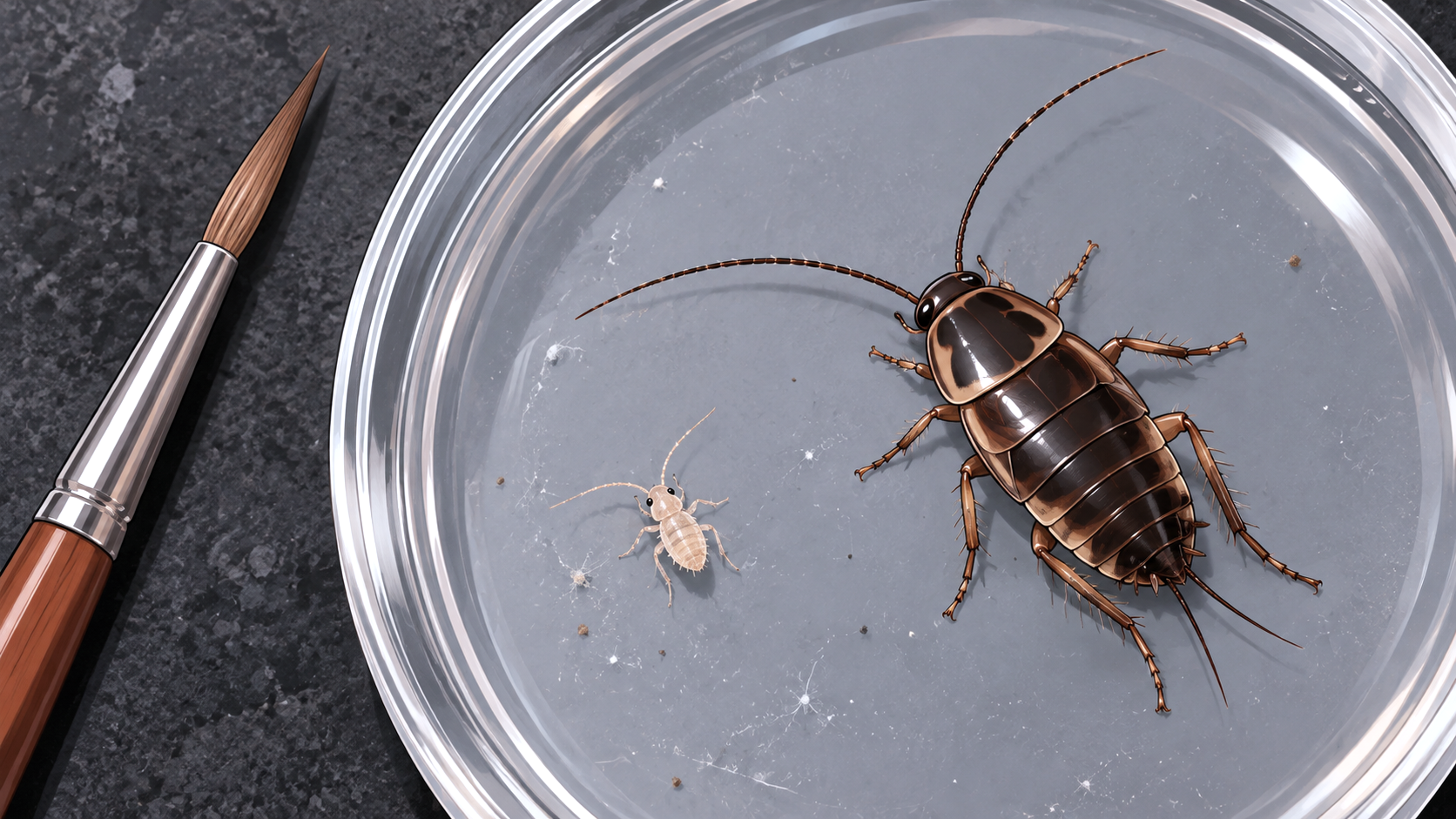
Booklice and baby cockroaches can overlap in size, especially when the cockroach has only recently hatched, but their proportions are different. Booklice have a conspicuously broad head, delicate body, and relatively slender legs. Cockroach nymphs look more robust and oval, with spiny legs and a body plan resembling a wingless adult cockroach.
The Smallest Cockroach Nymphs Create Most of the Confusion
An adult household booklouse is commonly only 1 to 2 millimeters long, according to current booklouse identification guidance. That tiny scale explains why booklice can look like little more than moving specks without magnification. Young cockroaches can enter the same size range. German cockroach nymphs, for example, range from approximately 1/16 inch upward as they grow, placing the smallest individuals at roughly 1.6 millimeters. Minnesota’s identification material gives German cockroach nymphs a range beginning around 1/16 inch.
Size therefore becomes less useful precisely where the comparison is hardest. A 1.5-millimeter insect cannot safely be called a booklouse simply because it seems too small to be a cockroach. Older cockroach nymphs become progressively easier to separate because they grow well beyond the usual size of household booklice. Adult German cockroaches eventually reach about 1/2 to 5/8 inch, and other pest cockroach species can become larger still. The overlap is concentrated mainly at the youngest stages rather than extending throughout the cockroach life cycle.
Look at the Head Before You Look at the Color
Booklice have an unusually prominent head for such a small insect. It is broad relative to the thorax and can appear nearly as wide as the rest of the body. A large clypeus at the front contributes to the distinctive head-heavy shape described in psocid identification material. Under magnification, this gives the insect a noticeably different silhouette from a cockroach nymph.
A baby cockroach has the characteristic cockroach arrangement in which the pronotum, the shield-like plate immediately behind the head, forms a prominent part of the front of the body. Viewed from above, the head does not dominate the silhouette as it does in a booklouse. The abdomen is also broader and more substantial. UC IPM photographs showing German cockroach adults and nymphs together make the continuity of that cockroach body plan clear even before the insect develops adult wings.
The legs offer another strong clue. Cockroach nymphs have conspicuously spiny legs adapted for rapid running. Booklice have six functional legs as well, but they appear much finer and less heavily armed. A sharp photograph showing pronounced leg spines supports a cockroach identification far more strongly than a booklouse one.
Dark Does Not Automatically Mean Cockroach, and Pale Does Not Automatically Mean Booklouse
Common booklice can be nearly clear, gray, tan, brown, dark brown, or orange-brown. Their normal color range is surprisingly broad, and a dark individual may look almost black when seen as a tiny dot against a light wall. German cockroach nymphs, however, are characteristically darker than the adults and often show a lighter longitudinal area along the back. Minnesota describes the German cockroach nymph as dark-colored with a light streak running down its back.
Freshly molted cockroaches create the opposite problem. Cockroaches can appear pale or nearly white immediately after shedding their old exoskeleton, then darken as the new cuticle hardens. UC IPM notes that cockroach nymphs are white immediately after molting before their body covering darkens. A pale mystery insect is therefore not automatically a booklouse.
Body structure should outrank color in this comparison. A pale insect with a broad booklouse head and delicate proportions still points toward booklice. A temporarily pale insect with a cockroach-shaped body and obvious leg spines points elsewhere.
Their Movement Usually Feels Different at the Same Scale
A cockroach nymph is built to run. When exposed by lifting an object or switching on a light, it can move quickly toward a crack or protected edge. Even a very small nymph often gives the impression of a compact insect darting deliberately across the surface.
Booklice crawl rather than producing the rapid escape response normally associated with cockroaches. Their small size can make them seem surprisingly active when viewed under magnification, but the movement usually lacks the fast, powerful running produced by a cockroach’s long, spiny legs. Motion is useful supporting evidence when the insect is alive, although a video should still be combined with shape and anatomy rather than used by itself.
Neither pest should be identified from the fact that it runs across a wall, shelf, or countertop. Several household arthropods occupy the same general size range, and the broader group of bugs commonly mistaken for booklice includes other small insects that can complicate a quick visual identification.
A Damp Kitchen Can Support Either Pest for Different Reasons
Location can mislead you because both insects may occur in kitchens, bathrooms, basements, and other moisture-prone spaces. Booklice favor high humidity because damp conditions support both the insects and the microscopic fungi they consume. Indoor psocids are particularly associated with warm, damp, undisturbed areas where mold and fungi grow. Repeated booklice sightings around damp cardboard, stored foods, condensation, recently wet building materials, or a mold-prone cupboard fit that ecology well.
German cockroaches also favor warm, humid interiors, but their relationship with the room is different. They are scavengers that exploit food, water, and protected cracks, with kitchens and bathrooms among their most common habitats. Penn State notes that German cockroaches commonly occur near sinks, stoves, dishwashers, and kitchen or bathroom fixtures. A tiny insect beside a sink therefore cannot be identified from room location alone.
The surrounding evidence can break the tie. Numerous booklice concentrated around a moisture source are consistent with the usual signs of a booklice infestation. Cockroach activity is more likely to be accompanied by additional nymphs or adults, droppings, shed skins, egg cases, or insects retreating into cracks when disturbed. Those findings carry more weight than simply asking which pest is “supposed” to live in a kitchen.
Misidentifying the Two Changes What the Infestation Means
Booklice are primarily nuisance and moisture-associated insects. Their presence often points toward humidity or fungal growth, and reducing the environmental moisture supporting them is central to management. They are not miniature cockroaches and do not create the same sanitation or public-health concerns.
Cockroaches warrant a different level of attention. Cockroach material, including feces and body parts, can act as an asthma and allergy trigger in susceptible people, and federal public-health guidance classifies cockroaches among pests of significant public-health importance because of allergy, asthma, and food-contamination concerns. Treating an actual cockroach infestation as a harmless booklice problem can therefore delay an appropriate response.
The reverse mistake wastes effort. Finding tiny booklice around a damp wall does not justify assuming cockroaches are breeding there. A clear macro photograph or intact specimen usually makes the comparison much easier because baby booklice retain the broad head and delicate psocid body form even when they are smaller and paler than adults.
Other Questions About Booklice and Cockroach Nymphs
Can a newly hatched German cockroach be as small as an adult booklouse?
Yes. Their size ranges can overlap at the youngest cockroach stage, so size alone cannot reliably separate them. The head proportions, body width, leg spines, coloration pattern, and movement become more useful at that point.
Can baby cockroaches be white?
Temporarily. A cockroach that has just molted can look white or very pale until its new exoskeleton hardens and darkens. An insect’s pale color should therefore never be used as the sole reason for calling it a booklouse.
Do booklice have the two rear projections seen on cockroaches?
Cockroach nymphs have paired cerci at the end of the abdomen. Booklice do not have the same conspicuous cockroach-style cerci. On a sharp close-up photograph, the rear of the body can provide another useful structural clue.
Can both pests occur in the same home?
Yes. A humid home could support booklice while food, water, and suitable harborages support cockroaches elsewhere. Finding one species does not identify every small insect in the building.
What should you photograph if you are unsure which one you found?
Photograph the insect directly from above beside a ruler or another reliable scale reference, then take the sharpest possible close view of the head, legs, back, and rear of the abdomen. Those areas reveal far more than a distant photograph of a tiny brown speck.