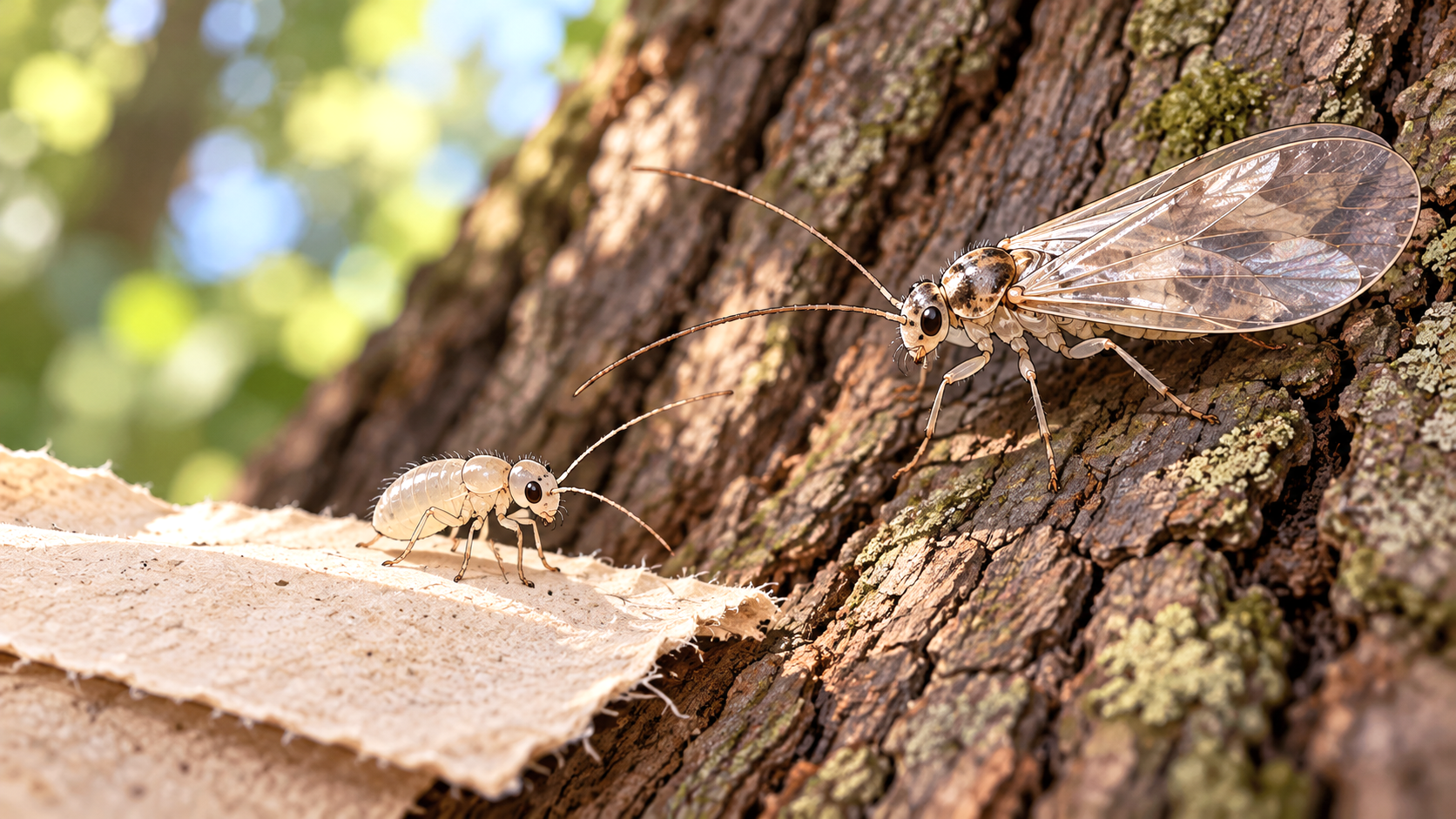
Booklice and barklice are closely related psocids, but the names usually describe different lifestyles rather than two neatly separated taxonomic groups. Booklice are the tiny forms most often found indoors around damp materials and stored products, while barklice usually live outdoors on tree bark, leaves, and similar surfaces. Many barklice have wings; common household booklice are usually wingless.
The Names Describe Where You Usually Find Them
The word booklice is commonly applied to psocids that live inside buildings, especially species associated with damp books, paper, cardboard, stored foods, cupboards, and other humid materials. Many familiar household species belong to Liposcelis, a group of tiny wingless psocids. Their broader scientific classification as booklice and psocids helps explain why the everyday name does not refer to one single species.
Barklice occupy the outdoor side of the same broader insect group. They occur on tree trunks, branches, leaves, stones, fences, and other exposed surfaces where fungi, algae, lichens, and organic debris are available. Outdoor barklice may gather in conspicuous groups or produce silk webbing across bark, while indoor booklice normally remain much less obvious. Barklice are described as small outdoor psocids that feed on fungi, algae, dead plant material, and debris, rather than insects that feed on the tree itself.
There is no formal biological rule saying every indoor psocid is a booklouse and every outdoor one is a barklouse. The terms are practical common names. Utah State groups booklice, barklice, moldlice, and dustlice together as psocids, which is a better reflection of their relationship than treating barklice as an unrelated pest.
Wings Are One of the Most Useful Visual Differences
Common indoor booklice are usually wingless. Typical household Liposcelis have flattened bodies that let them move through narrow spaces among paper, packaging, cracks, and stored materials. The question of whether booklice have wings becomes useful here because photographs of winged outdoor psocids are sometimes mislabeled online as ordinary household booklice.
Many adult barklice have two pairs of membranous wings held roof-like over the body. Texas identification material describes typical barklice as long-antennaed insects with two pairs of wings, although the broader psocid group also contains wingless forms. Wings therefore strongly favor barklice when the insect is outdoors, but their absence does not automatically prove that a specimen is an indoor booklouse.
Nymphs complicate the comparison because immature barklice are wingless even when the adult species eventually develops wings. A cluster of wingless young psocids moving together on tree bark can therefore still be barklice. Location, group behavior, and nearby adults are more informative than wing presence alone when only nymphs are visible.
Barklice Are Often Larger and More Conspicuous
Household booklice are extremely small. Many common indoor species are only about 1 to 2 millimeters long, which is why they may initially look like moving dots on a shelf or wall. Their exact booklouse appearance becomes much easier to see with magnification: long slender antennae, a relatively large head, six legs, and a soft body.
Barklice span a wider visible range. Some are tiny, but others are several millimeters long and much easier to recognize as insects. Texas records include barklice under about 1/8 inch long as well as larger species approaching 1/4 inch. Their wings can increase their apparent size further, making an adult barklouse look substantially larger and more elaborate than the nearly speck-sized Liposcelis found indoors.
Color is not a reliable dividing line. Booklice can be translucent, whitish, gray, tan, or brown, while barklice also occur in muted brown, gray, black, or patterned forms depending on the species. The wide color range of booklice means a brown psocid cannot be classified as barklice from shade alone.
Their Food Overlaps More Than Their Habitat
Both groups depend heavily on microorganisms and decaying organic material. Indoor booklice often feed on molds, fungal spores, damaged grain, and other suitable material, which explains the strong association between booklice and mold. Minnesota household guidance similarly describes booklice as feeding on molds, fungi, grains, insect fragments, and starchy material.
Outdoor barklice also graze fungi and algae. They may clean microorganisms and debris from bark without harming the underlying tree. Large aggregations can look alarming, particularly when barklice cover sections of a trunk or produce silk, but their feeding is directed at material on the bark rather than healthy wood. They are consequently considered harmless to trees in normal circumstances.
That shared fungal diet is one reason booklice and barklice resemble one another biologically despite occupying very different settings. The distinction a homeowner usually needs is not what their mouthparts can process, but where the population is living and whether the insects are established inside the building.
Finding Barklice Outside Does Not Mean You Have Indoor Booklice
A colony on a tree beside the house does not establish that the indoor environment is infested. Barklice can be abundant outdoors without creating a household pest problem. Their presence on trunks and branches may simply reflect a suitable supply of fungi, algae, lichens, and organic debris.
Repeated booklice sightings inside a bathroom, basement, cupboard, or storage room point toward a different environmental condition. Indoor populations depend heavily on moisture, and persistent activity can indicate humidity, condensation, leaks, or damp materials. The relationship between booklice and high humidity is far more useful for evaluating an indoor problem than the number of barklice visible on nearby trees.
Outdoor psocids can occasionally wander indoors, especially around windows or doors. One winged specimen beside a window does not carry the same meaning as dozens of tiny wingless booklice repeatedly appearing around damp cardboard or a humid cupboard. Distribution and persistence matter more than the fact that both insects belong to the same broader group.
Questions About Barklice and Booklice
Are barklice baby booklice?
No. Barklice are not an immature stage of household booklice. Both have their own eggs, nymphs, and adults. The booklice life cycle proceeds through nymphal stages before adulthood, and barklice develop through their own nymphal stages as well.
Can barklice come inside a house?
Yes, individual outdoor psocids can wander or fly indoors accidentally. A single barklouse near a window does not mean it has established an indoor breeding population. Repeated sightings in damp interior areas deserve a closer identification.
Do barklice damage trees?
Generally no. Barklice feed on material growing or accumulating on bark rather than consuming healthy tree tissue. Texas guidance describes them as harmless and potentially beneficial surface feeders because they graze fungi, algae, and debris.
Can booklice live outdoors too?
Psocids related to household booklice certainly occur outdoors, but the insects commonly called booklice are most strongly associated with buildings and stored materials. Outdoor specimens on bark or foliage are more often described as barklice.
Which one should concern you inside a home?
A persistent indoor population of tiny wingless psocids deserves attention because it can indicate favorable moisture and fungal growth. Barklice outdoors rarely require action, while the surrounding signs of an indoor booklice infestation can help determine whether the insects are actually established inside.