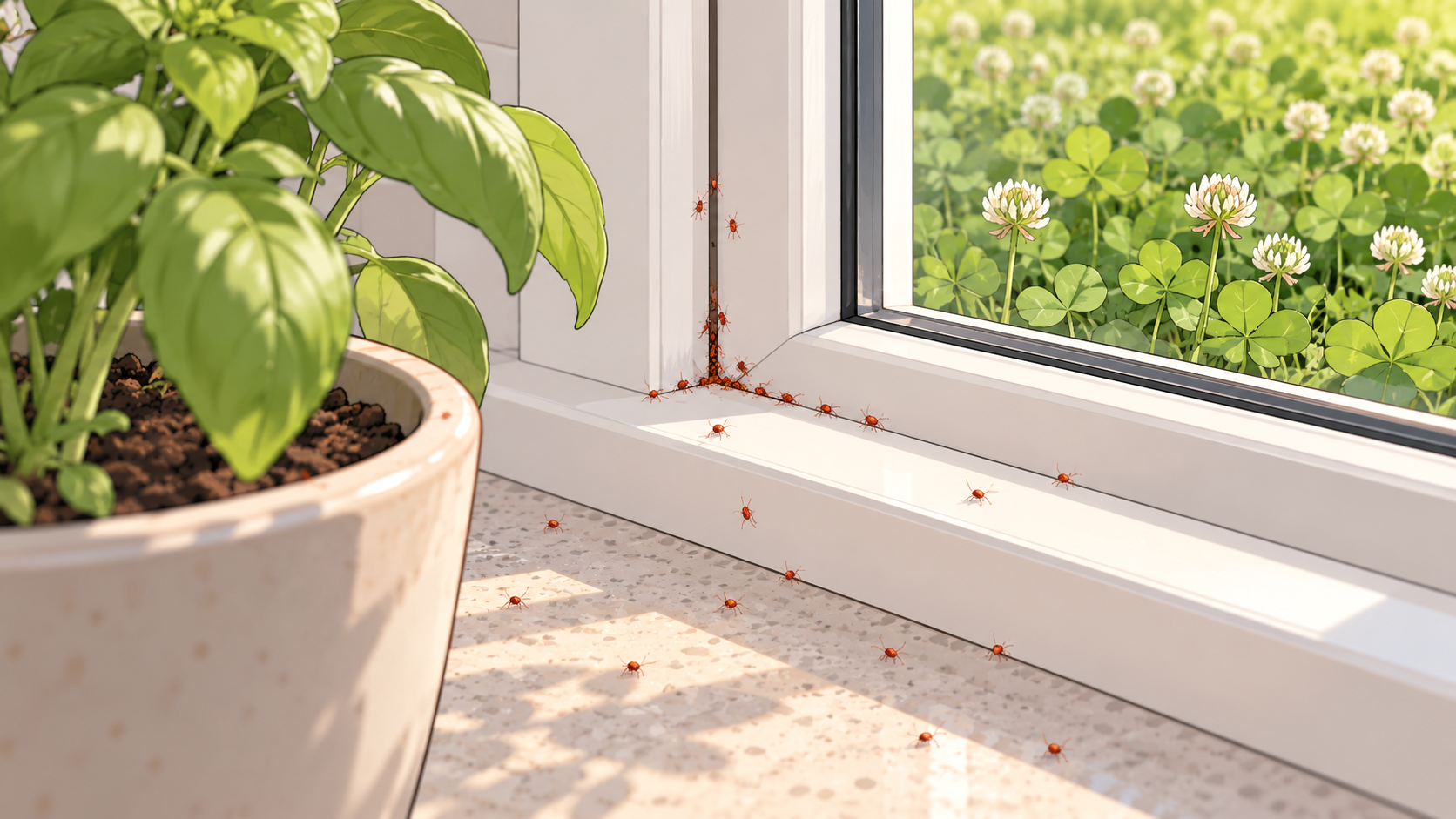
Seeing tiny mites beside a fruit bowl, pantry, sink, or countertop makes the kitchen itself look suspicious. With clover mites, it usually is not. They do not eat human food, and kitchen moisture does not provide the living plant tissue they require. A few wandering across the room can therefore be genuine clover mites. Tiny mites repeatedly concentrated inside flour, cereal, or another stored product deserve a second look because a different mite may be responsible.
Your Food Is Not Feeding Them
Clover mites are plant feeders. Outdoors, they feed on grasses, clover, weeds, and many other plants. Bread, cereal, flour, sugar, grease, crumbs, and other kitchen foods are outside that diet.
Government pest guidance specifically notes that clover mites do not infest stored foods. Entomology references likewise describe them as outdoor plant feeders that may wander across cabinets and other interior surfaces without feeding there. Finding one on a loaf of bread is therefore no more evidence of a food infestation than finding one on a windowsill. The mite happened to reach the surface. It did not come for the bread.
The Sink Is Not a Clover Mite Habitat
Water deserves a little more nuance. Clover mites have physiological responses to humidity and evaporation, and laboratory research has demonstrated active regulation of water loss across different humidities. Older experimental work also found that their humidity response was closely related to changes in evaporation rate.
Neither finding turns a kitchen sink into suitable habitat. Once clover mites are indoors, they have no plant food, cannot maintain a population, and eventually die. Dehydration can kill indoor clover mites within a few days.
A mite beside a wet sink may simply survive there temporarily. Claims that clover mites are drawn to leaking faucets, dishwater, or drains go further than the evidence supports.
Mites Inside Dry Food May Be Something Else
The location of the mites becomes useful when they consistently remain inside stored food. Grain mites and other stored-product mites actually can infest foods, and some thrive where food and moisture occur together. For example, grain mites may infest flour and other processed cereal products, with high humidity favoring stored-product mite problems. That biology is very different from a clover mite wandering through the same kitchen.
Look at the animal rather than relying on color. A clover mite has a remarkably long front pair of legs, often mistaken for antennae. Its color can range beyond the familiar bright red, so redness alone is weak evidence. A population apparently multiplying inside dry goods is especially inconsistent with clover mites because they cannot reproduce indoors.
Kitchen Sanitation Will Not Cure a Clover Mite Problem
Cleaning crumbs and wiping counters are sensible kitchen habits, but doing them more aggressively will not starve clover mites. There was no indoor food supply sustaining them in the first place.
For mites already crawling around the kitchen, a vacuum lets you collect them without crushing their soft bodies and leaving reddish stains. Indoor pesticide use is usually unnecessary because clover mites soon die after becoming trapped inside.
Be particularly cautious about pesticides around food-preparation areas. Current entomology guidance recommends relying on nonchemical control rather than applying insecticides to kitchen counters. Any pesticide used elsewhere must be currently labeled for the pest and intended treatment site.
If fresh clover mites continue appearing after the visible ones are removed, dirty countertops are not the explanation. A continuing pattern belongs to the broader issue of why clover mites keep coming back.
What Kitchen Sightings Can Tell You
Where you find the mites can help decide what to investigate next. A few clover mites wandering over counters or appliances fit an accidental indoor appearance. Dozens embedded in stored food point toward a different identification.
Living continuously on an indoor plant would also deserve closer inspection. Clover mites have a broad outdoor host range exceeding 200 plant species, but several other plant-feeding mites are common enough to be confused with them.
The kitchen itself is therefore useful evidence, just not in the way it first appears. Food, water, and cleanliness do not explain a confirmed clover mite population. They can, however, help reveal when the tiny mite in front of you probably is not a clover mite at all.
Questions About Clover Mites in Kitchens
Do I need to throw away food after seeing a clover mite nearby?
A clover mite elsewhere on the counter does not mean packaged food is infested. Evaluate food separately for actual contamination rather than discarding it solely because a mite was nearby.
Can clover mites eat fruit or vegetables on the counter?
Their normal feeding occurs on living plants. Household produce is not an established indoor food source that allows clover mites to maintain a population.
Can clover mites breed behind kitchen appliances?
No. They may temporarily disappear beneath appliances or into small spaces, but indoor clover mites do not establish breeding populations.
Are clover mites dangerous around food?
Clover mites are nuisance pests rather than biting or disease-transmitting mites. They do not bite people or transmit disease.