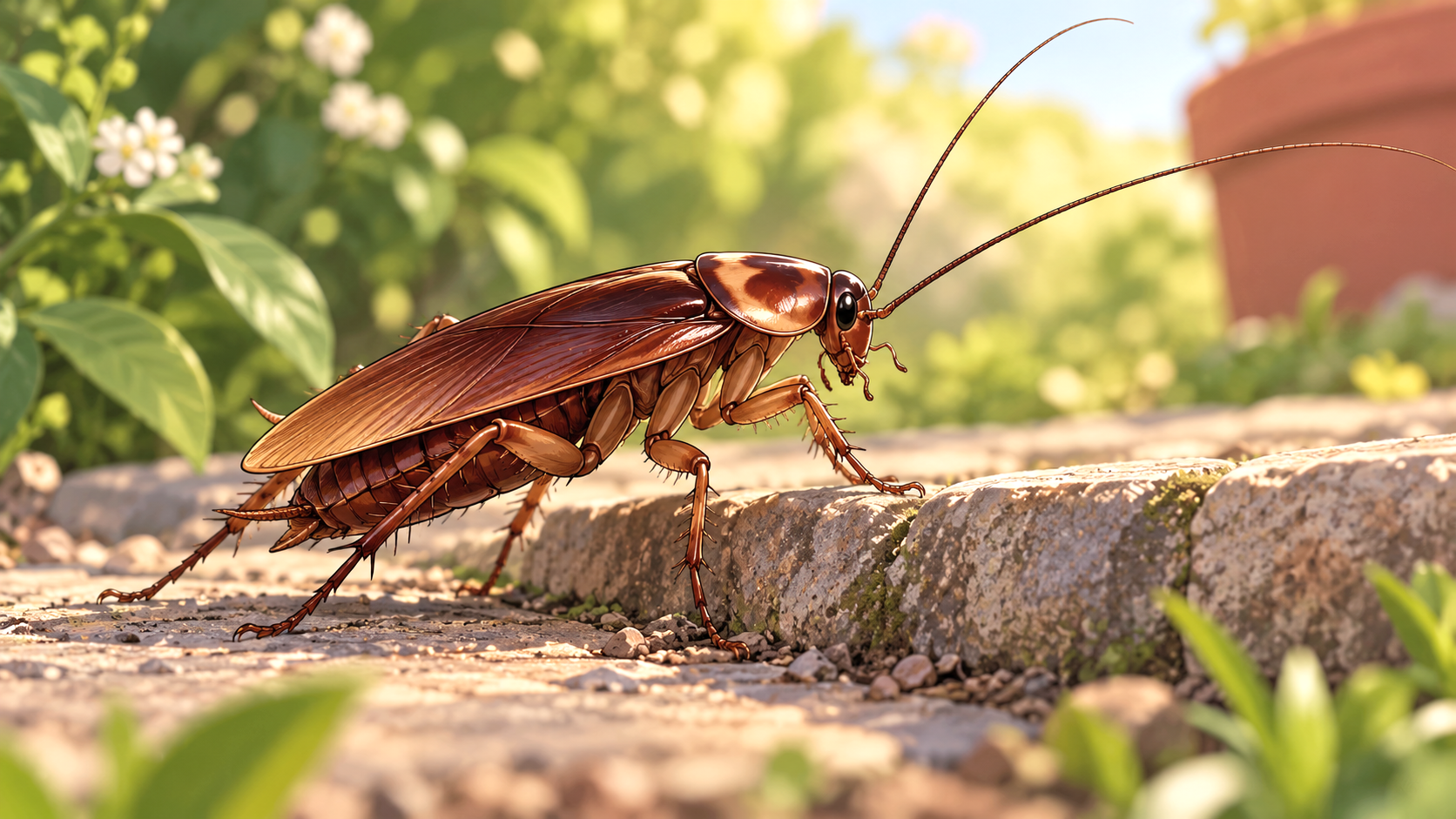
Cockroaches can jump, but most household species are not specialized jumpers. German, American, and smokybrown cockroaches have been filmed pushing themselves into the air before flying, while an unusual South African species called Saltoblattella montistabularis can leap considerable distances using enlarged hind legs.
The difference is important when identifying an insect that seems to jump across a room. A typical household cockroach usually escapes by running, although it may briefly become airborne. An insect repeatedly making powerful, controlled leaps without using its wings is less characteristic of common pest cockroaches.
What Counts as a Real Cockroach Jump?
A true jump begins when an insect uses its legs to push against a surface and propel its body into the air. Falling from a shelf, running over an uneven surface, or gliding downward does not meet that definition.
Cockroach movements can be separated into several categories:
| Movement | What happens | Is it a jump? |
|---|---|---|
| Running | The legs propel the insect while it moves across a surface | No |
| Leg-powered takeoff | The legs push the body into the air | Yes |
| Falling | The insect leaves an elevated surface without a powered launch | No |
| Gliding | Wings influence movement during descent | Not by itself |
| Flying | Wings generate aerodynamic forces to maintain or control airborne movement | Not necessarily |
| Specialized leaping | Powerful leg extension launches the insect without wing assistance | Yes |
The University of Cambridge’s research on the leaping cockroach demonstrates a clear example of specialized jumping. High-speed recordings showed the insect preparing its hind legs, extending them rapidly, and leaving the ground in a controlled leap.
For common household cockroaches, the relationship between leg-powered takeoff and subsequent flight is more complicated. A brief airborne movement should not automatically be classified as sustained jumping behavior.
German, American, and Smokybrown Cockroaches Can Push Off Into the Air
High-speed observations have challenged the simple claim that ordinary cockroaches never jump.
In a PBS science demonstration featuring American, German, and smokybrown cockroaches, researchers filmed all three species launching themselves from a platform at 6,000 frames per second. Each used its legs to initiate an airborne movement associated with flight.
The recordings revealed an unusual takeoff pattern. Rather than relying exclusively on the hind legs, the cockroaches initially pushed with their middle legs while repositioning their rear legs during the launch.
These observations establish that familiar pest species can perform leg-powered takeoffs. They do not establish that these insects routinely make long, grasshopper-like leaps while moving across household floors.
An American cockroach launching from an elevated surface may resemble an insect jumping toward someone, particularly when the takeoff is followed by wing movement. German cockroaches are much less associated with ordinary flight, but they are still capable of the brief leg-powered launching behavior observed in the recordings.
A cockroach’s ability to fly remains a separate characteristic from its ability to push itself momentarily into the air.
The Leaping Cockroach Is a Genuine Jumping Specialist
The most remarkable example is Saltoblattella montistabularis, a small, wingless cockroach discovered on Table Mountain in South Africa. Unlike familiar indoor cockroaches, it uses jumping as a regular way of moving through vegetation.
Researchers observed that jumps and shorter hops accounted for 71% of its movements in its natural habitat. In laboratory experiments, individuals leaped as far as 35.1 centimeters (13.8 inches), equivalent to approximately 48 times their body length.
The original 2010 species description in Arthropod Systematics & Phylogeny documented its unusual proportions. Its hind legs are much longer and more muscular than those of ordinary cockroaches, giving it a grasshopper-like appearance.
Subsequent high-speed biomechanical research published in Biology Letters revealed how those legs generate powerful jumps. The insect bends its hind legs before takeoff, storing energy that is released when they extend. A springlike protein called resilin contributes to the specialized joint structures involved in this movement.
Recorded takeoffs reached approximately 2.1 meters per second, with the fastest acceleration occurring over just 10 milliseconds. The species’ powerful jumping ability allows it to travel between stems and leaves without relying on wings.
Its existence demonstrates that jumping has evolved within cockroaches, but its specialized anatomy should not be assumed to occur in German, American, or Oriental cockroaches.
Why Most Household Cockroaches Do Not Hop Like Grasshoppers
Ordinary cockroaches have legs primarily adapted for rapid movement across surfaces. Their rear legs may be longer than the front and middle pairs, but they lack the extreme enlargement characteristic of specialized jumping insects.
Research on American cockroach escape behavior found that the insects respond to disturbance through rapid body rotation followed by forward movement. Their escape system is particularly effective at changing direction and accelerating away from a threat.
A separate study of cockroach escape trajectories demonstrated that these movements follow characteristic directional patterns rather than consisting of uncontrolled leaps.
This helps explain the apparent jumping sometimes reported when someone approaches a cockroach. The insect may turn abruptly, rush over an uneven surface, or disappear over an edge before the observer can follow its movement.
Its ability to cover ground quickly is distinct from a true airborne launch. The running performance of cockroaches is therefore relevant when interpreting a sudden movement, but speed alone does not demonstrate jumping.
Can Cockroaches Jump From Walls or Furniture?
A cockroach moving from a wall onto the floor may appear to have jumped, although several different movements can produce the same impression.
If it releases its grip and drops, the movement is a fall. If it pushes away with its legs before becoming airborne, the initial movement qualifies as a jump. If its wings subsequently contribute to its movement, the event may also involve gliding or flight.
The distinction is difficult to establish without a clear view of takeoff. An insect that travels outward from a high shelf has not necessarily performed a specialized leap.
The ability of cockroaches to climb walls also means that an insect discovered on the floor may have approached from an elevated surface. Its sudden appearance does not reveal precisely how it descended.
Research into flight initiation in American cockroaches has shown that sensory feedback from the legs helps regulate airborne behavior. Contact with a supporting surface can inhibit flight-related movements, while changes in that contact affect the insect’s response.
These findings demonstrate that takeoff and loss of surface contact involve coordinated sensory and muscular activity. However, they do not mean every cockroach dropping from a wall is deliberately jumping.
Can Baby Cockroaches Jump?
Cockroach nymphs are not generally specialized jumpers. Young German, American, and Oriental cockroaches ordinarily move by walking or running rather than performing repeated, controlled leaps.
Nymphs lack fully developed adult wings, so an airborne movement by a young cockroach cannot involve ordinary powered flight. A nymph can nevertheless fall from an elevated surface or briefly lose ground contact during a sudden movement.
The developmental changes associated with cockroach molting alter body proportions as nymphs grow, but these changes do not turn common household species into grasshopper-like jumpers.
A very small insect repeatedly springing several times its body length may therefore warrant closer identification. Size alone is insufficient, since both young cockroaches and unrelated jumping insects can be tiny.
How to Tell Whether an Insect Is Jumping or Running
An ordinary cockroach can be difficult to follow visually because its movements are abrupt. When an insect seems to jump, the sequence of movement is often more informative than its apparent speed.
A genuine jump involves a recognizable takeoff followed by a period in which none of the legs touch the supporting surface. Repeated launches from a stationary position provide stronger evidence of jumping than one sudden disappearance.
An insect that remains close to the floor while changing direction may simply be running. One that falls from a wall has not necessarily pushed itself into the air. An insect that opens its wings after leaving a surface may be transitioning into flight.
Short, clear video recordings can help distinguish these movements, especially when played in slow motion. They may also reveal whether the insect has the exceptionally developed hind legs associated with specialized jumping species.
The body proportions of different cockroach species vary considerably, but common household cockroaches generally retain the relatively balanced leg arrangement associated with running.
Observing a single airborne movement is not enough to rule out a cockroach. Repeated, powerful hopping without wing assistance, however, is a reason to consider whether the insect has been identified correctly.