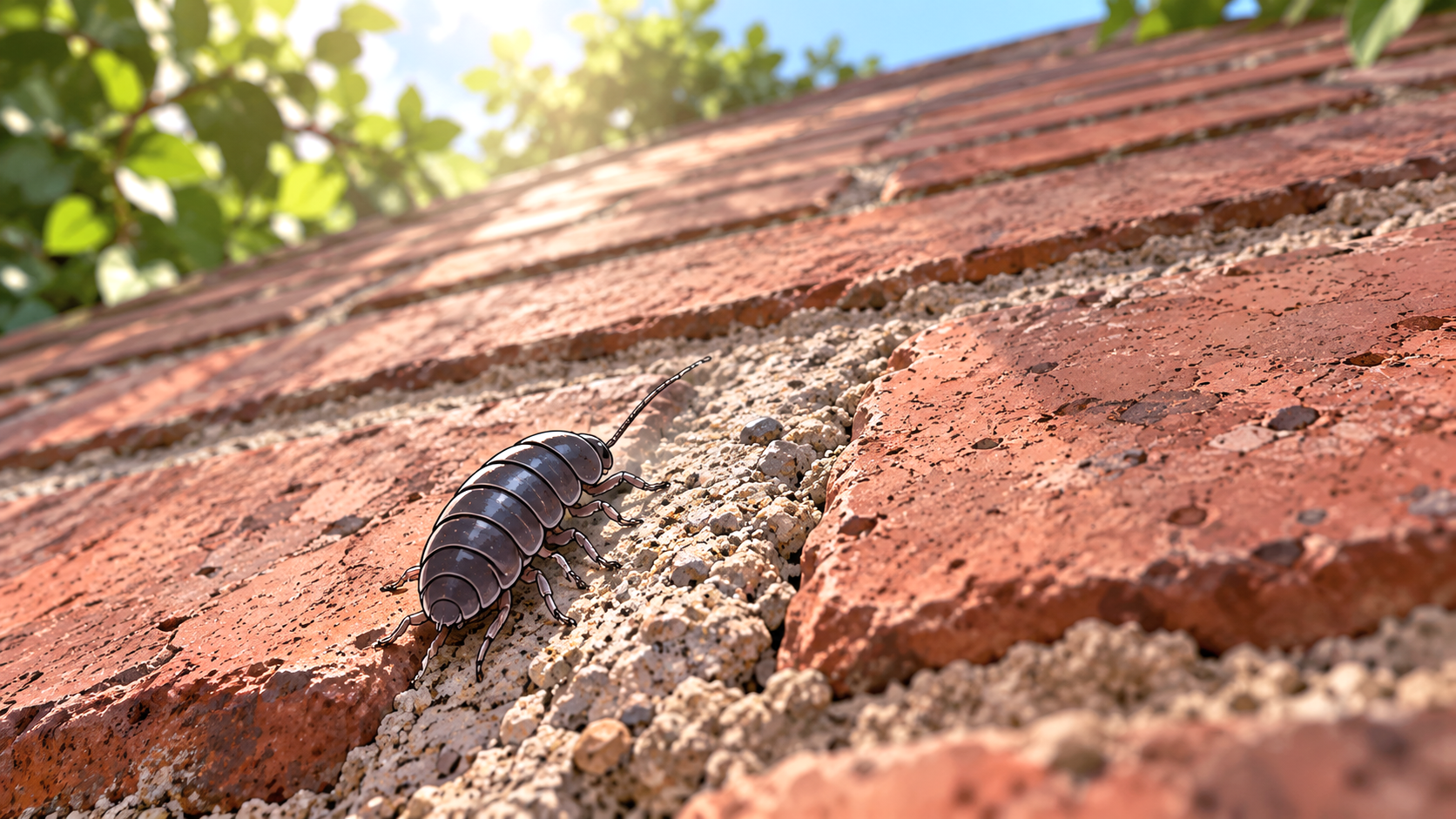
Roly-polies can climb walls and other steep surfaces when the material provides enough texture for their tiny claws to grip. Rough concrete, brick, bark and unfinished wood are much easier to climb than clean glass or very smooth plastic. A roly-poly on a wall therefore does not need wings or specialized adhesive feet to get there. Surface texture matters more than whether the surface is technically a “wall.” A nearly vertical piece of rough bark can offer excellent footholds, while the polished side of a container may provide almost none.
Their Feet End in Claws Built for Contact With the Ground
Roly-polies have seven pairs of walking legs, called pereopods. At the end of each leg is a short terminal segment called the dactylus. Detailed microscopy of the terrestrial isopod Porcellio scaber shows that each dactylus terminates in a curved claw. The claws are only a fraction of a millimeter long, but they withstand repeated loading as the animal walks and clings to surfaces.
High-speed recordings of P. scaber walking show how these structures interact with the ground. During an effective stride, the animal pivots over the dactylus while its legs transfer force through specialized joints. The same anatomical study notes that terrestrial isopods can climb and cling to substrates with their claws. Roly-polies therefore rely on mechanical contact at the ends of their legs rather than the conspicuous adhesive pads found in many wall-climbing insects.
That difference affects where they can travel. Adhesive pads allow some arthropods to maintain contact with extremely smooth surfaces, whereas claws work especially well when their tips can catch microscopic projections, edges or irregularities. General biomechanical research on climbing animals has found that claws gain purchase by interlocking with surface asperities. The rougher the usable texture, the more opportunities there are for a small claw to find a foothold.
Brick and Rough Concrete Are Very Different From Clean Glass
A brick wall contains pits, grains, mortar joints and small projections that are enormous relative to the tip of a roly-poly’s claw. Unfinished concrete, stone and weathered wood offer similar irregularities. Even surfaces that look fairly smooth to a person can contain enough microscopic texture for a small arthropod to climb.
Clean glass presents a much harder challenge because there are few projections for claws to engage. Research on animal attachment shows that stiff claws provide relatively little advantage on a rigid smooth surface unless they can interlock with roughness or penetrate the material. A roly-poly lacks the broad adhesive footpads that let flies and some other insects exploit smooth vertical glass.
“Smooth” can change after a surface has been outdoors or used as an enclosure. Dirt, mineral deposits, algae, scratches, silicone seams, dried residue and objects touching the side can introduce footholds. A roly-poly that cannot scale the clean center of a glass pane may still climb along a textured corner or use a plant, piece of bark or other object as a route upward.
A Wall Sighting Does Not Show Where the Roly-Poly Entered
Finding a roly-poly several feet above the floor can make it appear that the animal entered at that height. Climbing ability makes that conclusion unreliable. An individual can reach a rough vertical surface at ground level and continue upward after arriving there by an entirely different route.
Roly-polies normally occupy damp ground-level refuges beneath vegetation and debris, so climbing is an extension of terrestrial movement rather than evidence that walls are their preferred habitat. Their locomotor performance is also affected by environmental conditions. Experiments with terrestrial isopods found that temperature, body size and substantial water loss can alter walking speed, meaning an animal’s ability to traverse a surface is not fixed under every condition.
Indoors, a wall sighting similarly does not establish the entry point. The circumstances that bring roly-polies into houses include access from surrounding outdoor areas and favorable moisture conditions. Once inside, a sufficiently textured surface can simply provide another route of movement.
Smooth-Sided Containers Can Restrict Climbing, but Interior Objects Can Create a Route Out
The difference between rough and smooth surfaces is useful when roly-polies are temporarily contained. A container with clean, tall, smooth sides gives their claws little purchase. Roughened plastic, mesh, wood and textured decorative materials are far easier to use as climbing surfaces.
The sides are only one part of the route. Leaves, branches, bark, substrate piled against an edge or other objects touching the wall can function as a bridge. Once an animal reaches a seam, rim or textured area, the smooth lower portion of the container no longer determines whether it can continue upward.
Small individuals deserve particular attention because baby roly-polies are considerably smaller than adults. An opening that appears insignificant beside an adult can be proportionally much larger for a juvenile. Containment therefore depends on both climbable routes and the size of gaps at the destination.
A lid may still be useful even when the walls are difficult to climb, particularly if objects inside approach the rim. It should permit appropriate ventilation rather than turning the container into a sealed chamber because terrestrial pillbugs depend on air while also requiring humid conditions. Their limits during underwater submersion illustrate why keeping a terrestrial isopod moist is not the same as enclosing it in saturated, poorly aerated conditions.
Falling Does Not Mean the Roly-Poly Cannot Climb
A roly-poly can lose its grip on a vertical surface. Its claws must repeatedly find usable contact points, and an interruption in texture can leave the animal without sufficient purchase. A change from mortar to a smoother tile, for example, can stop a climb even when the preceding section was easy to cross.
Its compact body provides another defense if disturbance follows a fall. Pillbugs can roll into a ball when physically disturbed, protecting the legs and softer underside inside the armored exterior. Rolling is not a climbing mechanism, however, and a conglobated animal cannot continue walking until it opens again.
Questions About Roly-Poly Climbing
Can roly-polies climb ceilings?
Clinging upside down requires maintaining enough grip to support the entire body against gravity. Their claws can engage suitably rough material, but a ceiling that offers few usable projections is much more difficult than a textured vertical wall.
Can roly-polies climb trees?
Yes, bark can provide abundant crevices and projections for their claws. Roly-polies are primarily associated with the ground and low refuges, so the ability to climb bark does not make them primarily tree-dwelling animals.
Can roly-polies climb out of a bathtub?
The smooth glazed surfaces of many bathtubs can be difficult for claw-based climbing. Texture, residue, scratches or objects contacting the side can change the available grip, so the answer depends on the actual surface rather than the fact that it is a bathtub.
Can roly-polies climb plastic storage bins?
Very smooth, clean plastic can restrict climbing, while textured plastic provides more potential footholds. Scratches, residue and objects leaning against the side can also create routes that were absent when the container was clean.