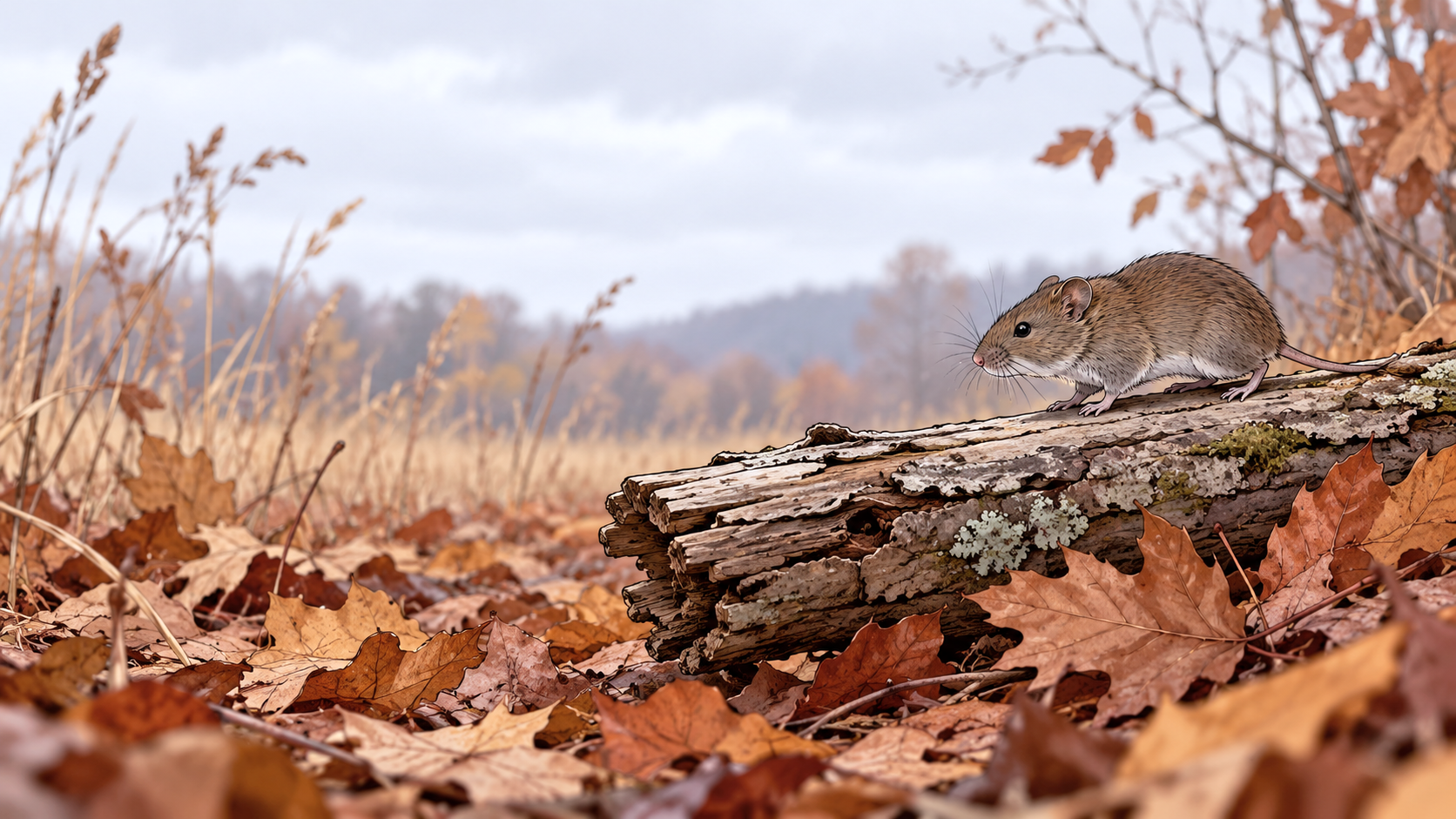
Most voles live only a few months to about a year in the wild, although some individuals survive considerably longer. Meadow voles typically live two to three months, woodland voles average less than three months, and prairie voles generally survive less than a year. Captive voles can live for several years, with documented longevity records exceeding five years in certain species.
These figures describe different kinds of survival. An average wild lifespan reflects the deaths of animals exposed to predators, weather, and other hazards, while a maximum recorded lifespan describes an exceptional individual. Using the longest captive record to estimate how long a vole in your yard will survive would give a misleading picture.
How Long Different Vole Species Live
Voles do not share a single life expectancy. Even closely related species have different recorded survival patterns, and individual animals may live far beyond their species’ typical wild lifespan.
| Vole species | Typical lifespan in the wild | Documented longevity |
|---|---|---|
| Meadow vole (Microtus pennsylvanicus) | 2–3 months | 16 months in the wild; over 2.5 years in captivity |
| Prairie vole (Microtus ochrogaster) | Less than 1 year | 5.3 years in captivity |
| Woodland vole (Microtus pinetorum) | Less than 3 months | Just over 1 year in the wild; 2.8 years average in captivity |
| Montane vole (Microtus montanus) | 6–12 months | 18 months in the wild |
| Bank vole (Myodes glareolus) | 6 months–2 years | 4.9 years in captivity |
The meadow vole’s documented lifespan demonstrates how short survival can be in natural populations. Although some individuals reach 16 months, the typical wild lifespan is only two to three months. A woodland vole has a similarly short average lifespan, despite a reported captive average of 2.8 years.
Prairie voles present a particularly interesting contrast. Their ordinary wild lifespan is less than a year, yet the AnAge longevity database records an individual that reached approximately 5.3 years in captivity. That figure comes from a small sample and represents a recorded extreme rather than the expected lifespan of a captive prairie vole.
Montane voles show another pattern. Their recorded wild longevity reaches 18 months, with typical survival varying according to the season in which an animal was born. Bank voles, common in Europe and parts of Asia, have a documented wild lifespan of six months to two years, while their captive longevity record reaches 4.9 years.
Differences among the various vole species make species identification necessary before assigning a lifespan to an individual animal.
Why So Many Wild Voles Die Young
Predation accounts for a substantial part of vole mortality. Their predators include owls, hawks, foxes, weasels, snakes, and other carnivorous animals. The precise importance of each predator varies by habitat and geographic location, but small ground-dwelling mammals face repeated exposure to hunting animals throughout their lives.
A field experiment involving root voles (Microtus oeconomus) measured the effect of birds of prey by excluding them from selected grassland plots. During winter and spring, avian predation reduced vole survival by as much as 22%. The effect varied among study locations and was strongest near a forest edge. This provides measured evidence of predation’s contribution to mortality, rather than assuming every vole death results from a predator.
Environmental conditions impose additional limits. Food availability, temperature, vegetation cover, and population density influence survival. Competition can increase when numerous animals occupy a limited area, while poor habitat conditions leave individuals exposed to threats that would otherwise be reduced by protective vegetation.
Survival also changes with the structure of a population. Young animals and adults do not necessarily face identical risks, and individuals in different habitats encounter different environmental pressures. An average lifespan combines these outcomes into a single figure, concealing much of the variation among individual animals.
Does the Season a Vole Is Born Affect Its Lifespan?
Montane voles provide a documented example of how birth timing changes survival. Individuals born in the first spring litters typically live approximately six months. Those born during mid-to-late summer survive approximately seven months, while fall-born animals have recorded lifespans of approximately 12 months. Winter-born litters generally fail to survive.
These differences reflect the seasonal conditions encountered during an animal’s life. A vole born in spring experiences its early development under different temperatures, vegetation conditions, and population pressures from one born late in the year.
The results also demonstrate why two animals of the same species need not have similar lifespans. The difference between six and twelve months is substantial for a small mammal, yet both outcomes fall within documented montane vole survival patterns.
Winter itself does not impose an automatic endpoint. Voles remain active during cold months, and winter activity in voles continues beneath snow and other protective cover. Survival through that period depends on the conditions encountered rather than a fixed seasonal lifespan.
How Much Longer Can Voles Live in Captivity?
Captivity can greatly extend vole longevity because animals are protected from many threats responsible for deaths in wild populations. Controlled housing, regular access to food and water, veterinary oversight, and the absence of wild predators change the conditions under which survival is measured.
The comparison is particularly striking for prairie voles. An individual surviving 5.3 years lived more than five times as long as the upper boundary of the species’ usual wild lifespan of less than a year. The prairie vole species account records captive survival up to three years, while the longer longevity record documents what an exceptional individual achieved.
Captivity does not guarantee an unusually long life. Research animals may be removed from studies before reaching their natural maximum age, and captive populations differ in housing, health, and management. The recorded longevity of montane voles illustrates this limitation because research colonies have not provided a reliable maximum captive lifespan.
Captive and wild statistics should therefore remain separate. One measures survival under managed conditions, while the other includes the hazards faced in natural habitats.
Can You Tell How Old a Vole Is by Looking at It?
An adult vole’s appearance cannot establish its exact age. Body size can provide developmental context, but mature individuals of the same species vary naturally in weight and proportions. A particularly large vole is not necessarily older than a smaller adult.
Physical development offers more useful information during the early stages of life. The appearance of young voles changes as they develop fur, open their eyes, and grow toward adult proportions. Once those developmental differences become less apparent, estimating age from an ordinary photograph becomes much less reliable.
Scientific studies obtain more dependable lifespan information by following known individuals. Capture-mark-recapture research, for example, allows researchers to identify animals encountered during successive sampling periods and measure their survival over time. Without a known birth date or documented observation history, a wild vole’s exact age generally cannot be established from its appearance alone.
Does a Vole’s Short Lifespan Mean It Will Disappear From Your Yard?
An individual vole may die within a few months while other voles continue occupying the same property. The length of time a population remains present is therefore separate from the lifespan of any one animal.
This is especially relevant when activity continues through several seasons. Observing voles in spring and again the following autumn does not establish that the same individuals survived throughout that period. Animals born later may occupy the habitat previously used by others.
The reproductive capacity of voles allows generations to overlap, so even substantial individual mortality does not automatically eliminate a local population. Habitat conditions and the arrival of animals from surrounding areas also influence whether a location remains occupied.
For homeowners, a useful observation is whether fresh feeding damage and active travel routes are still present. An old sighting provides no reliable estimate of how long an individual vole lived, while continuing activity establishes that the location remains in use. The signs of voles in a yard offer a more practical way to assess current presence than attempting to calculate when an animal first seen months earlier might die.