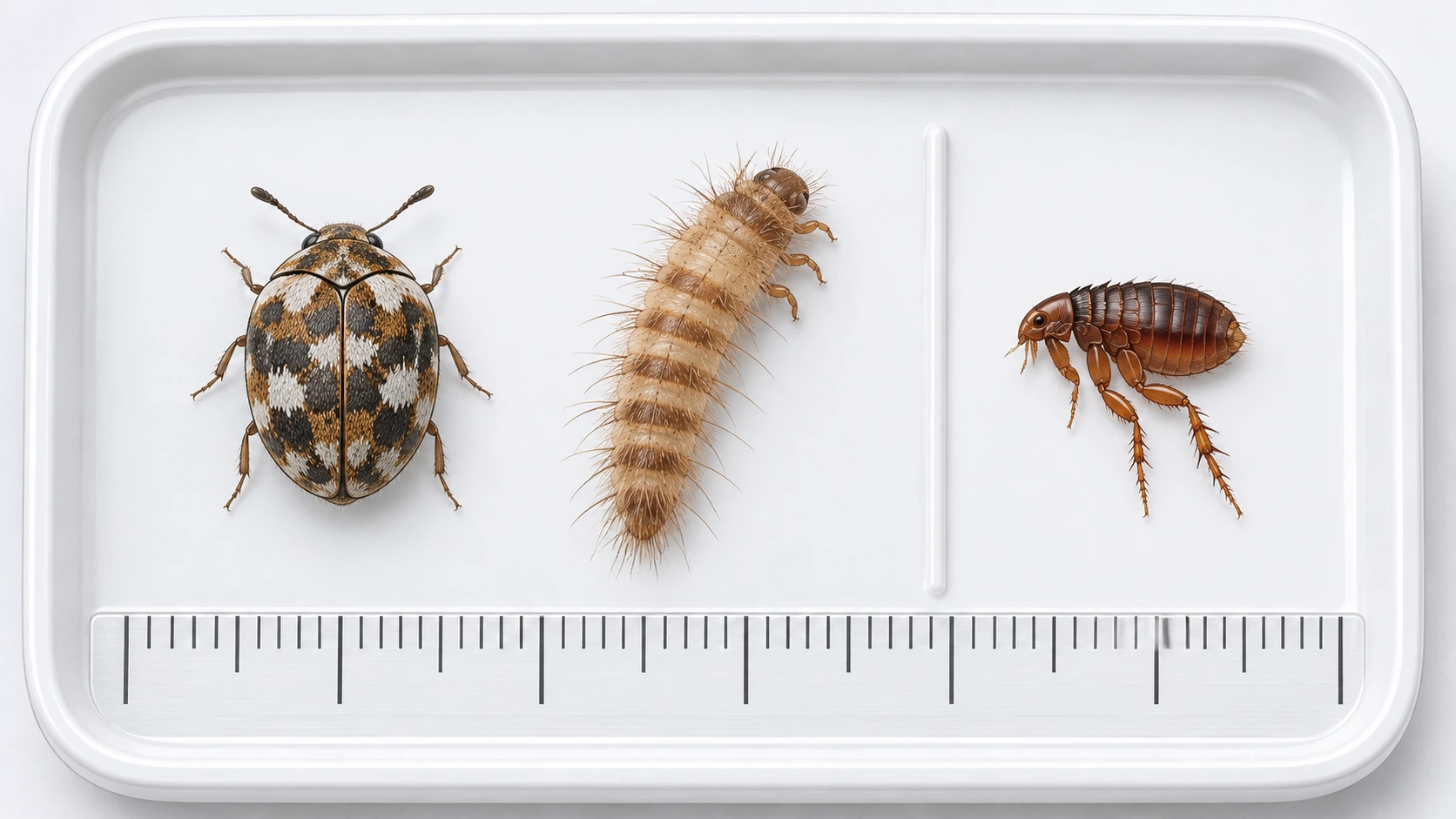
A carpet beetle vs. flea comparison starts with body shape and movement. Adult fleas are small, wingless insects with bodies flattened from side to side and enlarged hind legs built for jumping. Adult carpet beetles have rounded or elongated oval bodies, hardened wing covers, and relatively inconspicuous legs. They crawl or fly, but do not jump like fleas.
The confusion usually involves a tiny black or brown insect found in carpeting, around furniture, or near a pet’s sleeping area. Both insects can be small enough to escape identification by the naked eye, and their adult sizes overlap. Their immature stages are much easier to separate. Carpet beetle larvae have six legs and conspicuous hairs covering their elongated bodies. Flea larvae are pale, wormlike, and completely legless. The two also leave different evidence around the home.
We would examine three things before identifying either pest: how the adult moves, whether the specimen has a hairy or smooth immature body, and what other evidence appears around the suspected location. A flea associated with a pet creates a different pattern of household activity from carpet beetle larvae feeding on accumulated hair or natural fibers.
Carpet Beetle vs. Flea at a Glance
|
Feature |
Carpet beetle |
Flea |
|---|---|---|
|
Scientific classification |
Family Dermestidae, order Coleoptera |
Order Siphonaptera |
|
Typical adult size |
Approximately 2–5 mm for common household species |
Common household fleas approximately 1–3 mm |
|
Body shape |
Rounded, convex, or elongated oval |
Narrow when viewed from above, flattened from side to side |
|
Adult color |
Mottled white, brown, yellowish, or black; some species entirely dark |
Usually reddish-brown to dark brown or black |
|
Wings |
Adults have hardened wing covers and may fly |
Wingless |
|
Legs |
Six relatively short legs |
Six legs, with enlarged hind legs adapted for jumping |
|
Antennae |
Usually short and clubbed |
Short and relatively inconspicuous |
|
Adult feeding |
Many common species feed on pollen or nectar; some feed little |
Blood meals from suitable animal hosts |
|
Larvae |
Elongated, segmented, hairy or bristly, with six legs |
Pale, slender, wormlike and legless |
|
Typical larval food |
Animal-derived fibers, pet hair, feathers, dead insects and other organic material |
Flea feces, dried blood and organic debris |
|
Common indoor locations |
Closets, rugs, upholstery, stored fabrics, windowsills |
Pet bedding, carpets, floor cracks, upholstery and animal resting areas |
|
Movement |
Crawling and, for adults, flight |
Crawling on host or in the environment; adult jumping |
|
Main household concern |
Damage to susceptible fabrics and stored materials |
Blood-feeding adults and an established flea population around suitable hosts |
The size ranges overlap, particularly between fleas and varied carpet beetles. A specimen measuring 3 mm could belong to either group, so measurements should support rather than determine identification.
The more revealing clues are the flea’s sideways body compression, specialized hind legs, and lack of wings, compared with the carpet beetle’s hardened wing covers and rounded body.
Adult Fleas Have a Flattened Body Built for Jumping
An adult flea has a distinctive body profile. Viewed from above, it appears narrow and compressed rather than broadly oval. Viewed from the side, its body is flattened from left to right, allowing it to move through the hair and fur of animal hosts.
Common household fleas are generally reddish-brown to dark brown. Adult cat fleas, Ctenocephalides felis, are particularly important in US homes because they commonly infest both cats and dogs.
Most adult household fleas measure approximately 1–3 mm long. Their six legs are positioned around the underside of the body, with the rear pair substantially enlarged for jumping.
That hind-leg structure is one of the strongest identification clues. A flea can make sudden jumps between a pet, carpet, furniture, and nearby surfaces. The legs are adapted to propel the insect rather than simply support ordinary walking.
The physical features of adult fleas include their laterally compressed bodies, lack of wings, and enlarged jumping legs.
The flea’s mouthparts are also adapted for piercing skin and taking blood meals. This is fundamentally different from the feeding structures of adult carpet beetles, which do not obtain blood from animals.
Carpet Beetle Adults Have a Hard, Oval Body
Adult carpet beetles have the compact structure of ordinary beetles. Their front wings form hardened covers called elytra, which protect the flight wings folded underneath.
The varied carpet beetle (Anthrenus verbasci) is generally around 2–3 mm long. Its rounded body has irregular patches of white, yellowish, brown, and black scales.
Black carpet beetles (Attagenus unicolor) are usually larger, approximately 3–5 mm, with elongated oval bodies that range from dark brown to black.
The black carpet beetle can be particularly confusing when found on a dark floor or piece of furniture. Its small, dark body might resemble an unfed flea when viewed from a distance.
A close examination usually reveals a different profile. The beetle has a rounded or convex upper surface, visible wing covers, and relatively short legs. It does not have the distinctly flattened, sideways body of a flea.
The appearance of adult carpet beetles varies by species and age, so the absence of mottled markings does not rule out a carpet beetle.
Fleas Jump, While Adult Carpet Beetles Crawl or Fly
Movement can provide a useful clue when an adult insect is still alive.
A flea may disappear from view in a sudden jump after being disturbed. It can move rapidly between animal fur and nearby surfaces, making it difficult to capture or photograph.
Carpet beetles do not have the enlarged hind-leg structure used for flea jumping. Adults can crawl across surfaces and some species fly. They may also gather around windows because of their attraction to light.
The difference becomes particularly useful when inspecting a pet’s resting area.
Suppose you see several tiny insects moving through the fibers of a dog bed. One repeatedly springs away when approached, while another crawls steadily across the fabric. The jumping specimen deserves closer examination as a possible flea. The crawling specimen could be a carpet beetle or another small beetle.
However, movement alone should not settle the identification. A flea may crawl without jumping, especially when it is undisturbed or trapped in a confined space. A carpet beetle adult may also move quickly when disturbed.
An insect should therefore be examined for its wing covers, antennae, and leg proportions before being assigned to either group.
The adult flight capability of carpet beetles provides another useful clue, particularly when a small beetle is repeatedly appearing around windows or lights. Their ability to fly and move through buildings explains why an adult may be found away from the material supporting its larvae.
Carpet Beetle Larvae and Flea Larvae Look Very Different
The adult insects are relatively similar in size, but their larvae are much easier to distinguish. A carpet beetle larva is a visibly hairy insect with three pairs of legs. A flea larva resembles a tiny pale worm and has no legs.
Carpet Beetle Larvae Are Covered in Hairs
Common carpet beetle larvae have elongated, segmented bodies covered in noticeable bristles. Their appearance varies by species.
Varied carpet beetle larvae are often brown with alternating lighter and darker body segments. They have dense hairs along the body, with particularly noticeable tufts toward the rear.
Black carpet beetle larvae are more elongated and tapered. Their bodies may be brown or nearly black, with a long brushlike tuft of hairs extending from the rear.
Unlike flea larvae, carpet beetle larvae have six functional legs near the front portion of the body. These legs help them crawl through the materials in which they feed.
The larvae may also leave recognizable shed skins as they grow. These empty coverings retain much of the original hairy appearance and can accumulate near an infested textile or concealed feeding location.
A useful way to identify a suspected specimen is to examine its body covering rather than relying on color. A brown, fuzzy larva with visible legs is much more consistent with a carpet beetle than a flea.
The body shape, leg arrangement, and hair patterns of carpet beetle larvae are especially helpful when identifying an immature insect found in stored clothing or carpet fibers.
Flea Larvae Are Legless and Wormlike
Flea larvae look very different from adult fleas. They do not have enlarged jumping legs or the flattened body profile of their parents.
Instead, they are slender, pale or whitish larvae with a darker head capsule. Their bodies have small bristles, but they lack the dense, conspicuous hair covering typical of many carpet beetle larvae.
Newly hatched flea larvae are very small. They grow through successive molts and may reach approximately 5 mm in length, depending on the species.
Their lack of legs is particularly useful for identification. A flea larva moves through its surroundings using body movements and bristles rather than walking on six legs.
Flea larvae are also associated with different household materials. They commonly develop in protected places where pets rest, including carpet fibers, floor cracks, upholstered furniture, and bedding.
They feed on organic debris and dried blood-containing material, including flea feces left behind by adult fleas. They do not need to remain on the animal itself to complete their development.
The identification of flea larvae and their environmental feeding stages helps explain why a home can contain immature fleas even when few adult fleas are visible on a pet.
Why Both Pests May Be Found Around Pet Bedding
Pet bedding can support either pest, but for different reasons.
Fleas use animals as hosts for their adult blood-feeding stage. Their eggs are not firmly attached to the animal’s hair, so they fall into nearby surroundings. This allows flea development to continue in bedding, carpets, and other resting areas.
Carpet beetles are attracted to different resources. Their larvae can feed on accumulated pet hair, dead insects, natural-fiber materials, and other suitable organic debris.
For example, a wool pet blanket may provide food for carpet beetle larvae. A heavily used dog bed may also collect loose hair and skin debris. Flea eggs and larvae can occur in the same general resting area if a pet carries an established flea population.
This overlap means the discovery location is not enough to identify the insect.
A white, legless larva among debris in a pet bed suggests a flea larva. A brown, densely hairy larva with six legs suggests a carpet beetle or another dermestid beetle.
An adult flea jumping through the pet’s coat provides stronger evidence of fleas than merely finding an unidentified insect beneath the bed. Likewise, recognizable carpet beetle cast skins and feeding damage provide stronger evidence of carpet beetle development than finding a single dark beetle on the floor.
We would inspect the actual specimens before choosing which pest is responsible for the activity.
The Household Evidence That Separates Fleas From Carpet Beetles
A useful identification should explain not only what the insect looks like but also why it is present.
The surrounding evidence differs considerably between flea activity and carpet beetle development.
|
Evidence found |
More consistent with fleas |
More consistent with carpet beetles |
|---|---|---|
|
Live adults |
Small reddish-brown insects jumping between surfaces or through animal fur |
Oval beetles crawling on surfaces or flying toward windows |
|
Pet coat |
Adult fleas or dark flea fecal debris |
Occasional incidental beetle contact, without blood-feeding |
|
Bedding |
Eggs, larvae, pupal cocoons, or adult fleas associated with animal resting areas |
Hairy larvae, shed skins, and accumulated organic material |
|
Wool clothing |
Not a normal flea food source |
Susceptible material for larval feeding |
|
Carpet fibers |
May shelter developing larvae near animal resting areas |
May contain larvae feeding on suitable debris or fibers |
|
Cast skins |
Flea development may leave larval and pupal remains, but these are not typical carpet beetle-shaped casings |
Recognizable elongated, hairy larval skins |
|
Movement |
Adults can make sudden jumps |
Adults crawl or fly; larvae crawl |
Flea Dirt Is Supporting Evidence for Fleas
Flea dirt is the common name for the small dark fecal pellets left by adult fleas after feeding on blood.
It may look like black or reddish-brown pepper scattered through an animal’s coat or on its bedding. When examined in the context of a suspected flea infestation, it can help support an identification.
However, dark particles are not automatically flea dirt. Ordinary dust, soil, fabric debris, and other insect droppings can look similar.
The presence of a jumping adult flea or an identifiable flea specimen makes the evidence considerably stronger.
Carpet Beetle Shed Skins Support a Different Identification
Carpet beetle larvae molt repeatedly as they grow. Their shed skins can remain in protected places around the materials they have been feeding on.
These skins are usually recognizable by their elongated, segmented form and retained hairs or bristles. They may appear brown, dry, and hollow.
A wool sweater containing several bristly cast skins and irregular feeding damage provides a different pattern of evidence from a pet blanket containing live fleas and flea fecal debris.
The appearance and identification of carpet beetle larval shed skins can help establish whether a suspected fabric infestation involves developing beetle larvae.
One isolated shed skin does not establish current activity because it may have remained after the larva completed development. Other signs should be examined before deciding whether the infestation is ongoing.
Does Finding One Small Insect Mean You Have Fleas or Carpet Beetles?
An isolated insect is not enough to establish an infestation of either pest.
A single carpet beetle adult may have entered through a window or flown from another part of the home. Adult varied carpet beetles commonly appear around windows during spring and early summer.
Finding one adult flea is different in terms of its feeding biology, since adult fleas require a blood meal from a suitable host to reproduce. However, one flea still does not tell you the extent of the population or where every immature stage is developing.
Repeated flea sightings, confirmed flea dirt, and adult fleas recovered from a pet provide stronger evidence of an established flea problem.
For carpet beetles, multiple larvae, recognizable shed skins, and feeding damage among susceptible materials are more persuasive than the number of adult beetles on a windowsill.
The signs of an established carpet beetle infestation are most useful when the insect evidence matches the material being damaged.
An important mistake is assuming that every tiny insect found in a carpet must be a flea. Carpet beetle larvae can develop in carpet fibers, especially where hair, lint, and other suitable food accumulate. Their presence does not establish a flea population or imply that pets have parasites.
The reverse mistake happens when someone identifies every jumping or crawling insect as a carpet beetle simply because it was found near a rug.
A correctly identified specimen is a much better starting point than a count of unfamiliar insects.
Six Legs Do Not Automatically Mean Carpet Beetle
Both adult fleas and adult carpet beetles have six legs because both are insects. Counting six legs therefore cannot separate these two adult pests.
The more useful question is how those legs are arranged. Fleas have substantially enlarged hind legs, while carpet beetles have shorter legs positioned beneath their compact bodies.
The immature stages provide a different result. A carpet beetle larva has six legs near its head, while a flea larva has no legs.
This makes the life stage particularly important when examining a very small specimen. A six-legged adult with no recognizable wing covers might be difficult to identify, but a six-legged, bristly larva is consistent with carpet beetle development rather than a flea larva.
What Does the Pet’s Environment Tell You?
The relationship between the insect and the animal is another useful identification clue.
The cat flea, Ctenocephalides felis, is the flea most commonly associated with domestic cats and dogs in many US household settings. Despite its name, it can feed on both animals. Adult fleas seek hosts for blood meals, and their eggs fall into the surrounding environment.
A pet that regularly sleeps in one location can therefore leave behind the material from which immature fleas develop. The household flea evidence around pet resting areas includes adult fleas, eggs, larvae, and other signs associated with the animal’s sleeping environment.
Carpet beetles have a different relationship with pets. Their larvae can consume accumulated pet hair, feathers, and other animal-derived materials. A dog bed or cat’s favorite blanket may contain suitable food even when no flea population is present.
Adult carpet beetles may also enter a room independently of the pet. They can fly toward windows and lights, so discovering one on a nearby wall does not establish that the animal brought it inside.
The food sources available to carpet beetle larvae explain why pet hair and accumulated debris may support beetle development without the insects feeding on the animal.
Avoid using scratching, licking, or irritated skin as the deciding evidence. Those signs warrant appropriate veterinary attention when persistent, but they cannot independently identify fleas or carpet beetles.
What Should You Examine When the Specimen Is Hard to See?
A very small insect can be difficult to photograph accurately, especially when it is moving or resting against dark fabric.
A magnifying glass or macro-capable phone camera can help reveal the body outline, antennae, legs, and wing structures. A ruler marked in millimeters provides useful scale because adult fleas and several common carpet beetles have overlapping measurements.
The specimen should be photographed from above and, when possible, from the side. An overhead image may show the carpet beetle’s wing-cover outline, while a side view is more useful for noticing the flea’s flattened profile.
Avoid crushing the insect before identification. Even a damaged specimen may retain enough of its anatomy to establish whether it is a flea or beetle, but destroying the wings, legs, or body can remove the most useful clues.
When you find a suspected flea on a pet, a veterinarian can help confirm the parasite and assess the animal. For an unidentified household beetle, a cooperative extension insect identification service can help examine the specimen.
The identification should be based on the actual insect rather than a photograph of unexplained skin marks or an assumption about which pest normally lives in a particular room.
Let the Body Shape and Life Stage Settle the Identification
A flea has a narrow, sideways-compressed body, no wings, and enlarged hind legs used for jumping. An adult carpet beetle has a compact beetle-shaped body, hardened wing covers, and may fly or crawl instead.
The larvae offer an even clearer answer. Carpet beetle larvae have six legs and conspicuous body hairs, while flea larvae are legless, pale, and wormlike.
When the insect is found near pet bedding, examine the animal-associated evidence as well as the specimen. Live jumping fleas and flea debris support flea activity. Hairy larvae, cast skins, and damage to susceptible natural fibers support carpet beetle development.
Do not identify the pest from its location, color, or a pet’s scratching alone. An intact specimen and the evidence surrounding it provide a much more dependable answer.