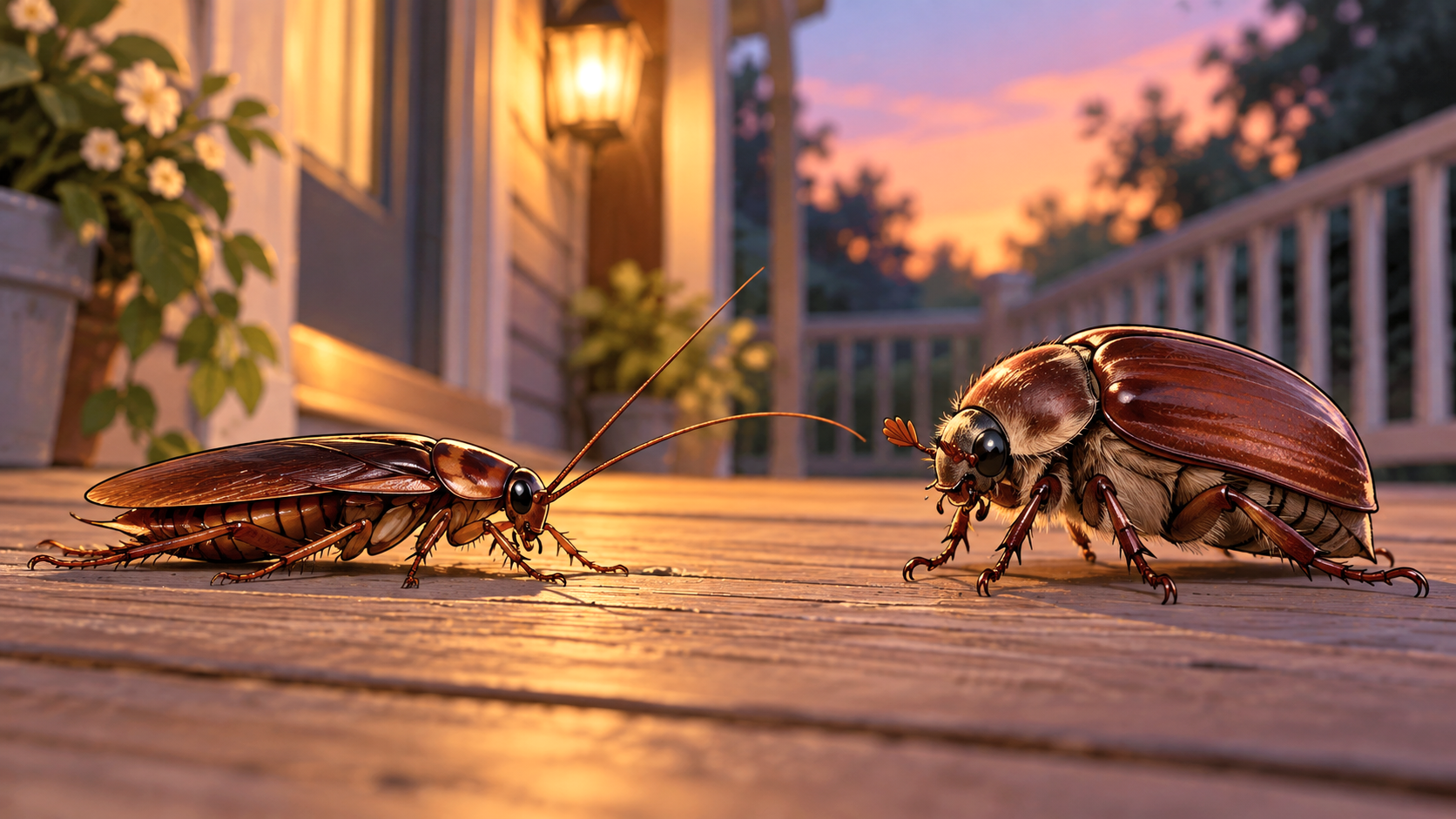
A large brown insect buzzing against a porch light can look surprisingly similar to a cockroach, particularly when it lands on the floor and starts crawling. Both insects have six legs, brown coloration, and wings, but their physical structures are noticeably different. June bugs have thick, rounded bodies, short antennae with fan-shaped tips, and hard wing covers. Cockroaches have flatter bodies, long threadlike antennae, and overlapping, leathery forewings. A close look at these features usually settles the identification without needing to capture the insect.
Cockroach vs June Bug: Key Differences
| Feature | Cockroach | June bug |
|---|---|---|
| Body shape | Flattened, elongated oval | Thick, rounded, often dome-shaped |
| Antennae | Long, thin, threadlike | Short, ending in fanlike plates |
| Wing covers | Leathery forewings, sometimes reduced | Hard wing covers called elytra |
| Back | Broad shield behind the head; overlapping wings | Two hard wing covers meeting along a straight central seam |
| Legs | Long, strongly spined, adapted for rapid running | Stout, often spined, suited to gripping and digging |
| Movement | Usually runs rapidly toward cover | Often crawls awkwardly or flies with a noticeable buzz |
| Typical encounter | Near sheltered indoor spaces or outdoor refuges | Around outdoor lights during spring and summer |
The comparison applies primarily to adult insects. June bugs are scarab beetles, particularly species in the genus Phyllophaga, although the common name is also applied to other related beetles. Cockroaches belong to a different insect order.
The University of Wisconsin’s June beetle identification guide describes their thick bodies, seasonal activity, and attraction to outdoor lighting. The University of Minnesota’s cockroach identification guidance emphasizes their flattened shape, long antennae, and prominently spined legs.
The Antennae Are Often the Fastest Way to Identify Them
June bugs have relatively short antennae ending in several flattened plates, called lamellae. These plates can spread apart like a tiny fan. In many common brown June beetles, the club consists of three segments, and its size may differ between males and females.
Cockroach antennae look entirely different. They consist of many small segments forming long, slender structures that often extend approximately as far as the body itself. They remain flexible and threadlike rather than ending in a compact fan.
The University of Kentucky’s scientific account of June beetles describes their distinctive lamellate antennae, while the University of Wisconsin-Milwaukee’s June beetle examination explains how the terminal plates open and close. When examining a photograph, zoom in on the head before relying on color or body length. Even if the insect is partly hidden, an unmistakable fan-shaped antennal tip strongly favors a June beetle. Very long, hairlike antennae extending outward from the head favor a cockroach.
June Bugs Have a Hard Shell Down the Middle of Their Backs
A June bug’s back has a particularly useful identifying feature: two rigid wing covers that meet along a straight line running lengthwise down the center.
These covers, called elytra, protect the delicate flying wings folded underneath them. During flight, the covers open outward, allowing the underlying wings to operate.
Cockroaches do not have the same rigid arrangement. Winged cockroaches possess leathery forewings called tegmina, which typically overlap when folded over the abdomen. Some cockroach species have shortened wings, making identification by wing length alone unreliable.
The North Carolina State University’s beetle anatomy guide identifies the central seam formed by hard elytra as one of the principal characteristics of beetles. The University of California’s cockroach guide specifically notes that cockroaches lack the thick, hardened forewings characteristic of beetles.
From directly above, a June bug resembles a compact insect enclosed in a pair of smooth plates. A winged cockroach has a flatter outline, with its forewings lying against the body.
Their Body Shapes and Legs Serve Different Purposes
A typical brown June bug is substantially thicker from top to bottom than a cockroach of similar length. Its back arches upward, giving the insect a stout, somewhat cylindrical appearance. Many common Phyllophaga June beetles measure approximately half an inch to one inch long.
Cockroaches have bodies compressed from top to bottom, allowing them to move through relatively narrow openings. Their long, spiny legs project outward and support rapid running. The head is largely concealed beneath the broad pronotum when viewed from above.
June beetles also have spines on their legs, so spines alone cannot establish the identification. Their legs tend to appear sturdier relative to their bodies, and the front legs are adapted partly for digging. The University of Kentucky’s entomological description characterizes June beetles as heavy-bodied scarabs, while the University of Minnesota documents the flattened profile and running legs of cockroaches.
Size is less dependable than shape. The different sizes cockroaches can reach overlap with those of June beetles, so a one-inch brown insect could belong to either group.
How They Behave Around Porch Lights and Windows
June bugs are familiar nighttime visitors around porch lights, illuminated windows, and screen doors. Many brown June beetles become active after dusk in late spring or early summer, flying with a heavy, audible buzz and sometimes colliding with nearby surfaces.
A cockroach encountered at night is more likely to run rapidly toward a sheltered opening after being disturbed. Most household pest cockroaches favor darkness and do not characteristically swarm around porch lights.
The University of Wisconsin’s observations of May and June beetles describe their tendency to collide with windows and cling to screens. Their attraction to lighting explains why one might suddenly appear on a windowsill or enter through an open door.
Behavior is supporting evidence rather than a perfect identification test. Some cockroach species, particularly certain outdoor wood cockroaches, also fly toward lights. An insect arriving at a porch lamp is therefore not automatically a June beetle.
Likewise, a June beetle that has landed indoors may walk across a floor, creating a momentary resemblance to a cockroach. The antennae and wing covers remain more dependable characteristics.
Is a Brown June Bug Easy to Mistake for an American Cockroach?
Yes, especially under dim lighting. Both can be fairly large and reddish-brown, and a brief glimpse of a moving insect may reveal little beyond its general outline.
An American cockroach, however, has a noticeably flattened body, exceptionally long antennae, and a broad shield behind its head bearing a pale yellowish margin. Its wings are not arranged into the rigid, straight-seamed shell of a June beetle.
A typical brown Phyllophaga June beetle is more rounded, with relatively short antennae and an obvious division between its hardened wing covers. It may also display fine grooves along those covers.
Color cannot settle the comparison because cockroaches occur in several shades of brown and reddish-brown. The same overlap exists among brown June beetle species.
A well-lit image taken from above is usually enough to examine the wing seam, while a close view from the front or side can reveal the antenna tips.
What if the Insect Is Metallic Green?
A metallic green insect may still be a June beetle.
The green June beetle (Cotinis nitida) differs considerably from the brown Phyllophaga species commonly encountered around porch lights. It has a broader, metallic green body with yellowish or bronze margins and is frequently active in daylight.
The University of California’s June beetle information explains that different scarab beetles may share the June bug name despite noticeable differences in appearance. A bright metallic green beetle is not a typical household cockroach. Its short, clubbed antennae and rigid elytra provide confirmation that it belongs to the beetle group. Not all June bugs are green, however, and the absence of metallic coloration does not make an insect a cockroach.
Does Finding One Indoors Mean You Have a Cockroach Infestation?
A June beetle discovered inside a home is usually an accidental visitor, particularly when it appears near a lighted doorway or window during the season when adults are flying. These beetles do not ordinarily establish reproductive populations inside kitchens, cabinets, or household wall voids.
Cockroaches require a different interpretation because several species can establish persistent indoor populations. Repeated sightings of small cockroaches, especially individuals of different sizes, provide more meaningful evidence of an established population than an isolated flying insect.
The physical evidence surrounding a cockroach harborage can help establish whether cockroaches are occupying a particular space repeatedly. A lone June beetle beside a porch-facing window does not indicate the same kind of activity.
June beetle larvae also look very different from young cockroaches. They are thick, pale, C-shaped grubs that develop in soil, while young cockroaches resemble smaller, wingless versions of adults. Finding a white grub while digging in a lawn is therefore consistent with a beetle rather than a developing cockroach.
When the insect itself is available for examination, its antennae, body profile, and wing covers provide a far more dependable identification than where it happened to be found.