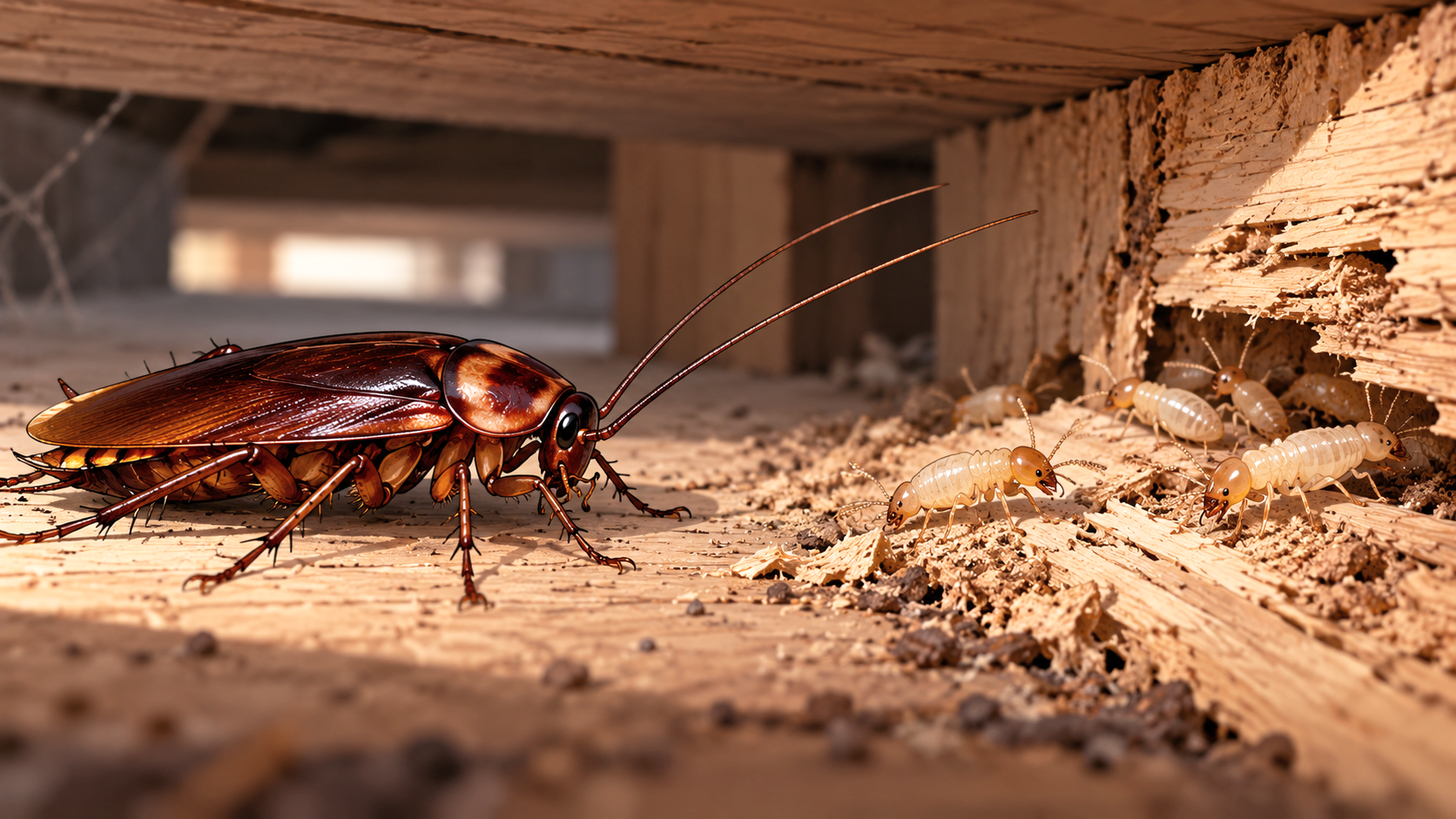
Cockroaches and termites may seem difficult to separate because the two groups are surprisingly close evolutionary relatives. Around a house, however, they usually look very different. A typical cockroach has a flattened, often brown or dark body, extremely long antennae, conspicuous spiny legs, and a head partly covered from above. Termites are usually identified as pale workers or soldiers, or as darker winged reproductives with a broad waist, bead-like antennae, and two pairs of similarly sized wings.
The termite’s caste makes a major difference to what you see. Comparing a cockroach only with the familiar winged termite can leave you unprepared for the pale workers hidden inside wood or soil.
First Work Out What Kind of Termite You Found
Termites live in colonies containing individuals with different roles and appearances. Workers are generally soft-bodied and pale. Soldiers are also commonly pale but have a distinctive defensive head, which may be enlarged and heavily hardened. Reproductive termites look different again. The winged forms, often called alates or swarmers, are darker and possess two pairs of long wings.
Cockroaches do not divide a colony into worker, soldier, and reproductive castes. A young cockroach develops through successive nymphal stages before becoming an adult, retaining the recognizable cockroach body plan as it grows. Termite workers can therefore look far less like an adult cockroach than a termite swarmer does.
Location adds useful context without proving identity. Workers and soldiers usually remain concealed within a colony’s protected environment, while winged reproductives leave established colonies during dispersal flights. Consequently, a homeowner is particularly likely to encounter termites during a swarm or after finding discarded termite wings around windows, doors, or lights.
Winged Termites Carry Four Long, Similar Wings
If the insect has wings, examine all four rather than simply noting that it can fly. A termite swarmer has two pairs of long wings that are approximately equal in length. The wings usually extend well beyond the abdomen and can dominate the insect’s outline. They are temporary equipment: reproductives shed them after their dispersal flight.
Adult cockroaches can also possess two pairs of wings, but their arrangement is different. The forewings cover the more delicate hind wings rather than appearing as four similarly shaped, equally prominent wings. Wing development also varies among cockroach species, with some adults having reduced wings and others possessing fully developed ones.
A pile of detached, similarly sized wings can consequently be valuable termite evidence even when the insects themselves have disappeared. Winged termites are recognized partly by their two pairs of roughly equal-length wings, although the remaining body characters should still be checked.
Their Antennae Create Very Different Profiles
A cockroach carries a pair of long, fine antennae that may approach or exceed its body length. They are among the most conspicuous features in the familiar cockroach silhouette and remain obvious even when the insect is moving.
Termite antennae are considerably shorter relative to the body and consist of a visible sequence of small segments that creates a bead-like appearance. They do not produce the exceptionally long, threadlike profile typical of many cockroaches.
Antennae become particularly useful when wings are missing. A termite reproductive that has already shed its wings can initially be harder to recognize, but its body proportions and shorter segmented antennae remain available for inspection.
Cockroaches Look Flatter and More Heavily Armored
The familiar household cockroach has a broad, flattened body with a firm exoskeleton. Its legs project prominently from the sides and usually bear obvious spines. From above, the pronotum forms a shield behind the head and may partly cover it. Small paired sensory structures called cerci project from the rear of the abdomen as part of the external anatomy of a cockroach.
Termite workers are softer-bodied and lack that combination of a broad shield-like pronotum, heavily spined running legs, and short rear cerci. Their abdomen is more exposed and often lighter in color. A termite reproductive is darker and more heavily sclerotized than a worker, but it still does not acquire the classic flattened cockroach construction.
Color can support an identification only after those structural features are considered. A pale insect is not automatically a termite, and a dark insect is not automatically a cockroach. Termite reproductives can be brown or black, while cockroach coloration varies considerably among species.
A Termite Swarmer’s Body Has a Broad Connection Through the Middle
Termite reproductives have a relatively broad connection between the thorax and abdomen rather than a strongly constricted waist. This feature is frequently used to distinguish termites from winged ants, which have a narrow waist, but it can also help when examining an unfamiliar insect found during a swarm.
Cockroaches have a continuous oval or elongated body profile rather than the characteristic swarmer shape created by a termite’s long wings and broad-bodied form. Their visible legs also tend to appear longer and more heavily spined. If the insect is running rapidly across a kitchen floor with very long antennae and a recognizable cockroach body shape, the overall structure provides more useful evidence than whether it happens to be brown.
Their Similarity Is Not Entirely Accidental
Modern classification places termites within the same evolutionary lineage as cockroaches. Genetic and morphological research has established that termites are nested within Blattodea, with wood-feeding Cryptocercus cockroaches among their closest living relatives. Termites were historically treated as a separate insect order called Isoptera, which is why older references may still present the groups as more taxonomically separate.
Evolutionary relationship does not make the insects difficult to distinguish in an ordinary household encounter. Termites evolved eusocial colonies with specialized castes, while the household species people normally mean by a cockroach retain a very different appearance and way of life. The shared ancestry is scientifically interesting, but visible anatomy remains sufficient for most homeowner-level identifications.
Questions That Resolve Less Obvious Cases
Can a termite be dark brown or black?
Yes. Winged reproductive termites are commonly much darker than pale workers, so dark coloration does not rule out termites. Wings, antennae, body proportions, and the circumstances of the sighting provide stronger evidence.
What if I find an insect with no wings beside a pile of wings?
A termite reproductive may shed its wings after swarming. Finding multiple similar detached wings beside insects with broad bodies and bead-like antennae deserves attention even if the remaining insects are wingless.
Could a baby cockroach look like a termite worker?
A very young cockroach can be small and wingless, but its body remains recognizably roach-like. It has long antennae, prominent legs, and a firmer, more flattened body. Cockroach nymphs also molt repeatedly as they develop rather than functioning as permanent worker castes.
Do cockroaches and termites produce the same kind of eggs?
No. Female cockroaches generally package eggs into structures called oothecae, whose appearance varies among species. The egg case associated with cockroach reproduction is not a termite egg structure.