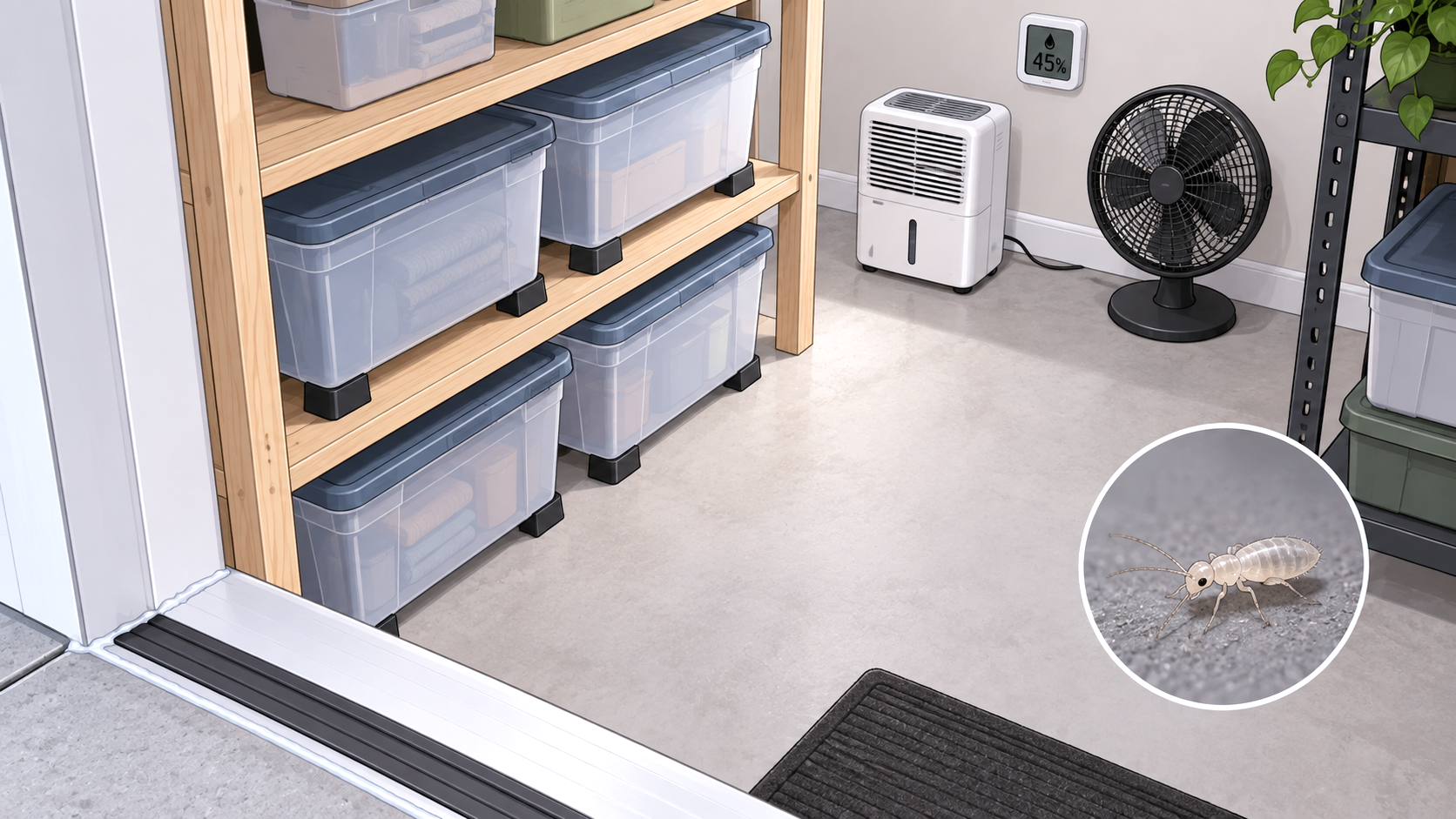
Getting rid of visible booklice is only half the job. If the same damp conditions remain, another population can develop even after you have vacuumed, cleaned, or treated the insects you found. To prevent booklice from coming back, keep indoor humidity around 50% or lower, repair leaks, control condensation, remove damp or moldy materials, and improve airflow in problem areas. Then monitor the places where booklice appeared before. Long-term prevention depends much more on keeping the home dry than repeatedly spraying for insects.
Treat the Moisture Problem as the Main Problem
Booklice are unusually dependent on moisture. Indoor species commonly live in damp, warm, relatively undisturbed places where molds and fungi grow. When humidity remains favorable, removing the insects you can see may only produce a temporary improvement.
The opposite is also useful. Psocids do not survive when relative humidity remains below roughly 45% to 50%. Keeping humidity below 50% also restricts mold growth and booklouse development, which is why drying the environment is recommended over routine pesticide treatment.
Start by measuring humidity instead of guessing from how the room feels. A small digital hygrometer can reveal whether a basement, bathroom, storage room, closet, or other problem area repeatedly becomes humid.
If high humidity is widespread, a dehumidifier can help prevent booklice. If only one small area stays damp, however, look for a local water source rather than assuming the entire house needs dehumidification.
Find Out Why That Part of the Home Was Damp
Humidity readings tell you there is a problem. They do not tell you what caused it.
Check the area where booklice were most concentrated. Look around plumbing, windows, exterior walls, sinks, toilets, showers, appliances, roof penetrations, and other places where water can enter or condense.
Health Canada recommends maintaining indoor relative humidity between 30% and 50% and addressing moisture through ventilation, exhaust fans, dehumidification where necessary, prompt leak repairs, and proper drainage around the building.
Condensation deserves particular attention. A window can stay wet even when no pipe is leaking. Cold-water pipes and cold exterior surfaces can also collect moisture under the right conditions.
Booklice returning to the same location can therefore be useful information. Instead of asking only how the insects entered, investigate why booklice are appearing in that particular part of the house.
Dry Hidden Areas, Not Just Visible Surfaces
A room can look dry while moisture remains behind it.
Water can become trapped inside wall cavities, beneath flooring, behind cabinets, around windows, or inside construction materials. Penn State notes that booklice can persist when moisture is trapped in a wall void and that, in some cases, the cavity itself may need to be opened so it can dry.
This is particularly relevant after a leak, flood, renovation, or construction project. Fresh building materials can retain substantial moisture, which helps explain why booklice sometimes appear in new buildings.
Do not repeatedly paint, caulk, or spray over an area that remains damp without identifying the source. Cosmetic changes can hide staining while leaving the conditions behind the surface unchanged.
When recurring moisture cannot be located, or when a leak may involve a wall, ceiling, roof, or plumbing system, the appropriate building professional may be more useful than another pest treatment.
Make Bathrooms and Kitchens Harder for Booklice to Recolonize
Rooms that routinely generate water vapor need their own prevention habits.
Run an effective bathroom exhaust fan during bathing and long enough afterward to clear excess moisture. Wipe persistent condensation from windows and other surfaces, and investigate grout, plumbing, toilet, sink, and shower areas that repeatedly remain wet.
Kitchen moisture can come from cooking as well as plumbing. Use ventilation when producing substantial steam and deal promptly with water beneath sinks, refrigerators, dishwashers, or other appliances.
These rooms also contain many protected gaps where tiny insects can disappear. Preventing booklice in bathrooms and booklice in kitchens becomes much easier when surfaces and concealed spaces are no longer continually damp.
Ventilation helps because it removes moisture. Fragrance, disinfectant, and repeated surface spraying do not provide the same environmental change.
Stop Damp Cardboard From Becoming a Reservoir
Cardboard deserves attention after a booklice problem.
Wet stored cardboard can support psocids, and household guidance specifically recommends keeping boxes, bags, books, and papers off floors where they are more vulnerable to dampness.
Discard cardboard that has become persistently wet, moldy, or heavily infested. Keep the boxes you need in a dry location, preferably on shelving rather than directly against a basement floor or damp wall.
Clutter matters for another reason. Large stacks of boxes and stored belongings create undisturbed spaces that are difficult to inspect. They can also conceal small leaks and moisture staining.
You do not need an empty house to prevent booklice. You need storage arranged well enough that you can see and correct a developing moisture problem before it supports another population.
Keep Dry Foods Dry and Protected
Booklice are not limited to walls and books.
Some psocids infest stored foods, including grains and other dry products. Their presence in food can be associated with fungal contamination, so food that is already infested should be discarded. Penn State recommends keeping unaffected food dry in tightly closing glass or plastic containers to help prevent future problems.
After finding booklice in a pantry, inspect nearby dry goods rather than assuming the insects came from the room itself. Clean spilled flour, cereal, crumbs, and other material from shelf joints and protected gaps.
Do not spray pesticide onto food to prevent booklice. Likewise, moving contaminated food into a new container does not reverse existing contamination.
The objective is to remove the affected material, clean the storage area, keep replacement products dry, and prevent another suitable food-and-moisture combination from developing.
Do Not Let Mold Become Their Food Supply Again
Booklice and mold often occur together for a reason.
Many indoor booklice feed heavily on molds and microscopic fungi. Dampness therefore helps them in two ways. It provides the humidity they need while encouraging the organisms they eat.
This does not mean mold somehow creates booklice. The insects still have to be present. However, a home that repeatedly supports fungal growth remains more favorable after the original insects have been removed.
Health Canada emphasizes that mold can return when the underlying moisture source has not been corrected. Booklice prevention follows much the same logic.
If mold keeps returning around the same window, wall, ceiling, cabinet, or basement area, focus on why that surface stays damp. Our separate explanation of why mold attracts booklice covers the feeding relationship in more detail.
Vacuuming Helps Reset the Area
Once the moisture source is under control, remove the insects and debris that remain.
Vacuuming is a simple way to physically remove accessible psocids. University of Minnesota guidance specifically lists vacuuming as an option for small numbers, while conservation pest-management guidance also uses vacuuming as a physical pest-removal method.
Pay attention to edges and protected areas where booklice were previously active. Shelf corners, baseboards, windowsills, cabinet joints, and similar locations are more useful targets than repeatedly cleaning an entire room without a reason.
Physical removal does not replace drying. Instead, it gives you a cleaner starting point after environmental conditions have been corrected.
If large numbers reappear after that, treat the recurrence as evidence that something has been missed.
Do Not Depend on Preventive Insecticide Spraying
A booklice-free room does not need to be routinely sprayed to keep it that way.
Household guidance consistently puts moisture reduction ahead of chemical control. Insecticides are normally unnecessary, and they perform poorly as a long-term solution while excessive moisture remains.
That also means there is little reason to rotate through bleach, vinegar, rubbing alcohol, essential oils, powders, and conventional pesticides as preventive treatments.
Even an insecticide capable of killing exposed booklice cannot repair a roof, dry drywall, ventilate a bathroom, or prevent mold from returning.
If an active infestation remains after the environmental problem has genuinely been corrected, that becomes a different question. A spray or insecticide for booklice may have a limited role when its current label permits the pest, treatment site, and application. Routine preventive spraying is not the foundation of recurrence prevention.
Check the Old Hotspots Before You Assume the Problem Is Over
Booklice do not necessarily disappear the day you lower the humidity.
Some psocids can survive temporary dry periods. Canadian conservation guidance describes Liposcelis surviving for a period in dry air by drawing on body water reserves, while continued dry exposure eventually becomes lethal. It identifies sustained dehumidification as the most reliable way to eliminate psocids and the mold associated with damp conditions.
Give environmental control time to work and keep checking the locations that previously had the most activity.
A few sticky traps can help monitor booklice if you want a fixed surface to inspect. Traps should be treated as monitoring devices rather than barriers that prevent insects from returning.
What matters is the trend. Continued heavy activity after sustained drying suggests another damp site, contaminated material, or source may still be present.
Make Booklice Prevention Part of Moisture Maintenance
The best prevention routine does not need to revolve around insects.
Check indoor humidity during humid parts of the year. Use kitchen and bathroom exhaust ventilation. Repair plumbing and roof leaks promptly. Keep gutters and drainage functioning so water moves away from the building, and investigate persistent condensation instead of simply wiping it away every day. These measures also reduce broader indoor moisture and mold problems.
Store moisture-sensitive belongings where you can inspect them. Avoid leaving paper, books, or cardboard in chronically damp areas. Clemson specifically recommends keeping books and paper in well-ventilated, uncluttered locations.
Booklice are easier to prevent when their appearance is treated as an environmental warning. If the home stays dry enough that mold and psocids cannot readily thrive, repeatedly killing individual insects becomes unnecessary.
Questions About Keeping Booklice From Returning
Can booklice come back even after I killed all the ones I saw?
Yes. Removing visible insects does not prove every individual or egg has been eliminated. More importantly, a damp environment can continue supporting any population that remains. Sustained moisture control is therefore more useful than relying on a one-time kill.
How long should I keep running a dehumidifier after booklice disappear?
Base the decision on humidity rather than the date the last insect was seen. If the room naturally remains too humid without dehumidification, continue using the unit as needed to maintain suitable indoor humidity. If a temporary water problem caused the infestation, dehumidification may become unnecessary after the structure has fully dried and the moisture source has been corrected.
Can opening windows prevent booklice?
Sometimes ventilation helps, but only when it actually lowers indoor moisture. Opening windows during hot, humid weather can introduce more moisture instead. A hygrometer is more reliable than assuming outdoor air will always dry the room.
Do I need pest control if booklice keep coming back?
Recurring booklice justify another search for moisture first. If the home has been properly dried and insects continue appearing in significant numbers, professional pest control for booklice can help with identification and locating persistent activity. Building, roofing, plumbing, or moisture specialists may be necessary when the underlying issue is structural rather than entomological.