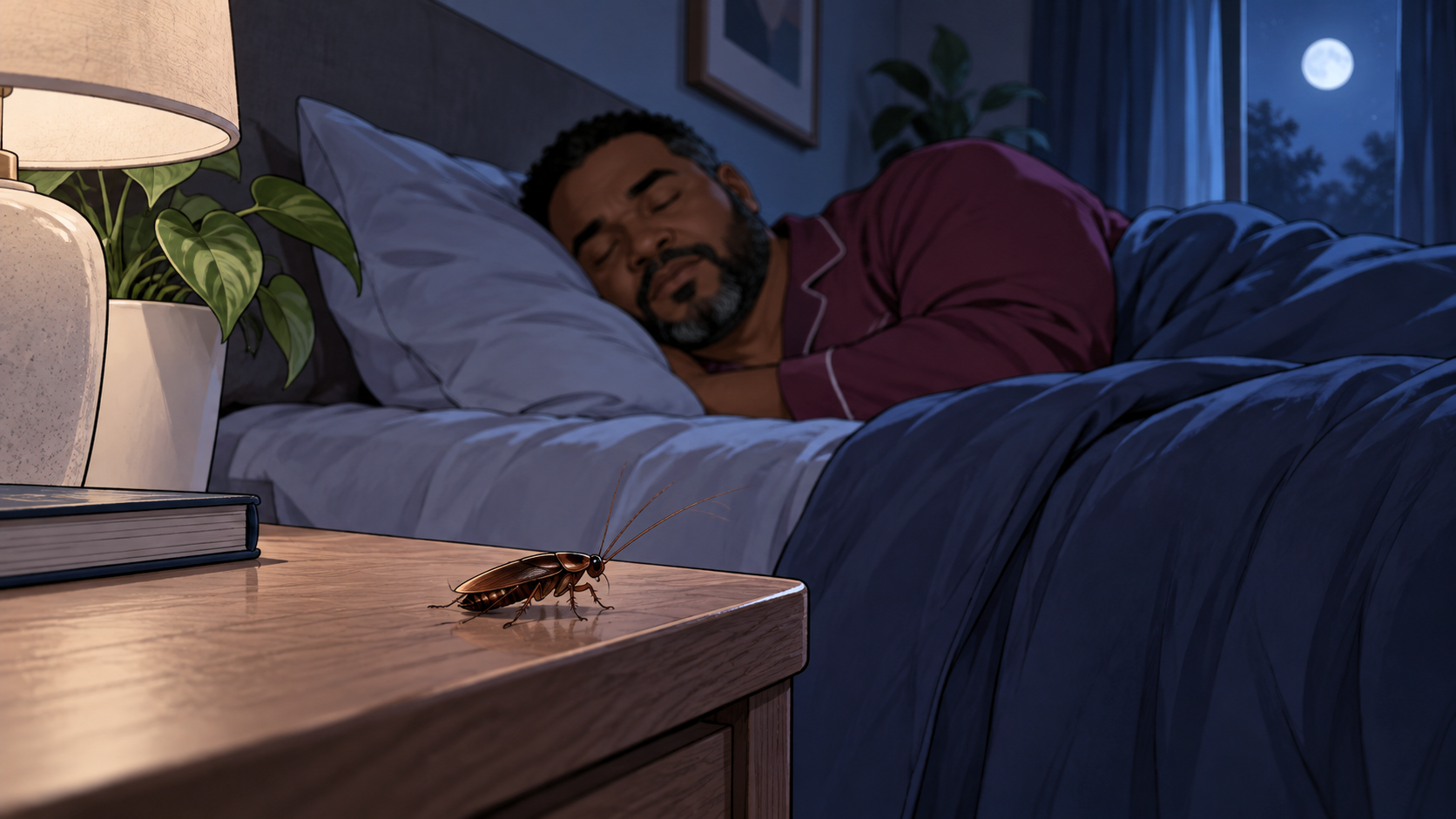
Cockroaches can crawl on people while they sleep, but they do not normally seek out humans as hosts. Accidental contact can occur when cockroaches travel across bedding, furniture, or other surfaces and encounter someone lying still. Such encounters are more plausible when cockroaches are already active in the room, although a single cockroach touching someone does not establish a bedroom infestation.
Cockroaches do not feed on human blood like bed bugs or mosquitoes. A cockroach crossing your arm, leg, or face is not necessarily trying to bite you. Most nighttime contact is better understood as incidental movement, although documented medical cases confirm that cockroaches sometimes enter people’s ears.
Why Cockroaches May Crawl Across a Sleeping Person
A sleeping person remains relatively motionless for long periods, allowing a wandering cockroach to approach without immediately encountering the movement that might otherwise cause it to retreat.
Cockroaches navigate by using their antennae and other sensory structures to detect obstacles, surfaces, and changes in their surroundings. Their movements frequently follow edges and objects rather than uninterrupted paths through open space. The University of California’s cockroach management guidance describes how cockroaches tend to travel along walls and other surfaces, creating predictable movement routes.
If a cockroach reaches a blanket, pillow, or exposed limb along such a route, it may continue moving until physical contact or another disturbance causes it to change direction. That movement does not demonstrate attraction to the person.
The sensory responses that sometimes make cockroaches run toward people can also produce unexpected movements during close encounters. An insect startled near someone’s shoulder might cross the person’s body while attempting to escape.
Although cockroaches possess mouthparts capable of chewing, ordinary contact does not mean feeding has occurred. Their ability to bite human skin is a separate question from whether they occasionally walk across it.
Are Cockroaches More Likely to Touch You While You Sleep?
The overlap between human sleeping hours and cockroach activity makes nighttime encounters possible.
German cockroaches (Blattella germanica) exhibit pronounced daily activity rhythms. A laboratory study published in the Journal of Insect Physiology found that male German cockroaches displayed two nighttime activity peaks under a regular light-dark cycle.
Research on female German cockroach activity rhythms also demonstrated that their movement is influenced by internal circadian regulation and reproductive condition. Cockroaches are therefore not equally active at every hour.
However, researchers have not established a universal probability that a cockroach will crawl on a sleeping person. That would depend on the species, population size, room layout, and whether the insect encounters the person during its movements.
The locations cockroaches use as daytime refuges also influence where nighttime contact can occur. An insect occupying a bedroom furniture gap has different opportunities for encountering a sleeper from one confined to a distant kitchen cabinet.
Can Cockroaches Crawl Into Your Ears While You Sleep?
Although uncommon relative to ordinary insect encounters, cockroaches entering human ears are medically documented.
A retrospective study at Universiti Sains Malaysia Hospital examined 348 patients with foreign objects in their ears. Arthropods accounted for 148 cases, and cockroaches were the most frequently encountered arthropods. The 1999 investigation published in Annals of Tropical Medicine & Parasitology confirms that cockroach entry into the ear canal is a genuine occurrence, although the study does not establish how often it happens among the general population or how many entries occurred during sleep.
A separate case published in Archives of Disease in Childhood described a 16-year-old patient with ear discomfort whose examination revealed a live insect. The family reported a cockroach infestation in their apartment. The clinical report illustrates the importance of direct examination rather than assuming that unusual sensations are caused by insects.
Cockroaches do not intentionally seek human ears as reproductive sites, and there is no evidence that they routinely enter sleeping people’s ears. An ear canal may occasionally be encountered during exploration and provide a confined opening that an insect enters accidentally.
If you experience sudden ear pain, persistent scratching sounds, a sensation of movement, or hearing changes suggesting an insect is inside your ear, seek prompt medical care. Do not insert cotton swabs, tweezers, or other objects into the canal. A 2022 medical review of live insects in the ear warns that improper removal can cause bleeding, infection, or damage to the eardrum.
How Can You Tell Whether a Cockroach Actually Crawled on You?
The strongest evidence is seeing a cockroach on your body, clothing, or bedding at the time of the encounter. Finding one immediately after feeling movement is also useful, although the sensation itself does not establish that the insect made contact.
A crawling sensation can have several causes, including fabric movement, loose hairs, skin irritation, and sensations occurring during the transition between sleep and wakefulness. An unexplained itch or skin mark cannot identify a cockroach as the source.
The appearance of suspected cockroach bites is especially unreliable for establishing contact because no distinctive lesion pattern has been validated for cockroach bites.
Other observations can establish whether cockroaches are moving through the room. A live specimen, a correctly identified photograph, or repeated captures in appropriately placed monitoring traps provides stronger evidence than an isolated sensation.
The Cornell Integrated Pest Management guidance recommends sticky monitors to identify species, determine where activity is concentrated, and observe whether different developmental stages are present. Such monitoring can confirm cockroach activity without assuming that every nighttime skin sensation involves an insect.
How to Reduce the Chance of Cockroaches Crawling on You
Measures that limit direct contact should concentrate on preventing cockroaches from reaching sleeping surfaces and reducing unnecessary opportunities for encounters.
Keep the bed slightly away from walls and avoid allowing blankets or sheets to hang onto the floor. These arrangements reduce some of the direct surface routes a crawling insect might use, although they cannot guarantee complete protection. Bed legs and furniture joints may still provide access, and some cockroach species climb readily.
Avoid keeping food, uncovered drinks, dirty dishes, or food wrappers around the sleeping area. Removing these materials reduces potential resources, although cockroaches may still travel through the room for other reasons.
The U.S. Environmental Protection Agency recommends removing accessible food and moisture sources and sealing cracks as part of integrated pest management. In a bedroom, that can include repairing accessible gaps around baseboards and utility penetrations and reducing unnecessary cardboard or clutter near the bed.
Sticky cockroach monitors can be positioned along wall edges and near suspected movement routes, following the product instructions. Keep them away from children and pets and avoid placing exposed adhesive where it can contact sleeping people. The EPA’s integrated pest-management inspection handbook recommends locating traps along the insects’ normal routes rather than placing them arbitrarily.
Do not spray insecticides, essential oils, or other pest-control products directly onto pillows, mattresses, sheets, or skin to prevent cockroach contact. The EPA’s pesticide safety guidance advises using products only as directed on their labels and avoiding unnecessary pesticide exposure.
These precautions reduce opportunities for contact but do not substitute for addressing an active infestation elsewhere in the building.
What if a Cockroach Crawls on You While You Are Asleep?
If you wake and find a cockroach on your body, move it away without rubbing it against your skin or crushing it onto the bedding. Wash any directly contacted skin with soap and water, particularly if there is visible contamination.
An encounter without broken skin generally does not require medical treatment. If you notice an actual injury, its care should depend on the symptoms and condition of the skin rather than assuming the cockroach caused it. The recommended care for a suspected cockroach bite is based on ordinary minor-wound management and recognition of complications.
If the insect was seen on your bedding, inspect the immediate area for additional activity and note where it went. The distance cockroaches can move between rooms means that a single individual encountered in a bedroom may have originated elsewhere. Repeated observations or trap catches provide a more useful indication of whether the room is regularly occupied.
Frequent nighttime contact is a stronger reason to investigate promptly than one isolated encounter. A licensed pest-management professional can assess persistent activity, especially when cockroaches repeatedly reach occupied sleeping areas despite reasonable preventive measures.