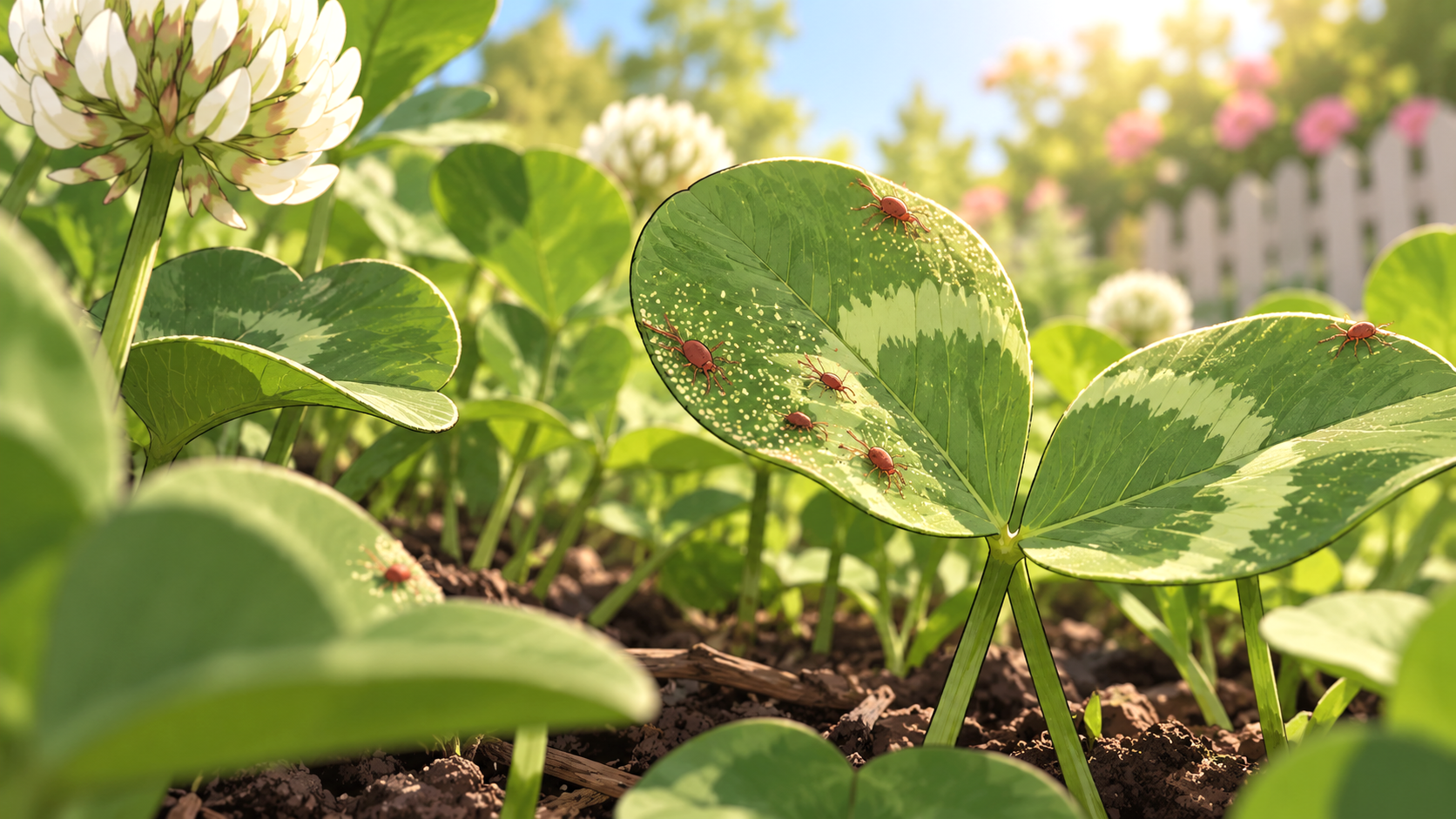
Clover mites really do feed on plants, so calling them completely harmless would be inaccurate. They can injure plants, particularly when large populations feed heavily, but the seriousness of that injury varies enormously with the plant, growing conditions, and number of mites present. A few clover mites on an established garden plant are a very different situation from a dense population feeding on young or vulnerable growth.
That range explains why descriptions of clover mites sometimes appear contradictory. Some references treat them mainly as nuisance pests, while agricultural guidance recognizes members of the same plant-feeding group as capable of significant crop damage. The sensible response is not to assume that every mite threatens the plant, nor to dismiss a heavy infestation simply because clover mites are better known for wandering onto buildings.
Feeding Takes Something From the Plant
Clover mites are not merely resting on leaves. They are phytophagous mites that puncture plant cells and remove their contents, so sufficiently intense feeding reduces healthy plant tissue. Their host range is broad and includes grasses, clover, ornamental flowers, strawberries, dandelions, salvia, primrose, and numerous other plants. That breadth is consistent with their plant-based diet and helps explain why they can occur throughout lawns and landscaped areas rather than remaining tied to clover.
Most garden encounters do not warrant assuming serious injury. Clover mites are often especially abundant around lush, heavily fertilized vegetation, where a healthy established plant may tolerate some feeding without an obvious decline. At the other end of the scale, large Bryobia populations are documented as significant pests of young crops and pastures, with vulnerable seedlings capable of being stunted or lost under substantial feeding pressure. Population size and the condition of the host therefore matter far more than simply finding a mite on a leaf.
Young Growth Has Less Room for Heavy Feeding
A mature plant with plenty of healthy foliage has considerably more tissue available than a newly establishing seedling. Agricultural experience with Bryobia mites shows that the greatest losses can occur during early establishment, when concentrated feeding reduces seedling survival and slows development. Gardeners should therefore pay closer attention when numerous mites occupy seedlings, transplants, or other limited new growth rather than applying the same level of concern to every established plant carrying a few mites.
Plant stress can narrow that margin further. Heat, drought, transplant shock, disease, or another pest can already be demanding resources from the plant before mite feeding is added. The presence of clover mites does not prove they caused an unhealthy plant, however, and treatment decisions should not be based on mite numbers alone. The separate guide to identifying clover mite damage on plants covers the feeding evidence that should accompany a diagnosis rather than treating any declining plant as a clover mite casualty.
Different Plants Do Not Face an Identical Risk
Clover mites use a surprisingly large collection of hosts, but host status does not mean every plant suffers equally. Government agricultural guidance reports stronger feeding preferences among some Bryobia mites for broadleaf plants such as clover, lucerne, lupins, vetch, and canola, while other hosts are attacked less readily. In residential landscapes, clover mites are commonly associated with turfgrass and vegetation near buildings. A mite being capable of feeding on a species therefore tells you less than the combination of population pressure, plant age, host suitability, and actual injury.
That variability is also why broad statements about one particular plant should be handled separately. The question of clover mites on tomato plants requires evidence specific to tomatoes rather than borrowing a damage verdict from clover, ornamentals, or agricultural crops. Likewise, turf has its own response to mite feeding, covered separately under clover mite lawn damage.
Finding Them Does Not Automatically Call for Treatment
Treatment makes more sense when confirmed clover mites are numerous and feeding injury is developing than when a few individuals happen to be present on vigorous plants. Landscape IPM guidance recognizes clover mites as plant pests but also recommends management within a broader integrated pest management approach, rather than treating every sighting as an emergency. That restraint also protects beneficial organisms, since clover mites have natural enemies that can be disrupted by unnecessary broad-spectrum pesticide use.
Correct identification comes first. Clover mites belong to the spider-mite family, but they should not be assumed to behave exactly like every other member of it. Their appearance and unusually long front legs help confirm the pest, while their lack of the conspicuous silk associated with some spider mites is covered in whether clover mites make webs. Once the mite and feeding injury are both established, the condition of the plant can determine whether monitoring is enough or intervention is justified.
Plant Questions That Change the Decision
Can a healthy plant recover after clover mite feeding?
Yes, if the growing points remain healthy and the plant retains enough functioning tissue. Recovery depends on the severity of feeding and the plant’s overall condition rather than the mere presence of mites.
Are seedlings more vulnerable than mature plants?
They can be. Young plants have relatively little foliage and root development, so substantial feeding represents a larger loss of their available tissue.
Does fertilizing an affected plant help it recover?
Do not automatically add fertilizer because clover mites are present. Clover mites can become particularly numerous in heavily fertilized, vigorously growing vegetation, so fertilization should follow the plant’s actual nutritional needs rather than being used as a default mite response.
Can clover mites kill a plant?
Severe Bryobia feeding has been documented to reduce seedling survival in susceptible agricultural hosts. Whether an individual garden plant faces that level of risk depends on the host, its condition, and the intensity of the infestation.
One thought on “Are Clover Mites Harmful to Plants?”