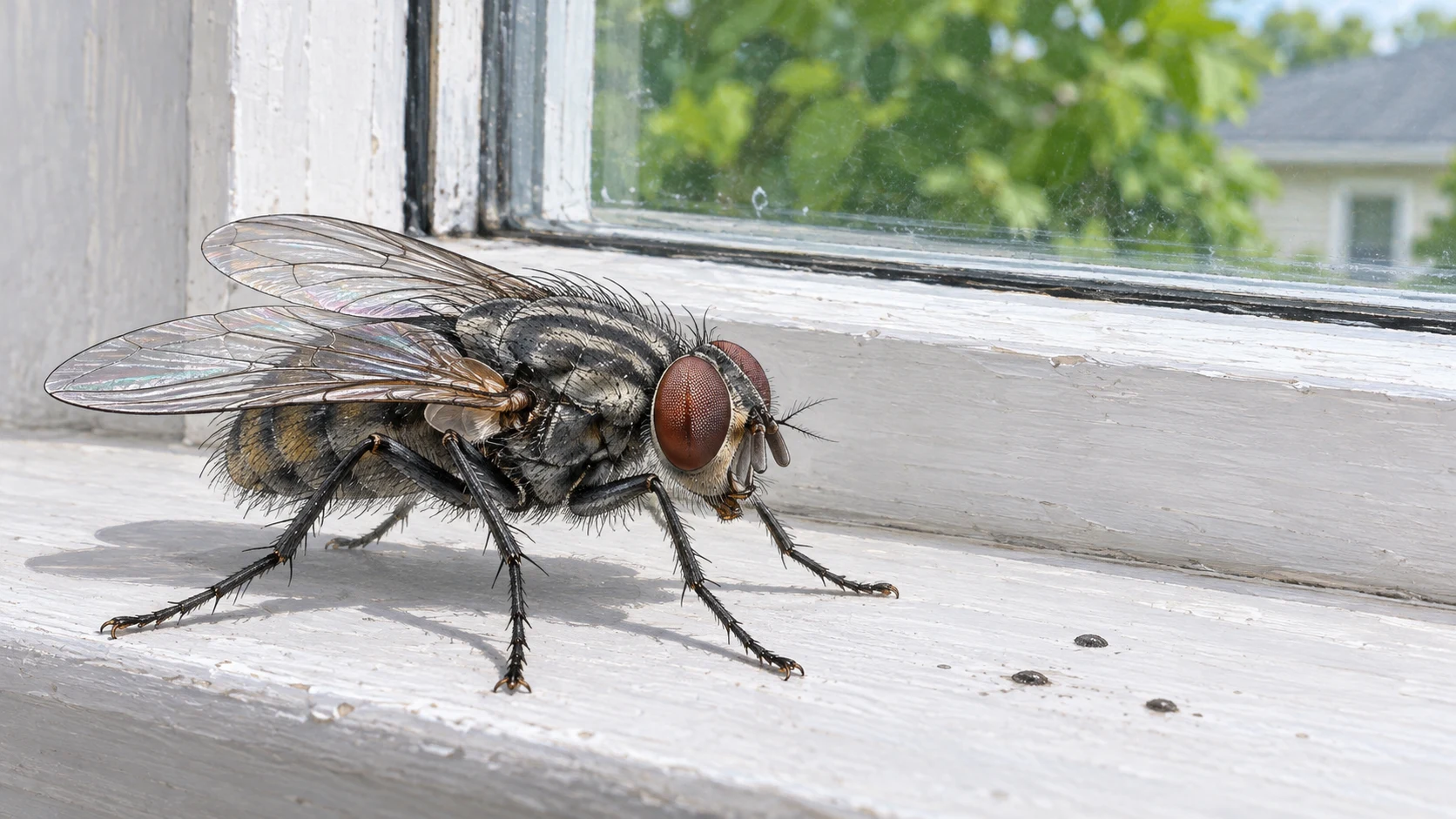
House flies can poop when they land on a surface, but they do not necessarily defecate every time they touch something. The common house fly (Musca domestica) regularly deposits small amounts of fecal material as it moves, feeds and rests. These deposits can accumulate on windows, walls, ceilings and other places where flies spend time.
The claim that a house fly poops every time it lands is an exaggeration. Defecation is a normal part of the insect’s digestive activity, not a compulsory response to landing. A fly may settle on a surface, walk around and leave without depositing anything.
House flies can also leave regurgitated liquid behind. Both substances contribute to the small marks commonly called fly specks, although they originate from different parts of the digestive system.
Why House Flies Leave Droppings on Surfaces
Like other animals, house flies produce waste after processing food. Material that is not absorbed during digestion passes through the digestive tract and can be expelled as feces.
Adult house flies feed on liquids and material they can dissolve into liquid form. Their feeding habits allow them to obtain nutrients from many substances, including food residues and decomposing organic matter.
As digestion proceeds, the insect periodically eliminates waste. It does not need to be eating at the moment this happens. A fly may deposit feces while resting on a wall, walking across a window or spending time on another surface.
This behavior is well documented in house fly biology and household identification, which describes the fecal spots these insects leave where they have walked.
The amount deposited during an individual event is small. People are therefore more likely to notice accumulated spotting than to observe a single fly defecating.
Does a House Fly Poop Every Time It Lands?
No reliable scientific evidence establishes that every house fly landing results in defecation.
Landing and defecating are separate activities. A house fly may land to rest, investigate a surface, feed or move between locations. None of those activities requires it to release feces immediately.
The insect’s digestive state also matters. A fly that has recently fed may have different digestive activity from one that has not consumed food for some time. However, there is no established household rule that predicts defecation from the number of seconds a fly remains stationary.
A house fly that touches a window and immediately flies away may leave nothing behind. Another resting in the same location for an extended period may deposit waste.
The documented feeding and resting behavior of house flies includes both fecal and regurgitation deposits, particularly on surfaces where insects repeatedly gather. That evidence supports the existence of the behavior, not the claim that it happens during every landing.
Statements such as “a fly poops as soon as it touches anything” or “every landing leaves a dropping” should therefore be treated as unsupported generalizations.
What Can You Actually Conclude From a Landing?
| What you observe | What it establishes | What remains unknown |
|---|---|---|
| A fly briefly lands and leaves | The insect contacted the surface | Whether it defecated |
| A fly walks across a surface | Several points of contact occurred | Whether any fecal material was deposited |
| A fly rests in one place for several minutes | The insect remained at that location | Whether defecation occurred during that period |
| A visible droplet appears near the rear of the fly | A deposit may have been released | Its composition without closer examination |
| Small marks accumulate where flies regularly rest | Repeated fly activity may be leaving deposits | Which individual visits produced them |
The distinction is useful because people often interpret a fly’s presence as proof that it has deposited waste. Without directly observing defecation or examining a deposit, that conclusion is not justified.
How Does a House Fly Defecate?
House fly feces leave the body through the anus at the rear of the abdomen. The material has already passed through the digestive tract.
The insect does not need to adopt an elaborate posture or stop flying for an extended period before defecating. A deposit may be released during an otherwise ordinary period of activity.
Its appearance and consistency can vary with what the fly has consumed and the amount of liquid in its waste. Small deposits may dry quickly on exposed surfaces.
The biological process should not be confused with regurgitation, which involves bringing previously ingested liquid back toward the mouthparts.
These two forms of deposition are sometimes grouped together because both can leave visible marks, but they are not interchangeable.
Fly Poop and Fly Vomit Are Different Deposits
House flies can leave two principal types of digestive deposits: feces expelled from the rear of the body and regurgitated liquid released through the mouthparts.
Regurgitation occurs when a fly brings stored liquid back toward its mouth. It may use that liquid during feeding or produce a droplet during a behavior known as bubbling.
Defecation, by contrast, eliminates material that has passed through the digestive system.
Both can occur while a fly occupies the same general area, and both can contribute to accumulated surface spotting.
A fly-management publication describing fecal and regurgitation deposits distinguishes darker fecal spots from lighter marks associated with regurgitated liquid. Those descriptions are useful background, but color alone cannot reliably identify an individual deposit.
The mechanics of why house flies regurgitate liquid are different from defecation and deserve separate consideration.
A fly does not have to vomit in order to poop, and it does not have to poop when it regurgitates. Either behavior can occur independently.
Where Do House Flies Commonly Leave Fecal Deposits?
House flies frequently rest on walls, ceilings, window frames and other exposed surfaces. Repeated visits can lead to accumulations of small deposits in those locations.
Their resting preferences vary with temperature, lighting, air movement and the surrounding environment. During the day, flies may gather on sunlit surfaces. At night, they often move to elevated resting locations.
The resting behavior of house flies in buildings helps explain why deposits may appear above eye level, even when flies are most noticeable around garbage or food during the day.
Common locations include window frames, upper walls, ceiling fixtures, sheltered corners and surfaces near areas of repeated fly activity.
The presence of deposits can indicate that flies have been using a particular location, but it does not establish where they originally developed. Adults may have entered from outdoors or traveled from another part of the property.
A concentration of marks on one windowsill may reflect repeated resting there rather than an infestation originating inside the window.
For the appearance of these marks, including how they differ from other household stains, house fly dropping identification covers the relevant visual details.
Can House Flies Poop While Walking?
Yes. A house fly does not have to remain motionless to release fecal material.
The insect may deposit waste during normal movement across a surface. This is one reason spotting can appear along areas where flies repeatedly walk rather than only where they remain stationary.
However, observing a fly walking does not establish that it left droppings. Its feet may contact the surface without any digestive material being released.
If a fly walks across a table and no deposit is visible afterward, you cannot conclude with certainty that defecation occurred or did not occur. Individual deposits may be difficult to notice.
The broader question of what happens when a house fly lands on food includes physical contact, feeding and possible digestive deposits. Those events should not be treated as automatic consequences of every visit.
Do House Flies Poop More Often After Eating?
Feeding supplies material that eventually passes through the digestive system, so food intake is relevant to subsequent waste production.
However, it would be misleading to assign a fixed defecation schedule to every house fly. The amount and composition of food, the insect’s physiological condition and the surrounding environment can affect digestive activity.
Research on house fly behavior has documented the production of fecal and regurgitation spots, but those observations do not establish a dependable number of droppings per meal or per landing for ordinary household conditions.
A fly may feed, move elsewhere and deposit feces later. Another may release waste while remaining near a feeding site.
The timing of defecation therefore cannot be reconstructed simply by watching where a fly lands.
Claims that house flies always defecate immediately after eating, or that they produce a particular number of droppings every minute, require specific experimental support before they can be treated as facts.
Can Fly Droppings Show Where House Flies Spend Time?
Accumulated deposits can provide useful evidence of repeated fly activity.
If spotting becomes concentrated around a particular window, overhead fixture or sheltered wall, that area may be serving as a regular resting location.
The pattern can be especially informative when flies are not present during an inspection. Some insects may have moved elsewhere, while the marks remain.
However, deposits do not provide an exact count of flies. One insect may visit the same location repeatedly, and several insects may contribute to the same accumulation.
Regurgitation spots can also be mixed with fecal deposits, making it unreliable to count every mark as one defecation event.
When monitoring a persistent problem, use actual fly sightings or appropriately positioned traps rather than attempting to calculate population size from spots alone. Monitoring house flies after treatment explains how repeated observations can establish whether activity is increasing or declining.
For an ordinary household, spotting is best treated as evidence of where flies have spent time, not as a precise measurement of infestation severity.
What Should You Do About Repeated Fly Deposits?
If marks continue appearing after a surface has been cleaned, determine whether house flies are regularly using that location.
Observe the area during the day and, where practical, check nearby resting surfaces. The insects may be entering through a frequently opened door or window rather than developing inside the room.
Clean affected household surfaces using a method appropriate for the material. Food-contact surfaces require cleaning and, where appropriate, sanitizing before reuse.
Avoid applying insecticides merely because deposits are present. Removing visible adults without addressing repeated entry or suitable breeding material may leave the underlying problem unchanged.
Persistent activity around a kitchen warrants attention to accessible waste and the routes insects use to enter. Finding the source of house flies in the kitchen can help separate repeated outdoor entry from conditions that may support continuing fly activity.
The purpose of examining deposits is to understand where flies are spending time and whether the problem continues. It is not necessary to identify the contents of every individual mark.
Common Questions About House Fly Defecation
Do house flies poop as soon as they land?
They can, but there is no reliable evidence that they do so during every landing. A fly may land, rest or walk away without releasing feces.
Can a house fly poop without eating at that moment?
Yes. Defecation eliminates material that has already passed through the digestive system. A fly does not need to be actively feeding when it releases waste.
Is every fly speck a dropping?
No. House flies can leave both fecal deposits and regurgitated liquid. Marks collectively described as fly specks may include either type.
Can you count house flies by counting their droppings?
No. The number of deposits does not correspond directly to the number of insects. Individual flies can leave multiple deposits, and the marks may include regurgitation spots.
House Flies Defecate Regularly, but Not on Every Landing
House flies produce fecal deposits during their normal digestive activity, and those deposits can accumulate wherever the insects repeatedly walk or rest.
There is no established rule that a house fly must poop each time it touches a surface. Landing, feeding, regurgitating and defecating are distinct activities that may occur separately.
When small marks repeatedly appear in the same location, they can help identify areas of frequent fly activity. They cannot reveal exactly how many flies were present or prove that every landing produced waste.