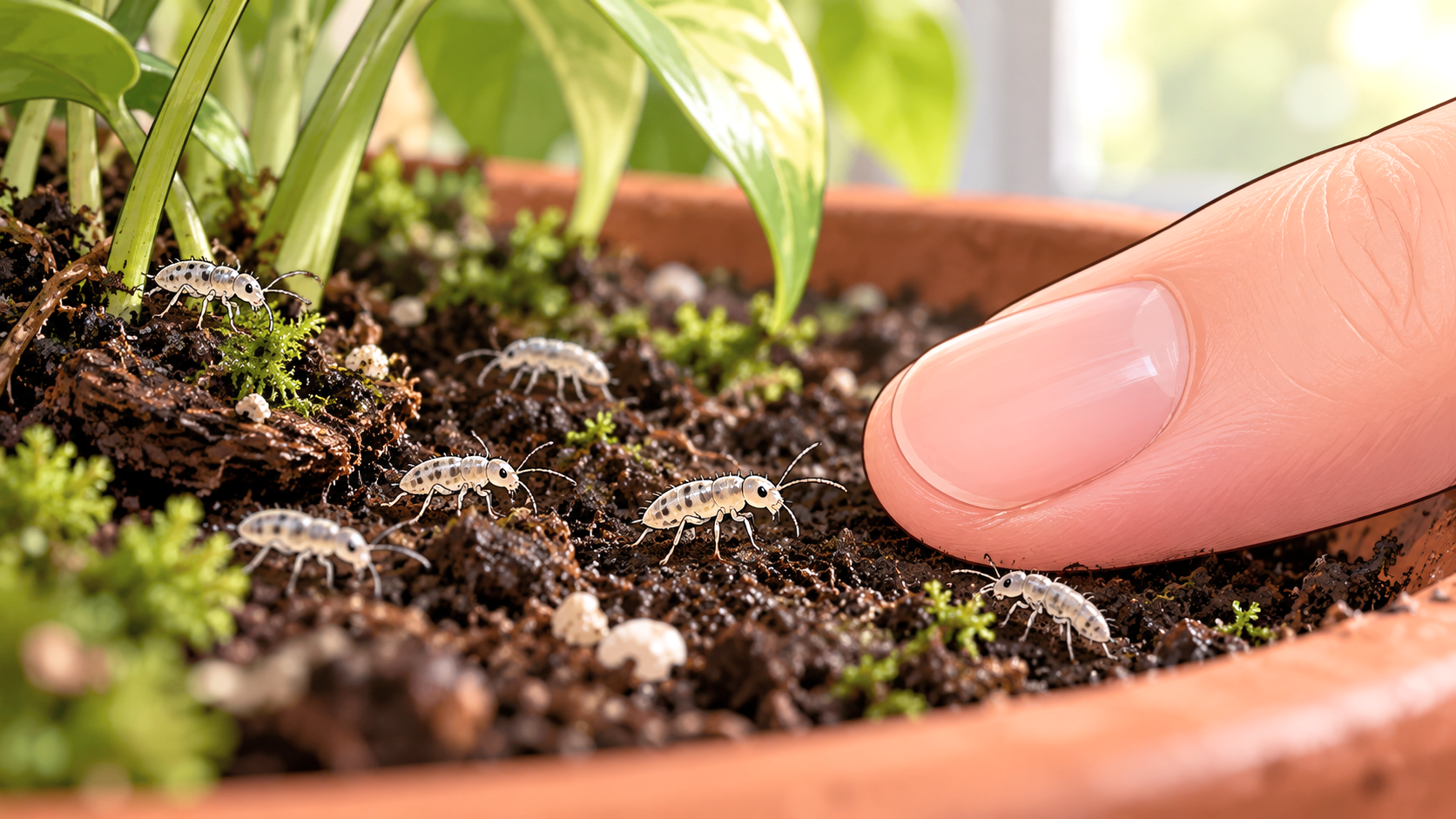
Springtails have an unfortunate nickname problem. Some are called “snow fleas,” and many species jump when disturbed. A tiny jumping animal discovered near your skin can therefore look suspiciously like something built to bite. The resemblance stops there.
Springtails do not bite humans. They do not sting, feed on human blood, or live as parasites on people. If you have unexplained bites, welts, persistent itching, or a rash while springtails are present, the skin symptoms should not automatically be attributed to the springtails.
Springtail Mouthparts Are Not Used to Bite People
Springtails are tiny arthropods in the group Collembola. Their feeding biology is centered largely on fungi, algae, microorganisms, pollen, and decaying organic material rather than animal blood. Canadian biodiversity information describes springtails feeding primarily on fungi, decaying plants, and microorganisms, while household pest guidance consistently classifies them as harmless to people.
Their mouthparts vary among species because springtails consume different foods, but this variation does not turn household springtails into human-feeding pests. Current entomological guidance states that springtails do not bite or sting people, and Connecticut’s state agricultural research agency additionally reports that they are not associated with contact dermatitis in humans.
Jumping Springtails Are Easily Mistaken for Fleas
A springtail can disappear from one spot and land somewhere else almost instantly. Most have a forked structure called a furcula folded beneath the abdomen. Releasing it propels the animal away from danger. That movement explains both the springtail name and much of the confusion with fleas.
The two animals behave very differently around people. Fleas are blood-feeding parasites and can bite humans and other mammals. Springtails are moisture-associated organisms that do not bite people or pets. They may jump onto clothing or skin accidentally when numerous, but landing on a person is not feeding. Their small size also makes identification by color alone unreliable, so repeated jumping should be considered alongside body shape and where the animals are occurring.
Skin Marks Need Their Own Explanation
Finding springtails and developing an itchy spot at roughly the same time establishes proximity, not cause. Many skin conditions and environmental exposures can produce redness, itching, bumps, or irritation, and some genuinely biting arthropods are small enough to be overlooked. A springtail infestation should not be used to diagnose those symptoms.
This becomes particularly important when visible marks persist after the springtails disappear or when no specimen has been reliably identified. Government guidance on insect bites and their prevention focuses on established biting pests such as mosquitoes, ticks, fleas, and flies rather than springtails. If a skin reaction is severe, spreading, infected-looking, accompanied by other concerning symptoms, or simply remains unexplained, medical assessment is more appropriate than continuing to treat the home on the assumption that springtails are biting.
Health disclaimer: This article provides pest-identification information, not a diagnosis of skin symptoms. Unexplained or concerning skin reactions should be assessed by an appropriate healthcare professional.
Large Numbers Indoors Point Toward Moisture, Not a Human Host
Springtails often become conspicuous in bathrooms, basements, around windows, near plumbing, in damp soil, and beside other moisture sources. Their continued indoor presence is strongly associated with damp conditions. State IPM guidance recommends reducing moisture and excess organic matter, while household guidance notes that fixing leaks, drying affected areas, and lowering excess humidity can remove the conditions supporting them.
That environmental dependence explains why springtails may repeatedly appear near people without feeding on them. A humid bathroom floor, wet basement edge, overwatered plant, or damp foundation can support the population. The insects are exploiting the moisture and associated food sources rather than seeking a person. Consequently, springtails in potted plants can remain concentrated around wet potting media even though people are nearby, and persistent indoor activity is better investigated as a moisture problem than as a biting-pest infestation.
Questions About Springtails and Skin Contact
Can springtails crawl on your skin?
Yes. A springtail can accidentally land or crawl on a person just as other tiny outdoor arthropods can. Physical contact does not mean it is biting, feeding, or infesting the body.
Do snow fleas bite?
No. “Snow flea” is a common name applied to certain cold-active springtails, not true fleas. Maine’s state forest service specifically notes that snow fleas do not bite.
Can springtails live on humans?
Springtails are not human parasites. Their normal habitats include soil, leaf litter, decaying vegetation, fungi-rich material, and other damp environments. They do not establish a normal life cycle by living and feeding on the human body.
Should I use insect repellent because I have springtails?
Springtails are not biting insects, so applying personal insect repellent to prevent springtail bites addresses a risk they do not present. Indoor populations are more effectively approached by correcting the damp conditions supporting them.