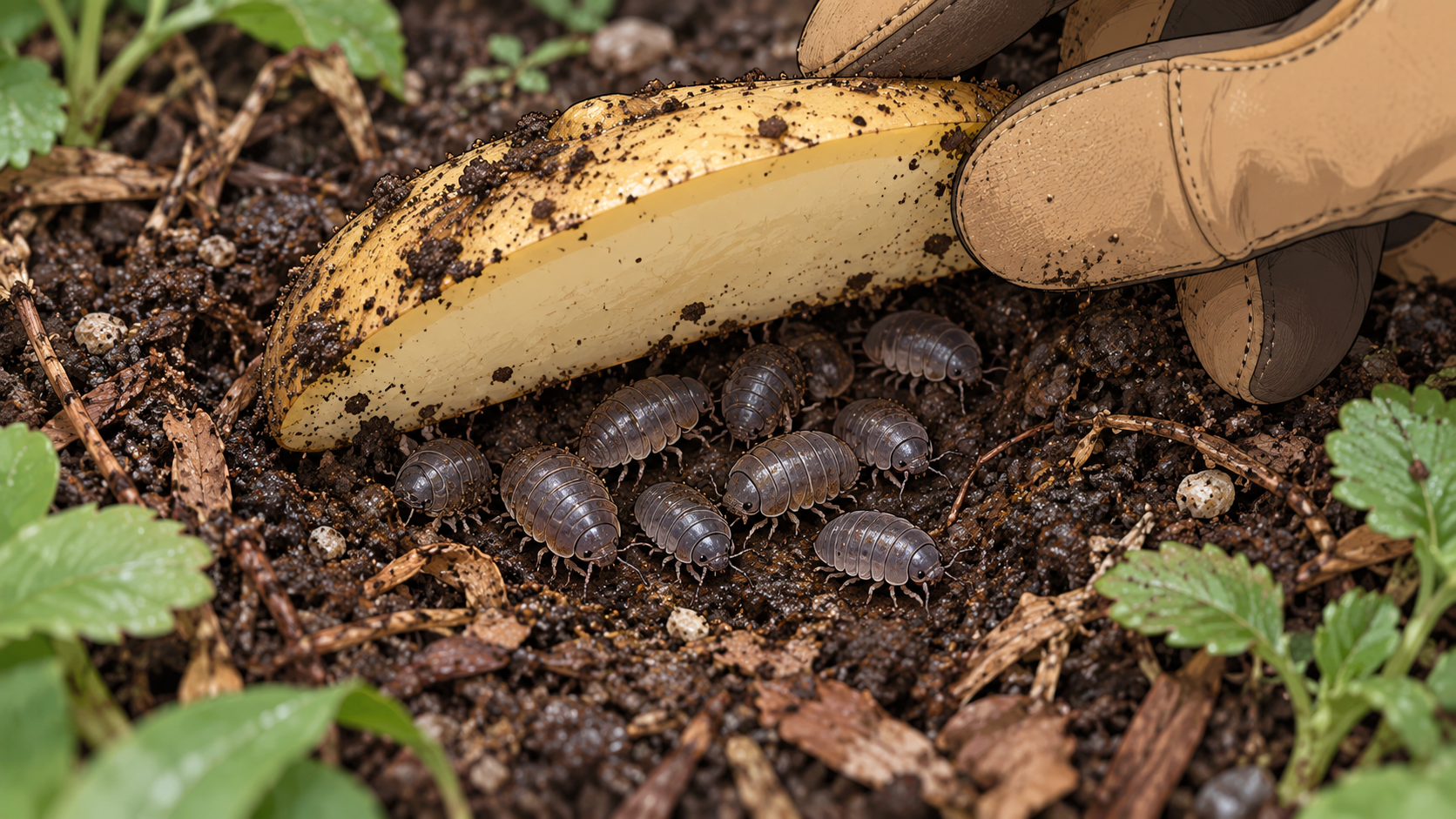
Roly-poly traps can catch or concentrate roly-polies, but they rarely solve a large population problem by themselves. Damp shelter traps can gather pillbugs for collection, food baits can attract feeding individuals, and sticky traps can reveal where they are moving. Their usefulness depends on placement and what you expect the trap to accomplish. Catching ten pillbugs proves that a trap captured ten pillbugs. It does not establish that the surrounding population fell enough to prevent further plant damage or indoor sightings. Traps are strongest as localized collection and monitoring tools.
A Damp Shelter Can Turn Their Hiding Behavior Into a Simple Trap
One of the simplest approaches requires no manufactured trapping mechanism. Place a board, piece of damp newspaper, folded cardboard or similar cover against the soil and inspect beneath it later. Roly-polies naturally seek humid, protected spaces during periods when exposed conditions are less favorable, so an artificial shelter can concentrate animals that were already moving through the area.
This approach matches their ecology closely. Terrestrial isopods select microhabitats partly in response to humidity, and experiments have documented strong behavioral responses to moisture and desiccation risk. Their ordinary daytime sheltering and nighttime activity also make a covered surface on damp ground an attractive refuge.
The cover does not kill the animals or continuously remove them. It becomes a collection trap only when you lift it and remove the roly-polies underneath. Repeated checking is therefore necessary if population reduction is the objective. Similar boards can be useful for monitoring because they provide a standardized location to inspect rather than requiring a search through an entire bed.
Placement matters more than the number of shelters scattered around the property. Put them close to the location where activity needs to be measured or where confirmed feeding is occurring. A shelter far from the affected plants may successfully attract roly-polies while telling you little about the animals using the problem area.
Food Baits Can Attract Roly-Polies, but Attraction Is Not Population Control
Roly-polies respond to suitable food, so vegetables and other organic materials are sometimes used as bait. Potato pieces are commonly suggested for monitoring soil and litter arthropods, and decaying plant material is consistent with the normal feeding habits of roly-polies. A hollowed potato, piece of vegetable or comparable bait placed against moist soil can attract feeding individuals that can later be collected.
Food preference complicates comparisons between baits. Armadillidium vulgare does not consume all plant material equally; feeding experiments found clear differences in consumption among different plant species and stages of decomposition. A bait that performs well in one setting may compete poorly with abundant leaf litter or other attractive food already present nearby.
Bait condition can also change over time. Fresh plant material loses water, decomposes and becomes colonized by microorganisms, altering both its physical condition and potential attractiveness. Leaving food indefinitely can therefore turn a temporary bait into additional organic debris. Check and replace or remove it rather than assuming that an old piece of vegetable remains equally effective.
Most importantly, successful baiting measures attraction. Unless the captured animals are removed, a food bait may simply concentrate them temporarily. Even repeated removal cannot guarantee suppression when a large surrounding population continues supplying new individuals.
Sticky Traps Are Better at Showing Movement Than Solving the Source
Sticky traps can catch roly-polies that walk across them, particularly when positioned along edges where the animals are already traveling. Indoors, this makes them useful for locating activity around basement walls, exterior doors, utility penetrations and other suspected access points. If one monitor repeatedly catches animals while traps elsewhere remain empty, the pattern can help narrow the search for an entry route.
Trap placement should follow the animal’s movement rather than the center of an open room. Many crawling arthropods move along structural edges, and sticky monitoring devices are commonly positioned against walls and near suspected pest activity. Roly-polies entering buildings usually arrive through ground-level openings, so monitoring near the areas associated with indoor roly-poly entry is more informative than random placement.
A sticky trap cannot correct the condition producing repeated arrivals. If animals are continually entering through a door gap, the trap intercepts only those that contact its adhesive. Likewise, persistent basement moisture can remain unchanged while a monitor continues accumulating pillbugs. Indoor management therefore depends on removing current roly-polies, correcting dampness and excluding new arrivals rather than expecting monitors to perform those functions. Use sticky traps where children and pets cannot contact the adhesive, and follow the manufacturer’s placement and disposal directions.
Traps Can Help Confirm Whether Roly-Polies Are Near Damaged Plants
Garden traps have diagnostic value when chewing damage has several possible causes. A shelter placed beside affected seedlings can establish that roly-polies are active in the immediate area, while repeated nighttime observations can provide stronger evidence of feeding. This is more useful than finding pillbugs somewhere else in the garden and assuming they caused the injury.
Trap counts still need careful interpretation. Agricultural research involving A. vulgare found that abundance was not consistently associated with soybean damage or seedling emergence. Higher isopod numbers did not reliably predict greater crop injury. A trap containing many pillbugs therefore indicates activity, not automatically economic or horticultural damage.
Plant evidence remains necessary. If susceptible seedlings are being chewed and roly-polies are repeatedly found at the feeding sites, trapping can contribute to the diagnosis. The actual symptoms and competing culprits need to be considered when identifying roly-poly damage on plants.
Trap Placement Changes What the Results Mean
A roly-poly shelter trap works best where its conditions resemble a refuge the animal would naturally use. Contact with the ground is important, and a shaded location that retains some humidity is more suitable than an exposed object baking on dry soil. This follows from the strong association between terrestrial isopods and moist protected microhabitats.
For monitoring, consistency matters. Use the same trap type, location and checking interval when comparing activity over time. A count of five animals beneath a board inspected after one night cannot meaningfully be compared with twenty beneath another board left undisturbed for a week. Weather can also shift activity independently of population size, particularly when rainfall or humidity changes how readily pillbugs move across the surface.
Indoor monitors require the same discipline. Moving traps every day makes patterns difficult to interpret. Marking the location and checking at regular intervals gives a clearer picture of whether activity is declining or remains concentrated at a particular structural edge.
A Trap Can Work Perfectly Without Fixing the Underlying Problem
Roly-polies can be numerous wherever moisture, shelter and organic matter support them. A trap samples or removes only part of that population. If favorable habitat remains extensive, animals from nearby refuges can continue entering the trapping area.
Garden management consequently uses trapping as one possible component rather than the entire response. Where confirmed feeding is substantial, reducing favorable conditions and protecting vulnerable plants address factors a trap cannot change. The same limitation applies indoors when structural openings or persistent moisture continue producing new sightings.
This limitation is particularly important when evaluating commercial products. A package containing captured pillbugs demonstrates capture, but meaningful control requires a different measurement: whether the unwanted activity, plant injury or indoor sightings decline. Claims about a trap should therefore be judged against the outcome it promises, not simply its ability to catch individual animals.
Questions That Help You Use Roly-Poly Traps Properly
How often should a shelter trap be checked?
Daily inspection is practical when the goal is collection or short-term monitoring. Leaving a shelter untouched for long periods makes it harder to know when the animals arrived and allows conditions beneath it to change.
Can a trap attract roly-polies that were not previously near my plants?
Food and damp shelter can attract nearby individuals, so a trap is not a neutral census of every roly-poly in the surrounding area. Its catch reflects both local activity and the attractiveness of the trap.
Will roly-polies escape from an uncovered container trap?
Possibly. Their ability to climb rough surfaces means container material and construction affect containment. A textured-sided container cannot be assumed to hold every animal that enters.
Does an empty trap prove there are no roly-polies nearby?
No. Placement, moisture, weather, bait condition and competing shelter can all affect catches. An empty trap shows only that none were captured under those particular conditions during the monitoring period.