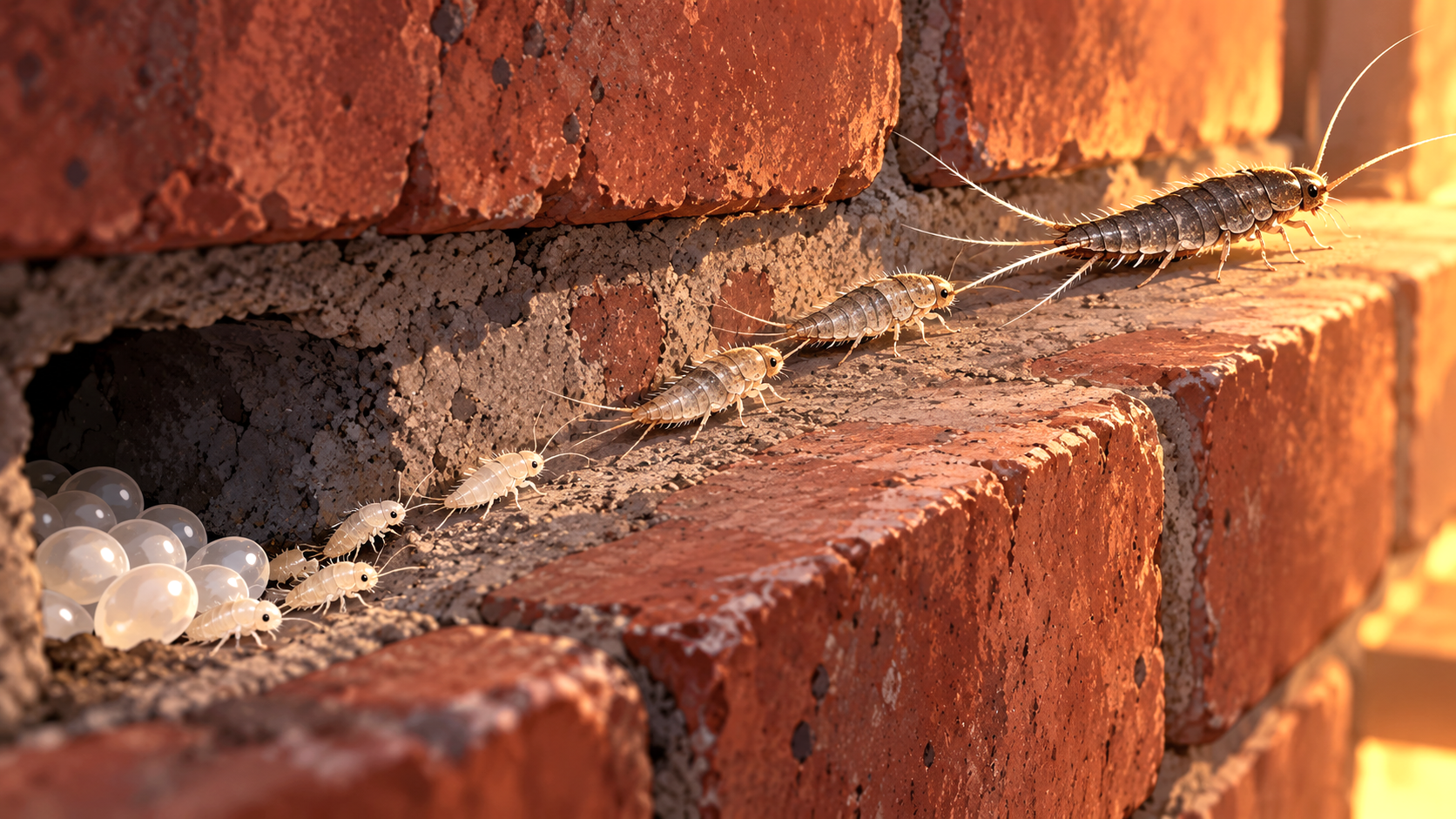
The firebrat life cycle moves from egg to nymph to adult, without the larval or pupal stages seen in insects such as beetles, moths, and flies. A newly hatched firebrat grows through repeated molts until it reaches sexual maturity, but the process does not stop there. Firebrats continue molting even as adults, potentially accumulating dozens of molts during a lifetime that can last about two years.
Temperature has a major influence on how quickly this cycle progresses. Under warm conditions, a firebrat can develop from a newly hatched nymph into an adult in as little as about 40 days, while sufficiently cold conditions can stretch the same period to roughly 300 days.
The Cycle Starts With Eggs Hidden in Protected Places
Female firebrats deposit their eggs in sheltered locations rather than leaving them exposed on open surfaces. Eggs may be placed in crevices, on cloth, or buried among food or dust. A clutch averages around 50 eggs, although recorded clutch sizes range from one to 200 eggs. Firebrats can produce more than 100 offspring during their lives, with eggs commonly deposited in batches rather than individually.
Under favorable conditions, the egg stage can pass quickly. Firebrat eggs hatch in about 14 days, although temperature can substantially alter the timetable. In colder surroundings, development can pause for several weeks before hatching resumes once temperatures rise.
Egg laying can occur in the same sheltered areas where groups of firebrats spend the day. These aggregations help regulate temperature and humidity around eggs and young nymphs, giving the earliest stages of the next generation a more stable environment. The physical characteristics used to recognize these early stages are covered separately in what firebrat eggs and nymphs look like rather than repeating them here.
Nymphs Grow by Molting Again and Again
Once an egg hatches, the firebrat enters its nymphal stage. There is no caterpillar-like larva and no pupa separating the young insect from adulthood. Instead, growth happens incrementally. The nymph periodically sheds its existing exoskeleton, grows, and enters another developmental stage between molts.
This repeated molting is a major part of the firebrat life cycle. Firebrats can pass through an exceptionally large number of instars, or stages between successive molts. Depending on how an instar is defined, as many as 60 molts have been recorded in Thermobia domestica. The number is not fixed because firebrats continue molting throughout life, and factors including temperature, humidity, food quality, and age can influence how many molts an individual ultimately undergoes. That distinction matters because a figure such as 45 to 60 instars does not mean a firebrat must complete 60 immature stages before becoming an adult. Some of those molts can occur after sexual maturity because adulthood does not end the molting process.
Heat Can Shorten Development From Months to Weeks
Firebrat development does not run on one fixed timetable. Temperature can change the time required to reach adulthood by several months. When conditions fall below 50°F, development to adulthood can take as long as about 300 days. Above 75°F, it can take as little as approximately 40 days.
This wide range fits an insect whose biology is strongly adapted to warm environments. Firebrats thrive particularly well at temperatures above 90°F, with optimum conditions around 98°F to 102°F. A population occupying a consistently heated location can therefore develop much more rapidly than firebrats exposed to cooler surroundings. Temperature is not acting entirely on its own. The number of molts an individual experiences can also vary with humidity and food quality. The life cycle is therefore better understood as environmentally responsive than as a rigid schedule in which every firebrat reaches each stage on the same day.
Becoming an Adult Does Not End Molting
One of the strangest parts of the firebrat life cycle begins where the development of most familiar insects effectively ends. Adult firebrats continue to molt after reaching sexual maturity. Most insects stop shedding their exoskeleton once the adult stage is reached, but firebrats retain the ability throughout their lives.
This continued molting is why lifetime counts can become so high. Firebrats and silverfish may pass through 45 to 60 developmental stages over their lives, with later molts occurring after the insect is already capable of reproducing. Because the total depends partly on age and environmental conditions, there is no universal final molt that every firebrat reaches before dying. Adult life can continue for a considerable time. A firebrat may live for about two years, leaving a long period after maturity in which it can continue molting and participating in reproduction.
Mating Starts the Next Generation
Adult firebrats use a courtship sequence rather than mating through direct copulation. A male interacts with a female through movements that include antenna contact and head wagging before depositing a capsule containing sperm, called a spermatophore. The female then picks up the capsule. Because the spermatophore is vulnerable to drying, males may deposit it on a moist surface.
Firebrats also tend to gather together in shared daytime hiding places, with chemical signals helping produce these aggregations. Females can deposit eggs in these protected areas, beginning another generation alongside older nymphs and adults already occupying the site. As a result, an established population does not have to progress neatly as one generation followed by another. Eggs, developing nymphs, sexually mature adults, and older adults can coexist while the cycle continues.
That overlap is particularly possible when a location remains warm and suitable for long periods. If firebrats are repeatedly developing indoors rather than appearing as isolated individuals, the combination of multiple life stages and other signs of a firebrat infestation can provide a clearer picture of whether a population has become established.
Questions About the Firebrat Life Cycle
Do firebrats have a larval or pupal stage?
No. Firebrats hatch as nymphs and develop progressively into adults through repeated molts. They do not become larvae, form pupae, or undergo the complete metamorphosis seen in insects such as flies and beetles.
Can firebrats reproduce all year?
Indoor firebrats can occupy environments where warmth persists far beyond a natural outdoor season, so reproduction is not necessarily restricted to a short seasonal window. The rate at which the population develops still depends strongly on environmental conditions.
Why can young and adult firebrats be present at the same time?
Generations can overlap. Adults may continue reproducing while earlier offspring are still developing, allowing eggs, nymphs, and adults to occupy the same established population.
Does a firebrat stop growing after becoming an adult?
Reaching adulthood does not stop molting. Firebrats are unusual among insects because they continue shedding their exoskeleton throughout adult life.
How many generations can firebrats produce in a home?
There is no single reliable number that applies to every home. Development speed changes substantially with temperature and other environmental conditions, while adults can live for about two years. A consistently favorable indoor environment can therefore support overlapping generations rather than one simple annual cycle.