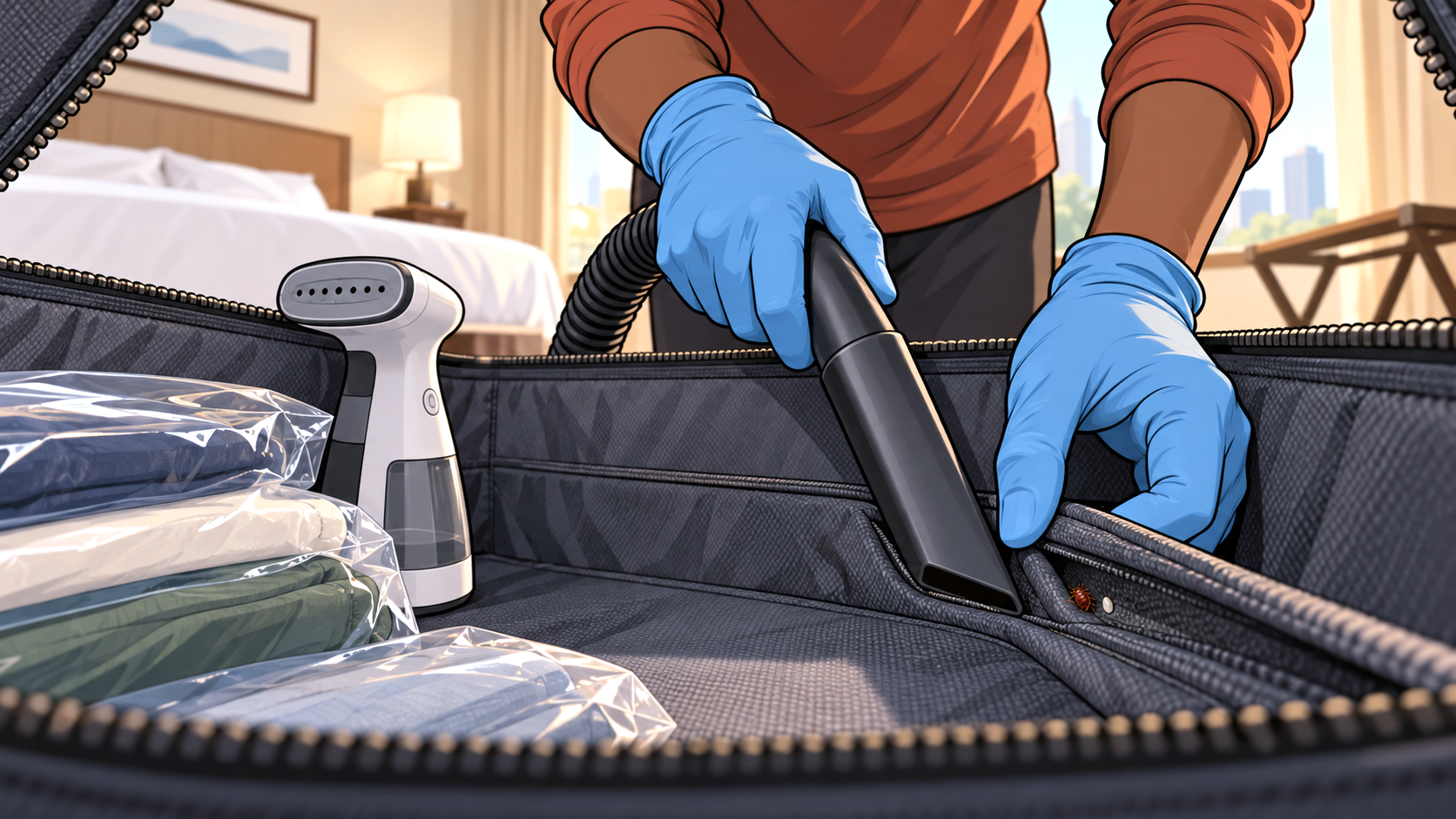
A suitcase doesn’t have to be thrown away because bed bugs got into it. Luggage can usually be inspected, cleaned, contained, and treated, but the right method depends on its materials and where the bugs may be hiding. Zipper tracks, seams, folds, pockets, handles, lining, wheels, and structural joints all deserve attention.
To get rid of bed bugs in luggage, isolate the suitcase before bringing it into a bedroom, remove and heat-treat washable contents, then carefully inspect and clean the case itself. Vacuuming can physically remove exposed bugs, while suitable luggage may be treated with controlled heat. EPA guidance also says a sealed black plastic bag in direct sun might work for luggage if the contents become hot enough, but this method isn’t guaranteed.
The important part is treating the contents separately from the suitcase itself rather than assuming one method is appropriate for everything you packed.
Keep Suspect Luggage Away From the Bedroom
If you’ve stayed somewhere with a confirmed or suspected bed bug problem, don’t bring the suitcase straight into the bedroom and unpack it beside the bed.
The EPA recommends unpacking directly into a washing machine and inspecting luggage carefully when you return home. It also recommends storing suitcases away from the bedroom, such as in a basement or garage, and specifically says never to store them under the bed.
Purdue University gives similar advice. Its bed bug guidance recommends inspecting and vacuuming suitcases before bringing them into the house after returning from an infested location. It also suggests containing luggage in a large plastic bag and keeping it in a garage, storage closet, or another area that isn’t commonly used rather than a bedroom.
Containment doesn’t eliminate bed bugs. It simply reduces the opportunity for a hitchhiking bug to leave the suitcase while you decide how to treat it.
Empty the Suitcase and Treat the Contents Separately
Don’t try to treat a fully packed suitcase as one solid object if the contents can be safely removed and handled individually.
Place washable clothing directly into bags for transport to the laundry area rather than carrying loose items through the home. EPA guidance says clothing, bedding, and other dryer-safe items can be heat-treated in a household dryer on high heat for 30 minutes, while washing alone may not reliably eliminate bed bugs and eggs.
That means the dryer is doing the important pest-control work for suitable clothing. Follow the garment’s care instructions, and keep treated belongings separated from anything that hasn’t yet been inspected or treated.
Our explanation of whether a clothes dryer kills bed bugs covers that process separately.
Once the contents are removed, the suitcase itself becomes much easier to inspect.
Inspect and Vacuum Every Hiding Place in the Luggage
A quick vacuum over the main compartment isn’t enough. Bed bugs are more likely to be concealed along construction details than sitting openly in the middle of the case.
Inspect the zipper tracks, seams, piping, folds, pockets, lining edges, handles, wheels, corners, straps, and joints. On luggage with removable or loose lining, check accessible spaces underneath without damaging the case.
Vacuum accessible hiding places slowly and carefully. EPA guidance recognizes thorough vacuuming as a way to physically remove some bed bugs, although vacuuming alone shouldn’t be treated as complete elimination.
Dispose of the vacuum contents immediately afterward. For a bagged vacuum, EPA recommends sealing the used vacuum bag inside a plastic bag and placing it in an outdoor garbage container. Clean a bagless vacuum carefully so captured bugs aren’t left inside to escape later.
Vacuuming is particularly useful as an initial removal step because it reduces the number of exposed insects before another treatment is used. It isn’t a substitute for dealing with bugs or eggs hidden where the vacuum cannot reach.
EPA Does Recognize the Black Plastic Bag Method, With an Important Caveat
One of the less obvious methods appears directly in EPA guidance.
The agency says black plastic bags placed in the sun might kill bed bugs in luggage or small items if the contents become hot enough. EPA notes that bed bugs die when their body temperature reaches 113°F, or 45°C, but the surrounding container has to become hotter so lethal heat actually reaches bugs wherever they’re concealed.
The phrase “might work” matters. Sunlight isn’t a controlled heat-treatment system. The temperature inside a black bag changes with outdoor temperature, cloud cover, sunlight intensity, bag placement, the amount and type of material inside, and how deeply a bug is concealed.
For that reason, we wouldn’t turn the EPA’s 113°F biological threshold into a simple instruction to leave a suitcase outside for a particular number of hours. The exterior of the bag becoming extremely hot doesn’t prove that the coolest protected location inside the luggage received a lethal heat exposure.
EPA’s separate DIY guidance also mentions black plastic bags in a hot, closed car in the sun, while again warning that success depends on climate and other factors.
If the required temperature isn’t actually reached throughout the item, the treatment hasn’t been demonstrated to work.
Controlled Heat Is More Predictable Than Hoping the Sun Gets Hot Enough
A portable heating chamber designed for treating belongings gives you considerably more control than outdoor sunlight. EPA specifically lists portable heating chambers as an option for items that may contain bed bugs, while warning users to read and carefully follow the manufacturer’s directions.
Whether the suitcase itself can be placed inside depends on the chamber’s instructions, its dimensions, and the luggage materials. Don’t assume every suitcase, battery-containing smart bag, adhesive, plastic component, or electronic accessory can safely tolerate the same temperature.
There is also direct research on heat treatment of luggage. In one experiment, soft-sided suitcases carrying adult male bed bugs on their exterior were exposed to air at 70°C to 75°C, or 158°F to 167°F. All 250 exposed bugs were killed within six minutes, including insects hiding beneath zipper flaps and decorative piping.
The limitation is just as important as the result. The researchers were testing bed bugs on the outside of the luggage. They explicitly concluded that this brief exterior treatment wouldn’t eliminate bugs already inside the suitcase.
So we wouldn’t use those six minutes as a DIY suitcase-treatment formula. It demonstrates that sufficiently intense controlled heat can rapidly kill exposed bed bugs on luggage, not that every suitcase can be made bed-bug-free with six minutes of heating.
Hard-Shell and Soft-Sided Luggage Both Need Their Hiding Places Checked
A hard-shell suitcase isn’t automatically easier or harder to treat simply because the exterior is rigid. Both styles can contain hiding places.
Soft luggage may have fabric seams, piping, folds, pockets, and layered material. Hard-shell luggage can still contain zipper assemblies, fabric liners, wheel housings, handles, joints, internal pockets, and other protected spaces.
The construction of the individual suitcase therefore matters more than assigning one treatment to every hard-shell case and another to every soft-sided one.
Neither type belongs in a clothes dryer unless its manufacturer specifically says it can tolerate that treatment, which ordinary suitcases generally aren’t designed for. Treat removable dryer-safe clothing and other contents separately instead.
Bed bugs can also hitchhike in luggage without establishing themselves permanently inside it. Our article on bed bugs in luggage and backpacks explains where they’re most likely to hide.
Freezing Can Work, but Simply Putting Luggage Outside in Winter Isn’t Enough
Cold can kill bed bugs, but freezing requires controlled conditions too.
EPA specifically warns that DIY freezing may not be reliable because temperatures must remain sufficiently low for long enough. A home freezer may not necessarily provide the conditions assumed by a particular treatment recommendation, so EPA advises checking temperature with a thermometer.
University of Minnesota Extension likewise emphasizes that the required temperature must reach the core of the item being treated, not merely the air surrounding it. Its guidance recommends longer exposure when freezer temperature is uncertain.
This makes outdoor winter weather a poor substitute for controlled freezing. Temperatures fluctuate, sunlight can warm objects, and an insulated suitcase may not reach the same temperature internally as the surrounding air.
We’ve covered those limitations more closely in whether cold weather kills bed bugs.
Don’t Put Treated Luggage Straight Back Into a Bedroom
Once you’ve inspected and treated a suitcase, keeping it away from the bed remains a sensible preventive habit.
EPA travel guidance recommends storing luggage away from the bedroom even when there isn’t a confirmed infestation. A basement, garage, or another suitable storage location reduces the chance that an overlooked hitchhiker will immediately find itself beside a sleeping host.
Continue checking the suitcase if you had a known exposure rather than assuming one cleaning pass guarantees success. Finding another live bed bug means the treatment didn’t eliminate everything or the luggage was exposed again.
The goal isn’t simply to make the suitcase look clean. It’s to prevent a bug that traveled home inside or on the luggage from becoming the starting point for an infestation.
Questions About Getting Bed Bugs Out of Luggage
How long should luggage stay in a black plastic bag in the sun?
There isn’t a reliable universal number of hours in EPA’s current guidance. The method depends on lethal heat reaching bed bugs throughout the luggage, including protected hiding places. Weather and the suitcase’s construction can change how quickly different areas heat, so time in the sun alone doesn’t confirm successful treatment.
Can you put an entire suitcase in a portable heat chamber?
Possibly, if the heating system’s manufacturer allows it and the suitcase and everything attached to it can tolerate the specified treatment. Follow the chamber instructions rather than improvising a temperature or treatment duration.
Should you throw away luggage that had bed bugs in it?
Usually not automatically. Suitcases can often be inspected and treated. Disposal becomes more reasonable when the construction prevents adequate treatment, the material cannot tolerate an appropriate method, or bed bugs continue to be found despite careful treatment.
Can shoes from an infested suitcase be treated too?
Yes, but the method has to suit the shoes. Purdue specifically identifies shoes and other non-washable belongings as candidates for appropriate temperature treatment. Don’t put shoes in a dryer, freezer, or heating device unless the materials can tolerate the process and the treatment conditions themselves are adequate.
Is vacuuming luggage enough to get rid of bed bugs?
No. Vacuuming can remove accessible bed bugs, but concealed insects or attached eggs may remain in areas the vacuum cannot reach. It works better as one part of inspection and treatment than as a guarantee that the suitcase is clear.