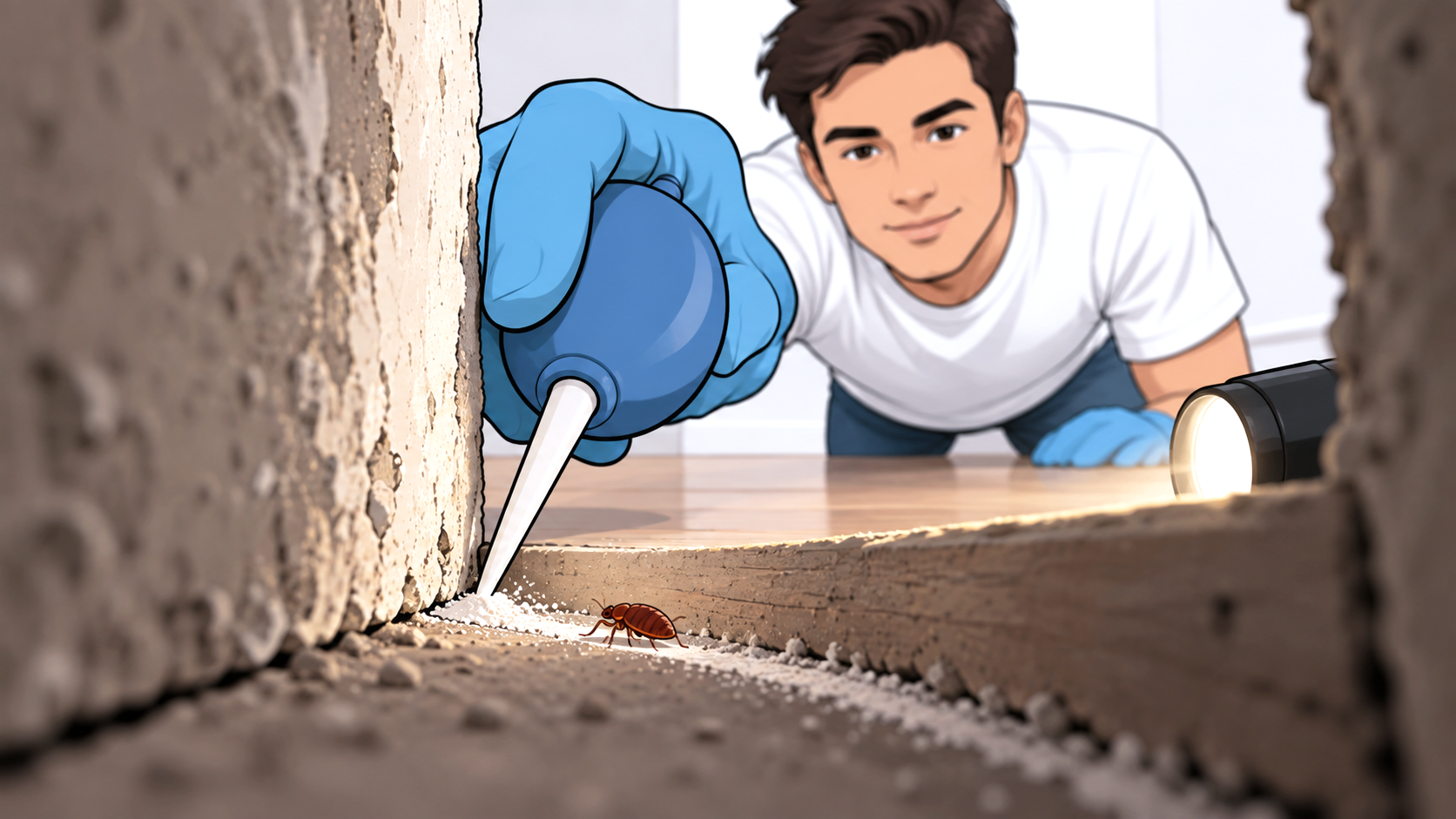
Diatomaceous earth can kill bed bugs by damaging the protective outer layer that prevents them from losing moisture. Once that barrier is compromised, an exposed insect gradually dehydrates and dies. However, its effectiveness varies considerably between products, and even a well-formulated dust will fail against bed bugs that never contact it. For household treatment, use only a pesticide product specifically registered and labeled for bed bugs. Ordinary food-grade diatomaceous earth and swimming-pool filter products are not suitable substitutes. Applying the wrong powder, or spreading excessive amounts throughout a bedroom, can create inhalation hazards without improving control.
Not All Diatomaceous Earth Products Work Equally Well
Diatomaceous earth (DE) is a powder made from the fossilized remains of microscopic aquatic organisms called diatoms. Their silica-based structures give the material properties useful in filtration, industrial applications, and certain insecticide formulations. Those uses do not make every DE product interchangeable.
The differences between pesticide-grade and other forms of diatomaceous earth are particularly important for bed bug control. Products intended for food processing, animal feed, or swimming-pool filtration have not necessarily been evaluated for effectiveness and safe application in bedrooms. Unregistered food-grade and pool-grade products can present increased inhalation risks when used as pesticide dusts.
Pool-filter diatomaceous earth deserves additional caution because some filtration materials undergo high-temperature processing that increases their crystalline silica content. Inhaling respirable crystalline silica can cause serious lung disease. Food-grade DE generally contains less crystalline silica, but fine particles can still irritate the respiratory system.
Even among products tested against bed bugs, performance varies. In a 2024 comparison of several diatomaceous earth formulations, a professional pest-control product caused much greater mortality than one supermarket formulation under the tested conditions. A DE product marketed for pet litter performed differently again.
These findings make product selection more important than the general claim that diatomaceous earth kills insects. In the United States, an EPA registration number and a current label listing bed bugs establish whether a particular pesticide product is authorized for that use.
How the Powder Causes Bed Bugs to Lose Water
Bed bugs have an external skeleton covered by protective surface lipids that help prevent excessive water loss. Diatomaceous earth interferes with this barrier through contact with the insect’s exterior.
Fine DE particles can abrade the cuticular surface and disrupt its protective properties, allowing moisture to escape more readily. The insect progressively loses water until dehydration becomes fatal.
Silica gel dusts also act as desiccants, but their interaction with the insect differs. Silica gel can adhere to the cuticle and adsorb protective surface waxes, whereas diatomaceous earth is commonly described as acting primarily through abrasion and disruption of the cuticular barrier. Both ultimately cause water loss through the insect’s protective outer surface.
This physical mode of action differs from that of pyrethroid insecticides, which interfere with nerve signaling. The resistance mechanisms that reduce permethrin effectiveness therefore do not automatically protect a bed bug against desiccation.
However, physical activity does not guarantee identical mortality across every population. Differences in cuticle properties, exposure duration, humidity, and recent feeding can influence how rapidly an insect loses water. Diatomaceous earth should not be described as universally effective under every condition simply because it bypasses a conventional insecticide target.
A Bed Bug May Survive for Days After Exposure
Diatomaceous earth does not normally kill on contact in the way some fast-acting insecticides can. After picking up an effective quantity of particles, a bed bug may continue moving while dehydration develops.
Laboratory findings illustrate how much the timeline can vary. In the 2024 dust comparison, a professional diatomaceous earth formulation produced complete mortality within two to four days under continuous-exposure conditions, depending on the tested colony. Other DE formulations required substantially longer or produced limited mortality.
Another comparison of insecticidal dusts under different exposure conditions found that a silica gel formulation produced higher mortality after brief contact than several alternatives, including diatomaceous earth.
Neither experiment establishes a fixed number of days for eliminating an infestation in a home. Laboratory insects may be required to remain in contact with treated surfaces, whereas bed bugs inside furniture can occupy untreated areas or cross a deposit only briefly.
A desiccant-based control program may take considerably longer in a household, particularly when concealed insects encounter the material slowly or repeated intervention is necessary.
The relevant timeframe is therefore not simply how fast the dust kills an exposed insect. It is whether enough insects encounter effective deposits to reduce the entire infestation.
Where Diatomaceous Earth Should Be Applied
The location of the dust matters more than the quantity visible on a surface. A bed bug must physically contact the material for its desiccating properties to affect the insect.
Registered bed bug desiccants are generally intended for label-specified cracks and crevices. Depending on the product, permitted locations may include particular furniture joints, baseboard gaps, and other sheltered areas associated with bed bug movement.
A thin, barely visible deposit is preferable to heavy piles when the label calls for a light dusting. Excessive material can make treated areas less suitable for insect contact and increases the chance of particles becoming airborne.
The proper application of insecticide dusts depends on using an appropriate applicator and following the product’s directions. Dust should not be scattered across carpets, exposed bedding, floors, or mattresses merely because those surfaces are near suspected activity.
Bed bugs frequently occupy mattress seams and concealed bed-frame joints, but the presence of insects does not automatically make every location suitable for pesticide treatment. The product label determines whether any particular mattress, box-spring, or furniture application is permitted.
Electrical outlets and equipment also require special caution. Do not introduce powder into electrical components unless the product’s instructions specifically authorize the application and it can be performed safely.
Moisture and Humidity Affect Performance
Diatomaceous earth works most effectively when its particles remain dry and capable of adhering to insects. Moisture can cause fine dust to clump, changing its distribution and reducing the amount that transfers onto a bed bug’s body.
Humidity affects the insect as well. Water loss generally proceeds less readily in humid conditions, potentially slowing the dehydrating effect of a desiccant.
In laboratory and field conditions, desiccant performance can be influenced by moisture, recent feeding, and insect development. A recently fed bed bug has a different internal water balance from an unfed individual, while an immature insect may molt after exposure and shed some contaminated outer material.
There is no single household humidity percentage at which diatomaceous earth suddenly becomes ineffective. Nor is there sufficient justification for treating a dehumidifier as a substitute for appropriate product placement and comprehensive bed bug management.
If a treated location becomes wet or the dust is disturbed during cleaning, consult the pesticide label before deciding whether removal or reapplication is necessary. Continually adding more powder over old, clumped deposits can increase exposure without restoring effective contact.
Diatomaceous Earth and Silica Gel Are Not Equally Fast
Both diatomaceous earth and silica gel can control exposed bed bugs through desiccation, but their formulations and performance are not identical.
In comparative studies, certain silica gel insecticide dusts have killed bed bugs more rapidly than tested DE products, particularly after brief exposure. The difference is relevant because a bed bug may only cross a treated location for a short time before returning to shelter.
The performance of silica gel against resistant and susceptible bed bugs reflects its ability to adhere to the insect and interfere with the protective waxy layer. Some professional DE formulations have nevertheless produced substantial mortality in controlled experiments.
The results should not be reduced to a universal claim that every silica gel product outperforms every diatomaceous earth product. Formulation, particle properties, exposure method, and the insects being tested all affect the outcome.
Nor should household silica gel packets be emptied and substituted for a registered pesticide dust. Consumer moisture-control products and formulated insecticides are different products intended for different uses.
Protect Yourself From Inhaling the Dust
Diatomaceous earth can be hazardous when inhaled, even when it is sold as a pesticide. Registration and proper labeling help establish permitted uses and precautions; they do not mean the dust is harmless.
Dust exposure can occur during application, cleaning, or disturbance of treated surfaces. Inappropriate placement on bedding, carpets, or other exposed areas can increase opportunities for people and pets to inhale or contact the powder.
The restrictions on bed bug desiccant applications are intended in part to reduce inhalation exposure. Use the equipment, protective measures, application methods, and re-entry precautions specified on the particular pesticide label.
Do not improvise by choosing a mask or respirator based solely on general online advice. Some products or applications may require specific protective equipment, while others have different requirements.
Children and pets should not be allowed to disturb treated areas contrary to label instructions. A relatively low systemic toxicity profile does not eliminate the physical hazards associated with breathing fine particulate material.
If excessive dust has already been applied, avoid sweeping or brushing it into the air. Follow the product label and obtain appropriate cleanup guidance rather than redistributing the material throughout the room.
Why Diatomaceous Earth Alone May Leave an Infestation Behind
A laboratory result demonstrating high mortality after direct exposure does not establish that every insect inside a bedroom will encounter the treated material.
Some bed bugs may remain in untreated harborages, particularly within furniture, structural gaps, or belongings. Eggs attached in concealed locations may also remain unaffected until nymphs hatch and begin moving.
The physical removal of accessible bed bugs by vacuuming can reduce the population before other appropriate methods are used, although eggs and firmly attached insects may be difficult to dislodge.
Suitable fabrics can also be treated using adequate clothes-dryer heat, while properly fitted encasements and interceptor traps serve different roles in containment and monitoring.
A coordinated bed bug treatment program combines compatible methods according to the infestation’s location and severity. Dust is one possible component, not a replacement for inspection, preparation, and follow-up.
The durability of dry desiccant deposits can be useful where a label permits treatment in protected locations. However, residual activity only benefits control when bed bugs actually cross those deposits.
How Can You Tell Whether the Dust Is Helping?
A decrease in visible bed bugs after applying diatomaceous earth may be encouraging, but one quiet night is not reliable evidence that an infestation has been eliminated.
Inspect known hiding places over time and record whether live insects, new spotting, or other physical signs continue appearing. Bed bug interceptor cups can provide additional evidence of movement around monitored furniture when installed and maintained correctly.
Continued sightings do not automatically prove that the DE formulation is ineffective. Bed bugs may be moving through untreated areas, avoiding deposits, or emerging from concealed locations where the dust never reached them.
Persistent activity should prompt reassessment of the overall treatment rather than automatic reapplication of larger quantities. Professional evaluation may be appropriate when the infestation occupies multiple rooms or remains active despite correctly implemented control measures.
Can Diatomaceous Earth Be Used Directly on a Mattress?
Do not spread diatomaceous earth over the sleeping surface of a mattress. Bed bug desiccants are subject to label-specific restrictions designed to prevent inappropriate exposure.
Even when a product permits some form of treatment associated with a mattress or box spring, that does not authorize applying it across areas where people sleep or routinely make skin contact. Check the exact permitted location and application method before use.
Does Diatomaceous Earth Kill Bed Bug Eggs?
Diatomaceous earth should not be relied upon as a dependable direct egg treatment. Its principal value comes from contact with moving insects, while bed bug eggs remain attached to the surfaces where females deposit them.
Newly hatched nymphs may encounter a properly placed residual dust after emerging, but exposure is not guaranteed. Egg survival and subsequent movement are among the reasons continued monitoring is necessary.
Can Bed Bugs Become Resistant to Diatomaceous Earth?
Diatomaceous earth acts physically rather than targeting the sodium channels or other biochemical pathways affected by many conventional pesticides. Therefore, resistance to pyrethroids does not automatically prevent a desiccant from killing an insect.
However, natural variation in cuticle characteristics, humidity tolerance, and exposure behavior may influence susceptibility. The physical mechanism supports its usefulness against chemically resistant populations without justifying a claim that every bed bug will be killed under every condition.
4 thoughts on “Does Diatomaceous Earth Kill Bed Bugs?”