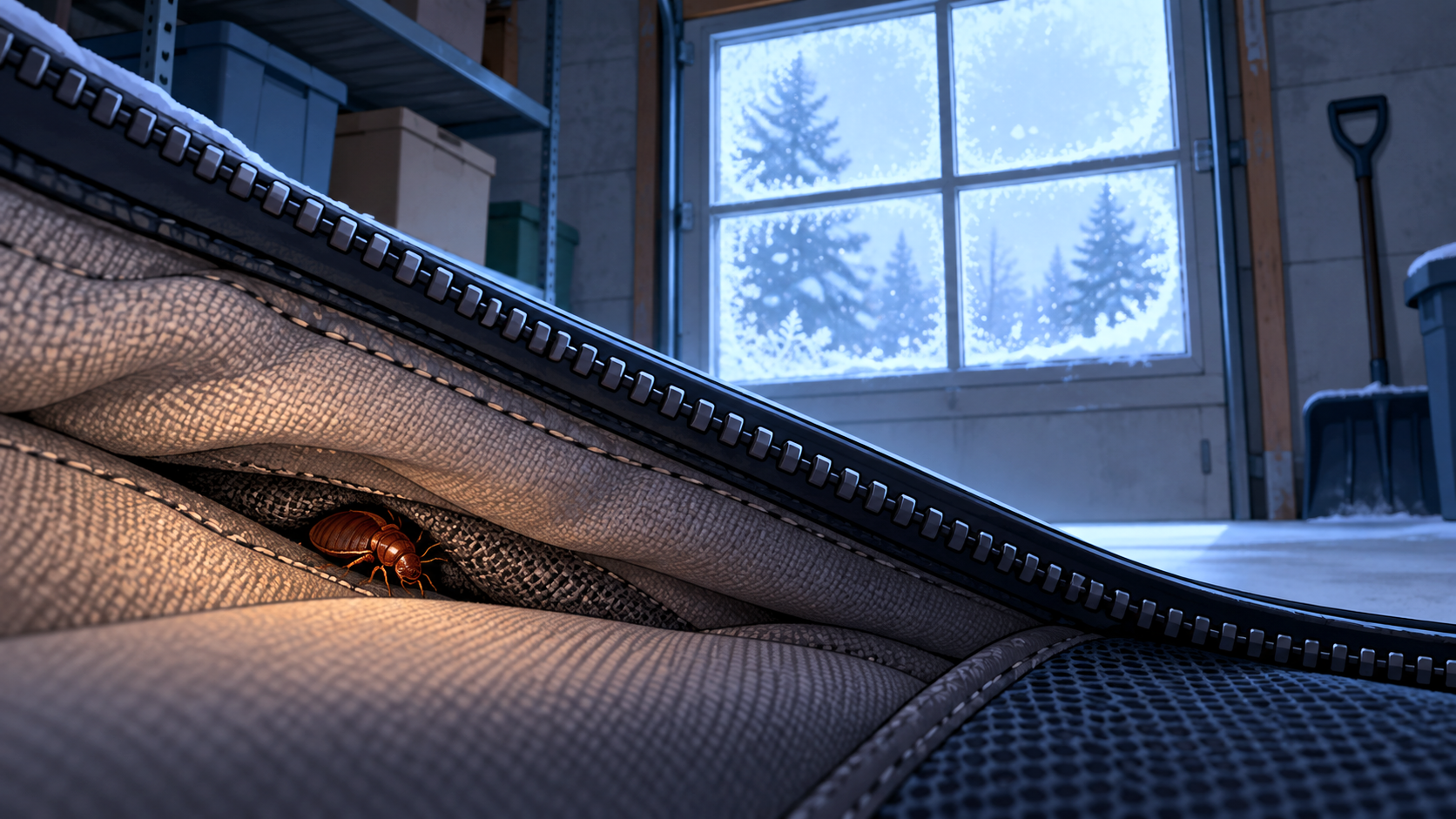
Cold can kill bed bugs, but ordinary winter weather isn’t automatically cold enough to eliminate them. Both temperature and exposure time matter, and the cold has to reach the bed bugs themselves, including those protected inside furniture, bags, or other belongings.
Laboratory research shows that bed bugs are remarkably cold tolerant. They can survive prolonged exposure to temperatures below freezing, while sufficiently severe or sustained cold eventually kills every life stage. This makes freezing potentially useful for treating certain individual items, but much less dependable as a way to eliminate an infestation from a room, house, or piece of furniture left outdoors.
How Cold Does It Have to Be to Kill Bed Bugs?
There isn’t one temperature at which every bed bug immediately dies. Mortality depends on how cold the insects become and how long they remain at that temperature.
A major study of cold tolerance across bed bug life stages found mean supercooling points ranging from −21.3°C to −30.3°C (−6.3°F to −22.5°F). Researchers calculated an LLT99, an estimated temperature associated with 99% mortality, of −31.2°C (−24.2°F) when data from the different life stages were combined.
That doesn’t mean −31.2°C is required to kill bed bugs. Less extreme cold can work when exposure lasts longer. In the same research, survival was predicted at temperatures above −12°C (10.4°F) even after a full week, while sufficiently long exposure below −13°C (8.6°F) produced complete mortality.
At −16°C (3.2°F), the researchers observed 100% mortality after about 80 hours. Their model estimated that approximately 85 hours at −15°C (5°F) was required to kill all life stages under the experimental conditions.
Bed Bugs Are Freeze-Intolerant
Bed bugs don’t have to literally freeze solid before cold kills them.
They are classified as freeze-intolerant insects, meaning they can’t survive the freezing of their body fluids. However, lethal cold injury can occur before their supercooling point is reached.
An earlier laboratory study of adult female bed bugs found a supercooling point around −20°C (−4°F), yet a direct one-hour exposure to −16°C (3.2°F) killed all of the bed bugs tested. This showed that cold injury could be fatal without the insects themselves freezing.
Later research found considerably greater cold tolerance under different experimental conditions, including survival after shorter exposures to lower temperatures. That difference is one reason a single laboratory temperature shouldn’t be treated as a universal household treatment threshold.
Can Bed Bugs Adapt to a Sudden Cold Exposure?
Bed bugs have demonstrated a phenomenon called rapid cold hardening.
In the earlier laboratory study, exposing adult females to 0°C (32°F) for one hour improved their subsequent survival when exposed to −14°C and −16°C. By contrast, keeping them at 4°C (39.2°F) for two weeks didn’t produce the same improvement, nor did losing 15% of their body water through dehydration.
Rapid cold hardening shows that bed bug physiology can respond surprisingly quickly to temperature changes. However, the experiment doesn’t establish that placing belongings in a garage first, using a frost-free freezer, or allowing a freezer to cycle will make bed bugs resistant enough to survive an otherwise adequate freezing treatment.
For household treatment, the more useful approach is to verify the actual freezer temperature and maintain the recommended exposure long enough for the center of the treated item to become sufficiently cold.
Can You Kill Bed Bugs in a Home Freezer?
A freezer can kill bed bugs if it becomes cold enough and stays there long enough.
The EPA’s current DIY guidance recommends placing suitable items in a sealed bag and keeping them in a freezer at 0°F (−18°C) for three days. The agency stresses that the temperature should be checked with a thermometer because some household refrigerator freezers don’t reliably reach 0°F.
Other EPA guidance takes an even more conservative approach, recommending temperatures below 0°F for at least four days. University of Minnesota guidance similarly recommends holding items at 0°F for at least 72 hours and suggests 96 hours to provide an additional safety margin.
These practical recommendations are more useful for home treatment than trying to reproduce the exact mortality thresholds from laboratory experiments.
Large or densely packed objects need particular care because the surrounding freezer air can reach the target temperature before the center of the object does. Treatment time should account for the item itself reaching the required temperature.
Will Putting Infested Furniture Outside in Winter Work?
Outdoor winter temperatures aren’t a dependable substitute for a controlled freezer.
Even when the weather forecast shows temperatures well below freezing, bed bugs hidden deep inside a mattress, sofa, or other insulated object may experience considerably warmer conditions. Outdoor temperatures also rise and fall throughout the day instead of remaining at a controlled treatment temperature.
The EPA warns that putting belongings outside in freezing weather isn’t reliably effective because many factors influence whether the insects actually experience lethal conditions.
Extremely cold weather maintained for long enough could kill exposed bed bugs, but simply leaving infested furniture outside during winter doesn’t establish that every bug and egg inside has died.
Why Freezing Works Better for Individual Items
Cold treatment is much easier to control when you’re dealing with a small object that fits completely inside a freezer.
Suitable belongings can be sealed to prevent bugs from escaping, placed inside a freezer with a verified temperature, and left there for the required period. The process becomes much less predictable when trying to freeze an entire mattress, sofa, vehicle, room, or building.
Some belongings can also be damaged by freezing, so temperature-sensitive electronics, liquids, medications, delicate materials, and other potentially vulnerable objects shouldn’t automatically be placed in a freezer.
For a household infestation, freezing individual possessions doesn’t address bed bugs remaining in the bed frame, furniture, baseboards, walls, or other untreated locations. It therefore works best as one component of a broader control plan rather than as a whole-room treatment.
Questions About Cold and Bed Bugs
Does normal winter weather kill bed bugs?
It can kill them if the insects themselves become sufficiently cold for long enough, but freezing outdoor air alone doesn’t guarantee this. Bed bugs can survive prolonged exposure to moderately cold temperatures, and protected harborages may remain warmer than the surrounding air.
Can bed bugs survive being frozen solid?
Bed bugs are considered freeze-intolerant. Once their body fluids actually freeze, they aren’t adapted to survive the process. They can also die from cold injury before reaching their supercooling point.
Is 32°F cold enough to kill bed bugs?
Not quickly. Temperatures around the freezing point of water shouldn’t be treated as a reliable bed bug treatment. Effective household freezing requires considerably lower temperatures maintained for an appropriate period.
Can you use dry ice to freeze bed bugs?
Dry ice shouldn’t be improvised as a household bed bug treatment. Carbon dioxide can create a serious asphyxiation hazard in enclosed or poorly ventilated spaces, and the EPA warns that carbon-dioxide-based pest treatments can be dangerous when used incorrectly.
3 thoughts on “Does Cold Weather Kill Bed Bugs?”