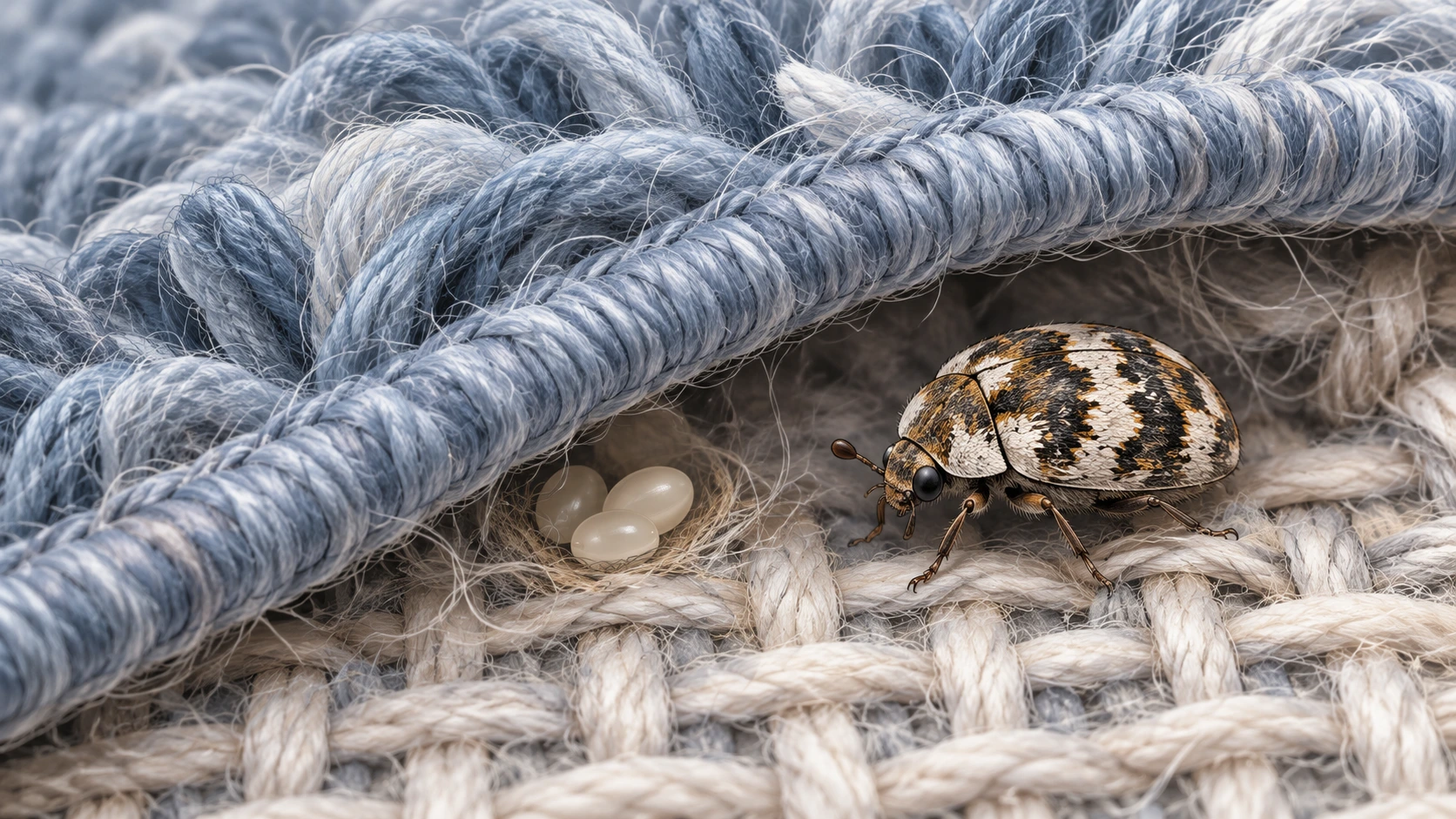
You can kill carpet beetle eggs with suitable heat, freezing, hot laundering, or dry cleaning, and you can physically remove accessible eggs by vacuuming. The most reliable choice depends on what contains the eggs and whether the treatment can reach the entire affected material.
Carpet beetle eggs are often missed because they are deposited in protected places near food that the emerging larvae can eat. They may be buried among wool fibers, trapped in dusty crevices, or concealed inside a neglected household item. Spraying the visible floor does little for eggs inside an untreated cushion or folded garment.
There is an important difference between an egg being difficult to kill and an egg being difficult to reach. Carpet beetle eggs are not immune to ordinary pest-control methods, and they are not necessarily more resistant than larvae or adults to every treatment. Some methods, such as appropriate laundering or controlled freezing, can kill all life stages. Others depend on insects moving across a treated surface, which an egg cannot do.
The goal is to match the method to the egg’s location rather than assume that one treatment can reach every possible hiding place.
Why Carpet Beetle Eggs Are Easy to Miss
Adult female carpet beetles place eggs in or near materials that can support their offspring. Depending on the species and conditions, these can include wool, fur, feathers, stored natural-fiber fabrics, and accumulations of animal-derived debris.
The eggs themselves are small and usually inconspicuous. They can be difficult to distinguish from dust or other particles without magnification. Even a careful inspection may overlook eggs nestled between fibers or inside a protected seam.
Unlike larvae, eggs do not crawl out of hiding places. They remain where they were deposited until they hatch. That matters when a treatment depends on movement.
An exposed larva might cross a strip of insecticide residue along a baseboard. An egg inside the lining of a coat will not. If the coat remains untreated, the residue on the baseboard provides no direct egg control.
Carpet beetle eggs may hatch in approximately two weeks under favorable indoor conditions, although the timing varies with species and temperature. The exact timing, number of eggs, and reproductive behavior belong in our separate guide to how many eggs carpet beetles lay and when they hatch.
For egg control, the immediate question is whether the material or hiding space containing the eggs can be removed, cleaned, or treated in its entirety.
The Best Way to Kill Eggs Depends on Where They Are
There is no single best egg-killing method for every household item. A wool sweater, a removable rug, an upholstered chair, and a dusty wall void present different access problems.
We would prioritize treatments by how completely they can reach the suspected eggs, rather than by how quickly they kill an exposed insect.
| Method | What it can do to carpet beetle eggs | Main limitation |
|---|---|---|
| Hot laundering or professional dry cleaning | Can kill eggs and other stages in suitable textiles | Fabric must tolerate the treatment, and the complete item must be processed |
| Controlled freezing | Can kill eggs in items that reach and maintain a sufficiently low temperature | Large, densely packed items take longer to cool throughout |
| Appropriate heat treatment | Can kill eggs when lethal conditions reach the infested material | The center of a thick item may not reach the necessary temperature |
| Thorough vacuuming | Physically removes accessible eggs with dust and debris | Eggs inside inaccessible fabric layers or cavities may remain |
| Steam treatment | May kill eggs where sufficient heat penetrates | Surface exposure does not establish that deep eggs were heated adequately |
| Labeled insecticides | May affect eggs if the specific product has demonstrated egg activity and reaches them | Many treatments primarily affect exposed or moving insects |
| Removing an infested item | Removes the eggs and their associated breeding material from the home | An independent infestation source may remain elsewhere |
The table describes treatment capabilities, not guarantees. A method that can kill eggs under appropriate conditions will still fail when the eggs are outside the treated area.
Can Washing and Dry Cleaning Kill Carpet Beetle Eggs?
Hot laundering and dry cleaning are among the better-supported choices for eggs contained in suitable clothing and fabrics.
The advantage is whole-item exposure. Instead of relying on an egg to contact insecticide deposited on a nearby surface, the garment itself undergoes treatment.
Proper hot laundering or dry cleaning can kill all carpet beetle life stages, including eggs. This makes textile treatment particularly useful when the suspected infestation is contained within an item that can be cleaned appropriately.
Fabric-care restrictions still matter. Wool, silk, antique materials, and certain finished or lined garments may be damaged by unsuitable washing conditions. Washing something in lukewarm water solely because the label permits gentle laundering does not establish that the wash killed its eggs.
The same caution applies to a dryer. Heat must reach the affected material under conditions capable of killing the insects. A short warming period is not equivalent to a validated lethal treatment.
For detailed temperature, duration, freezer, washing, and fabric-care considerations, see does washing, drying, or freezing kill carpet beetles. Those procedures depend on both the material and the conditions that can actually be achieved.
For egg control, the main benefit is that a properly selected whole-item treatment can reach eggs that would remain untouched by spraying the closet or floor around the garment.
Does Freezing Kill Carpet Beetle Eggs?
Freezing can kill carpet beetle eggs, provided the entire infested item becomes sufficiently cold for a sufficient period.
The treatment is useful for certain objects that cannot be laundered but can tolerate freezing. Small fabric items and other suitable possessions may be candidates, while large upholstered pieces or fragile materials require more care.
The challenge is temperature penetration. Air inside a freezer may be very cold while the center of a tightly packed item remains warmer. Timing the treatment solely from when an object is placed inside the freezer can therefore overestimate the exposure received by eggs concealed deep within it.
Guidance for controlling dermestid beetles describes sustained deep freezing as capable of killing all developmental stages. It also cautions that larger objects need longer for lethal temperatures to penetrate.
That is especially relevant when an item is folded, densely packed, or insulated by layers of material.
Ordinary cool storage is not the same as freezing. A chilly garage, refrigerator, or brief exposure to winter air should not be assumed to kill carpet beetle eggs.
For a valuable textile, controlling moisture and condensation is another concern. Incorrect handling can damage the object even if the insect treatment succeeds.
Freezing is therefore an egg-control option with real evidence behind it, but its reliability depends on the temperatures reached throughout the affected item, not simply the freezer setting.
Does Heat or Steam Kill Carpet Beetle Eggs?
Sufficient heat can kill carpet beetle eggs. Steam may also be effective where it delivers enough heat to the location containing them.
The word where matters.
A heated surface can reach a lethal temperature while an egg hidden beneath several layers of fabric remains comparatively cool. Briefly passing a steam cleaner over the outside of an upholstered chair does not prove that eggs in the filling have been killed.
The same problem can occur with thick rugs, densely packed fabrics, or furnishings containing internal seams and compartments.
For appropriate items, heat treatments can kill all carpet beetle stages when the necessary conditions are maintained. However, the treatment temperature and duration must be suitable for the insect and sufficient to penetrate the material.
Steam cleaning can be useful on certain rugs and household surfaces, but its effectiveness depends on access, heat delivery, and material tolerance. Guidance on clothes moth and carpet beetle control recognizes steam cleaning as a possible effective treatment while also emphasizing the limitations of methods that fail to penetrate larger infested objects.
There are additional risks. Excess moisture can affect upholstery padding, adhesives, carpet backing, wood finishes, and delicate textiles. A handheld steamer can also cause burns.
We would not recommend using improvised whole-room heaters, ovens, or other uncontrolled heat sources to treat household possessions. They can damage materials or create fire hazards without guaranteeing that eggs receive adequate exposure.
Heat and steam are useful only when the material tolerates them and the treatment reaches the suspected eggs.
Can Vacuuming Remove Carpet Beetle Eggs?
Vacuuming is one of the most useful ways to physically remove accessible carpet beetle eggs, particularly when they are mixed with lint, hair, and debris.
It works differently from a pesticide or thermal treatment. An egg does not have to be poisoned or heated if it can be collected and removed from the home.
The limitation is access. A vacuum may collect eggs from carpet edges, exposed fibers, accessible furniture seams, and dusty floor junctions. It cannot reliably remove eggs sealed inside upholstery filling or buried behind inaccessible structural materials.
Vacuuming also does not establish that every egg it encounters is destroyed. The vacuum’s main contribution is collection and removal.
That makes handling the collected debris important. Eggs and other carpet beetle stages can remain in material gathered by the machine. Emptying the collection container or disposing of the bag promptly outside the home reduces the risk of keeping infested debris indoors.
Thorough vacuuming is recommended as part of carpet beetle management because it removes eggs, insects, and their food sources. Its value is particularly high where the infestation is associated with accumulated hair, lint, or dead insects rather than a valuable textile that must be preserved.
The separate guide to how often to vacuum for carpet beetles covers cleaning priorities and schedules. For eggs, the critical issue is how much of the suspected breeding material the vacuum can actually reach.
Do Carpet Beetle Sprays Kill Eggs?
Some insecticides may have activity against insect eggs under particular conditions, but you should not assume that a carpet beetle spray kills eggs merely because it kills adults or larvae.
The outcome depends on the active ingredients, formulation, concentration, exposure conditions, and whether the product has evidence supporting an egg-killing claim.
A product labeled for carpet beetle control may primarily act through contact with exposed insects or through residual deposits that moving insects encounter later. Carpet beetle eggs remain stationary. Residue along a baseboard cannot affect an egg inside an untreated woolen cushion simply because the larva might eventually travel across that baseboard.
Even direct contact does not establish reliable egg mortality for every formulation. The egg stage differs biologically from a mobile larva, and results for one life stage should not automatically be applied to another.
There is also a labeling issue. A product may permit treatment of selected carpet edges or cracks while prohibiting use on bedding, clothing, or other personal fabrics. The need to reach hidden eggs does not override those restrictions.
For household pest control, insecticides should supplement source removal rather than replace it. If the suspected eggs are inside a removable garment, an appropriate textile treatment is generally more direct than applying insecticide to the surrounding storage area.
The full label-led procedure belongs in how to spray for carpet beetles. For egg control, the question to ask about any product is whether it has a supported egg-stage claim and can legally be applied where the eggs are likely to be.
Why Foggers Often Miss Carpet Beetle Eggs
A total-release fogger disperses insecticide into a space, but dispersing a chemical throughout a room is not the same as delivering an effective dose inside every object.
Carpet beetle eggs within dense fabrics, furniture padding, protected folds, or inaccessible cavities may be shielded from droplets or airborne insecticide.
That access problem is not unique to eggs. Concealed larvae can survive for similar reasons. Eggs are particularly vulnerable to being overlooked because they cannot emerge from a hiding place and move across a treated surface.
Surface sprays and store-bought foggers do not reliably reach insects buried deep within larger infested objects. The limitations of aerosol foggers for carpet beetles and clothes moths are a strong reason not to mistake whole-room treatment for complete coverage.
Using more pesticide than the label allows will not solve that physical access problem and may increase exposure to people, pets, and non-target organisms.
Foggers can also introduce inhalation, flammability, and contamination risks. They should not be treated as a shortcut for reaching eggs inside personal belongings.
Should You Throw Away Something That Contains Carpet Beetle Eggs?
Not necessarily. If the affected item can safely undergo an effective whole-item treatment, discarding it may be unnecessary.
A washable garment, removable textile, or other suitable object can often be treated and then stored in a way that prevents new beetles from reaching it.
Disposal becomes more reasonable when the item is badly damaged, cannot be treated effectively, or contains inaccessible infestation material that is not worth preserving.
The decision is different for valuable or irreplaceable objects. Antique rugs, taxidermy, museum pieces, and delicate textiles may require a conservator or a professional experienced with pest treatment of sensitive materials.
A large item can also present two distinct problems. Its outer surface may be accessible, but the material sustaining the infestation may be inside its structure. Treating the outside may not reach the eggs, while an unsuitable whole-item treatment could damage the object.
For upholstered furniture, the practical considerations are covered more fully in how to get rid of carpet beetles in couches, stuffed animals, and upholstered furniture.
If disposal is necessary, contain the affected material during removal so loose insects and debris are not scattered through the home.
Why Can New Larvae Appear After You Think the Eggs Are Gone?
Finding new larvae after treatment does not automatically mean carpet beetle eggs survived a properly completed whole-item treatment.
Several possibilities need to be separated.
First, eggs may have remained in another untreated item or location. A successfully cleaned sweater does not eliminate eggs in a different garment, old nest, or accumulated debris elsewhere.
Second, a treatment may have failed to penetrate the original item completely. Eggs inside its center may have received less heat, cold, or insecticide exposure than those near the surface.
Third, larvae may already have been present in concealed locations before the treatment. Their later appearance can be mistaken for newly hatched insects.
Finally, adult beetles can enter from outdoors and create new opportunities for egg laying if suitable materials remain available.
The timing of an observation can provide clues, but it cannot establish the cause by itself. Egg development varies with conditions, and larval development can continue for much longer.
Repeated sightings should prompt attention to fresh activity rather than old evidence. Our guide to how to tell if carpet beetles are gone explains why dead adults and shed skins should not be interpreted as proof of an active or eliminated infestation.
A successful egg-control effort is best judged by whether suitable breeding materials have been addressed and whether new evidence of development continues to appear.
How to Avoid Missing Eggs During Treatment
The most useful decision is to identify what you are actually treating.
If eggs may be inside a removable textile, a suitable whole-item treatment has a clear advantage over spraying a surface nearby. If they are in accessible debris, physical removal can be effective. If they are inside a fixed, concealed structure, the difficulty is identifying and safely reaching the source.
Our preferred approach is to treat the suspected material as the unit of control rather than treating the room as though eggs were evenly distributed across it.
For example, cleaning the carpet in the center of a bedroom does not establish that eggs inside a wool scarf in the closet have been addressed. Similarly, freezing one infested item says nothing about eggs in a separate pile of natural-fiber materials.
Avoid moving potentially infested objects around the home without containment. Once an item has been properly treated, protect it from reinfestation in a clean, tightly closed storage container.
It is equally important not to assume that a successful insecticide application means every egg is dead. If a treatment works mainly against moving insects, eggs may remain outside its effective exposure zone.
When activity continues, investigating why carpet beetles keep coming back after treatment is more useful than automatically repeating the same method.
Are Carpet Beetle Eggs Harder to Kill Than Larvae or Adults?
Not under every treatment condition.
Some methods can kill eggs, larvae, pupae, and adults when the entire infested item receives an appropriate exposure. Thorough hot laundering, dry cleaning, and validated temperature treatments are examples.
The practical difficulty is often greatest with eggs because they are small, stationary, and easily hidden within material. A visible adult can be removed directly. An exposed larva can be collected or may encounter a residual treatment. An egg remains in place and may not be discovered until larvae emerge.
That is an access difference, not proof of universal biological resistance.
Comparisons between life stages also depend on the method being used. An insecticide that performs well against moving larvae might have limited egg activity. A properly applied whole-item thermal treatment may kill both stages effectively.
Carpet beetle egg control therefore needs two separate questions. Can the method kill an egg under the right conditions? And will those conditions reach the eggs in this particular item or hiding place?
If the answer to the second question is uncertain, the outcome remains uncertain even when the method itself is capable of killing eggs.
The Bottom Line
Carpet beetle eggs can be killed, but successful control depends on reaching them. Appropriate hot laundering, dry cleaning, controlled freezing, and heat treatment can address eggs in suitable items. Vacuuming can remove accessible eggs, while insecticides may be useful only where their label, demonstrated activity, and actual exposure support that use.
Surface sprays and foggers are less dependable for eggs concealed deep inside fabrics, furniture, or other protected materials. Their limitations arise largely from incomplete coverage, not from proof that carpet beetle eggs resist every form of treatment.
We would begin with the suspected breeding material rather than the visible room surface. When the whole item can be cleaned or treated effectively, egg control becomes much more predictable. When eggs remain hidden outside the treatment area, even a powerful insecticide may leave the infestation unfinished.