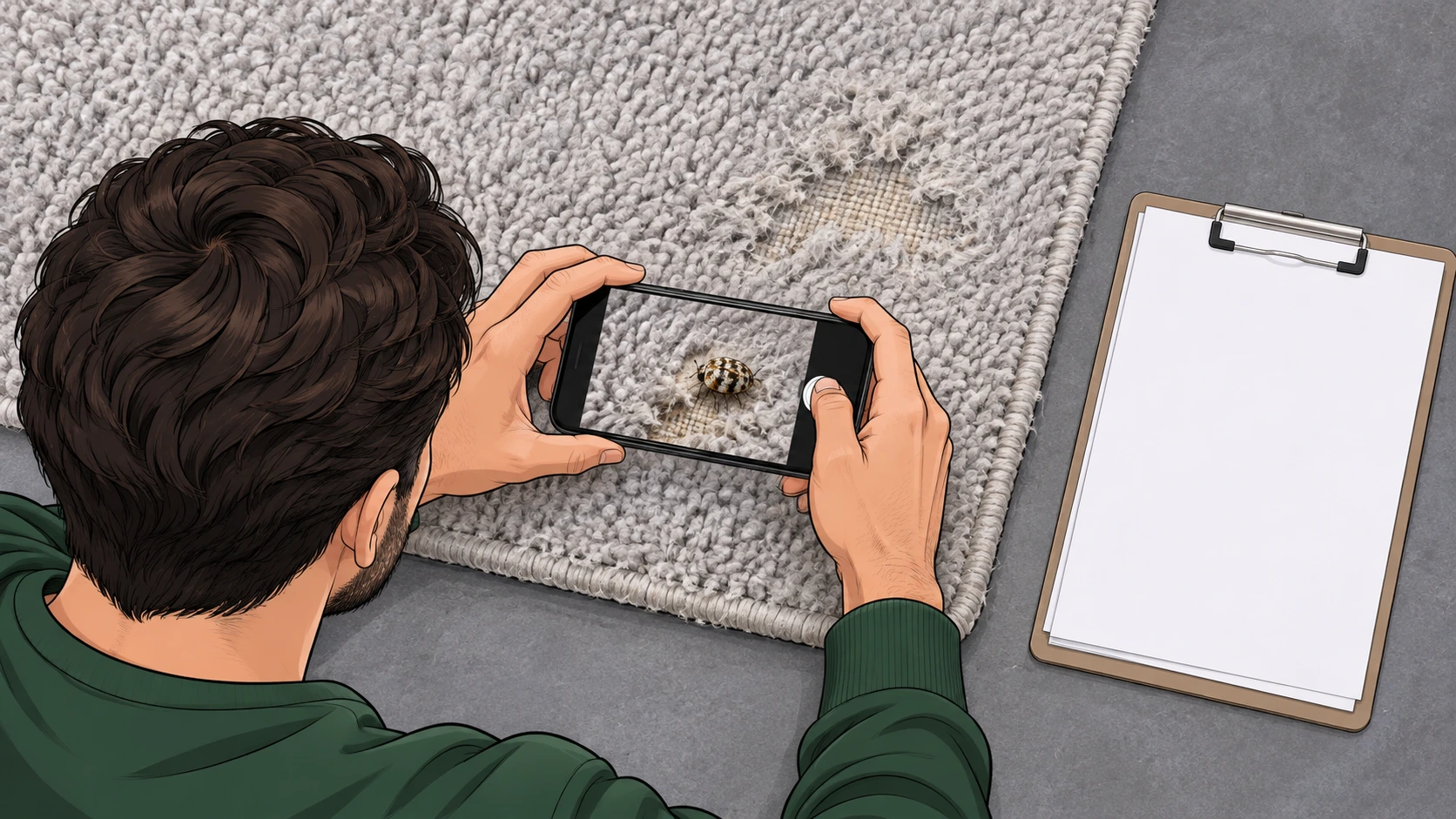
Home insurance usually does not cover carpet beetle damage, but the final answer depends on your policy. Most standard homeowners insurance policies exclude damage caused by insects, pests, or infestations. That means a carpet beetle infestation that leaves holes in an expensive wool rug, damages clothing, or ruins upholstered furniture will generally not qualify for reimbursement.
There are exceptions and distinctions worth understanding. Insurance policies do not all use identical wording, and an excluded insect infestation does not necessarily mean that every unrelated loss involving the same property is excluded. The insurer must consider what caused the damage, which parts of the policy apply, and whether any exceptions or endorsements change the standard coverage.
You also need to distinguish the cost of eliminating carpet beetles from the cost of replacing belongings they have damaged. Those expenses are not automatically treated the same way.
Before assuming that your insurer will pay, or that a claim is impossible, check the actual policy and ask how its insect-damage exclusion applies to your particular loss.
Why Home Insurance Usually Excludes Carpet Beetle Damage
Homeowners insurance is primarily designed to protect against specified losses, such as fire, theft, wind damage, and certain accidental events. It is not generally intended to pay for routine property maintenance or every type of gradual deterioration.
Carpet beetle damage usually falls into the excluded category because it results from insects feeding on susceptible materials over time.
The larvae can damage wool carpets, rugs, natural-fiber clothing, fur, feathers, and certain upholstered items. A homeowner may not notice the infestation until extensive damage has already developed in a storage area or beneath furniture.
That does not automatically mean the homeowner was negligent. Carpet beetles can be difficult to detect even in a well-maintained home. An insurance exclusion generally concerns the cause of the loss, not necessarily whether the policyholder did something wrong.
For example, the Canadian Insurance Bureau’s explanation of home insurance exclusions lists damage caused by insects and rodents among losses normally excluded from home insurance.
U.S. homeowners policies commonly have similar restrictions, although policy forms and state requirements differ.
An infestation that begins suddenly or is discovered unexpectedly does not necessarily become an insured event. The date you noticed the holes in a rug is not the same as the date the damage occurred, and neither fact overrides an exclusion for insect activity.
The underlying principle is that insurance protects against the losses defined by the contract. It does not guarantee reimbursement for every unexpected household expense.
What Types of Carpet Beetle Damage Are Usually Excluded?
The most common carpet beetle insurance questions involve possessions rather than the structure of a building.
A homeowner might discover damage to an expensive handmade rug, several wool suits, a fur-trimmed coat, or the fabric of an upholstered chair. The items may otherwise be insured as part of the home’s contents, but that does not mean every cause of damage is covered.
The distinction is between property that is insured and an event that is insured.
A wool coat may be protected against theft or a covered fire while having no coverage for holes caused by insect larvae. The item’s inclusion in your personal property coverage does not remove a separate insect-damage exclusion.
Here is how that distinction commonly applies:
| Carpet beetle-related loss | Typical insurance position | What needs checking |
|---|---|---|
| Larvae damage a wool rug | Usually excluded as insect damage | Insect and infestation exclusions |
| Wool clothing develops feeding holes | Usually excluded | Personal property coverage and cause-of-loss restrictions |
| Upholstery fabric is damaged by larvae | Usually excluded | Contents coverage, exclusions, and item ownership |
| Carpet beetles infest a closet | Usually no payment for treatment alone | Whether any specific pest-removal benefit exists |
| A separately covered fire damages an infested room | Fire damage may still be covered | Covered cause, ensuing-loss wording, and exclusions |
| A renter’s belongings are damaged | Usually excluded under tenant insurance | Tenant policy wording and local rules |
These are general interpretations, not guaranteed claim decisions.
One useful example comes from Canadian home insurance coverage guidance, which identifies pest damage and gradual deterioration among common exclusions. That does not establish what every policy issued in Canada says, but it illustrates the distinction between broad property protection and excluded causes.
A policy covering personal belongings up to a substantial limit may still pay nothing for carpet beetle damage if the applicable insect exclusion bars the claim.
Does Insurance Cover a Carpet or Rug Ruined by Carpet Beetles?
Usually not, even if the carpet or rug is expensive.
Suppose you own a handmade wool rug worth several thousand dollars. Carpet beetle larvae feed underneath it, damaging the pile in an area that was concealed by furniture.
The fact that the rug has substantial value does not make the damage insurable. Under a policy excluding insect damage, the insurer may decline reimbursement regardless of whether restoring the rug is economical.
There is an additional distinction between a removable rug and installed carpeting.
A removable area rug will generally be considered personal property. Wall-to-wall carpet that forms part of the building may fall under dwelling or building coverage. The relevant definitions depend on the insurer and the policy.
Either category can still contain an insect exclusion.
A homeowner should not assume that damage to a permanently installed carpet is covered simply because it is part of the house. The relevant question remains whether the cause of damage is insured.
Before attributing damage to carpet beetles, confirm that larvae or other reliable evidence supports that conclusion. Worn patches, fraying, or damaged fibers can have other causes, and the patterns of carpet beetle damage to rugs, carpet, and furniture can help distinguish possible insect feeding from ordinary wear.
Accurate identification matters when discussing the loss with an insurer. If the damage has been misidentified, the coverage assessment may be based on the wrong cause.
Are Clothes Damaged by Carpet Beetles Covered?
Clothing damaged by carpet beetle larvae is also usually excluded under standard home or renters insurance.
The problem can be especially frustrating when the damaged items are expensive suits, wool coats, cashmere sweaters, or stored seasonal clothing.
These items may be included within personal contents coverage for specified insured events, but that protection does not ordinarily override insect-damage exclusions.
For example, a policy might cover clothing destroyed by a covered house fire. The same policy could exclude damage caused by carpet beetles feeding on a sweater stored in a wardrobe.
It is possible to have additional coverage for valuable personal possessions, but the existence of a scheduled item or special endorsement does not automatically mean insect damage is insured. Special coverage can retain exclusions or impose its own conditions.
A claim involving a valuable garment deserves a closer look at the particular endorsement rather than an assumption that additional insurance must cover every kind of damage.
Photographs, purchase receipts, and a careful assessment of carpet beetle damage to clothing can help establish what happened. They do not, by themselves, create coverage where the policy excludes the cause.
Will Home Insurance Pay for Carpet Beetle Extermination?
Standard homeowners insurance generally does not pay for routine carpet beetle extermination.
Pest removal is usually treated as part of managing and maintaining the property, rather than repairing damage from a covered insured event.
This means an insurer may exclude both the damage caused by larvae and the expense of hiring someone to remove the infestation. However, they are separate questions under a policy, and they should be checked separately.
A professional treatment invoice is not automatically covered simply because the infestation has damaged insured belongings. Conversely, a specific policy benefit related to pest treatment would not necessarily cover replacement of a ruined rug.
The distinction becomes relevant when a homeowner discovers an infestation after another insured event.
For example, if a covered incident requires substantial repairs and a pest problem is discovered during those repairs, the insurer may need to distinguish necessary work related to the insured incident from unrelated pest management. The treatment expense is not automatically included in the insured repair costs.
An insurer may also distinguish preventive treatment, removal of insects, cleaning of contaminated material, and repairs to physically damaged property. Those categories should not be combined into one general request for pest reimbursement without checking the contract.
If you are considering a claim, ask the insurer to evaluate each expense under the relevant coverage provision. Do not assume that an approved building repair authorizes every additional maintenance expense.
Can You Claim If Carpet Beetles Were Discovered After a Sudden Event?
Discovering carpet beetles after a sudden event does not automatically turn their feeding damage into an insured loss.
Imagine a pipe bursts and damages a bedroom. While moving wet furnishings, you discover old carpet beetle feeding damage beneath a rug.
The water damage may be covered if the policy insures that particular event. The previously existing beetle damage may remain excluded.
Both losses occurred in the same room, but they have different causes.
The reverse distinction matters too. An insured event does not necessarily lose coverage merely because carpet beetles were also present in the property.
Some policies contain provisions allowing coverage for a separate resulting loss even where an earlier event or condition is excluded. These are sometimes called ensuing-loss provisions.
Their effect depends on the precise contract. They do not ordinarily transform the original insect damage into a covered loss.
For instance, a Canadian insurer’s discussion of pest-related claims and subsequent fire damage distinguishes the excluded damage caused directly by pests from damage caused by a fire that the policy otherwise covers.
This example involves a distinct insured event. It should not be interpreted as a promise that any secondary damage associated with carpet beetles will qualify.
When more than one cause contributed to a loss, insurers may also examine exclusions concerning concurrent causes, resulting losses, and the sequence of events. These provisions can materially change the outcome.
The safest conclusion is that the covered event and the excluded insect activity must be assessed separately under the actual policy wording.
Does Renters Insurance Cover Carpet Beetle Damage?
Renters insurance usually has similar limitations concerning insect damage, but the type of property being insured differs.
A tenant’s policy generally protects the tenant’s own belongings against covered risks. The building itself is usually insured by the owner or landlord.
This means a renter whose wool clothing is damaged by carpet beetles will generally need to look at their own contents coverage. If the carpeting belongs to the landlord, the renter’s contents insurance may not cover that carpeting at all.
Even where the belongings are included in contents coverage, the insect exclusion may prevent payment.
The Canadian guidance on renters insurance limitations specifically identifies insect infestations as a commonly excluded source of damage.
There is another issue that insurance alone does not resolve: who is responsible for addressing the infestation in a rental property.
That question can depend on the lease, building conditions, local tenancy legislation, the source of the infestation, and whether the landlord or tenant has failed to meet an applicable obligation.
A renter should not assume that an insurance exclusion automatically makes the tenant responsible for the cost of pest control. Nor should a landlord assume that damage caused by insects establishes tenant negligence.
A tenant who discovers carpet beetles should document the evidence, notify the landlord or property manager as required, and review the applicable local tenancy rules. A dispute over maintenance responsibility is distinct from whether an insurer will reimburse damaged belongings.
Does Comprehensive or All-Risk Home Insurance Make a Difference?
An all-risk, comprehensive, or open-perils policy does not necessarily cover carpet beetle damage.
Those descriptions can sound as though every possible cause of loss is included. In practice, these policies protect against a broad range of events except those expressly excluded.
An insect or pest exclusion can therefore apply even in a comprehensive policy.
Other policies use named-perils coverage, meaning that only specified causes of loss are insured. If insect damage is not among the listed causes, there may be no coverage even without an additional specific insect exclusion.
This difference is particularly important when reviewing personal property coverage. Some policies insure the building and belongings on different terms.
Do not decide whether a carpet beetle claim is covered based only on the marketing name of the insurance package.
You need the section that applies to the damaged item and the actual language describing insured and excluded causes.
An additional endorsement may expand coverage, but only if its wording changes the relevant exclusion or otherwise grants protection for that specific loss. Simply increasing your contents limit or purchasing higher replacement-cost coverage does not normally make an excluded insect loss payable.
What Wording Should You Look for in Your Insurance Policy?
The most useful part of reviewing a policy is not searching for the exact phrase carpet beetle. Many insurers use broader categories.
Start with the coverage section for the property involved, then look at the exclusions that apply to that section.
These are the terms most likely to matter:
| Policy wording | Why it matters for carpet beetles |
|---|---|
| Insects or insect infestation | May directly exclude carpet beetle feeding damage |
| Vermin or pests | May be defined broadly enough to include relevant insects |
| Nesting or infestation | May exclude losses associated with infestation activity |
| Wear and tear or deterioration | May independently affect gradually damaged materials |
| Gradual or continuous damage | May limit losses that develop over an extended period |
| Ensuing or resulting loss | May address a separate insured event following an excluded cause |
| Special limits or endorsements | May change how particular items are insured |
Not every policy contains all these terms. The presence of one term also does not establish that every related loss is excluded.
Definitions matter. A policy may define vermin, while another may list insects separately. Wording that looks similar can produce different results when read with the surrounding provisions.
Check endorsements and amendments issued after the original policy. An updated endorsement may modify the original wording.
It is also worth checking which policy period applies. Insurance purchased or changed after damage occurred generally does not retroactively insure an earlier excluded loss.
If the wording is unclear, ask the insurer or broker to identify the exact clause being applied to your circumstances.
The most useful question is: “Does this policy exclude direct damage caused by carpet beetle larvae to the specific item that was damaged, and is there any endorsement or exception that changes that result?”
That is more precise than asking whether home insurance covers bugs.
What If Your Damaged Items Are Very Expensive?
The financial value of a damaged item can make an insurance claim more important, but it does not determine whether the cause of loss is covered.
Consider two hypothetical losses involving a wool rug.
In the first, larvae have caused $4,000 worth of damage. The policy clearly excludes insect damage. The value of the rug does not override the exclusion.
In the second, the rug suffers $4,000 of damage from a covered fire. Its replacement or repair value, the applicable deductible, policy limits, and settlement method now become relevant.
Those are two different coverage outcomes despite the same dollar amount.
Insurance settlements can use replacement cost or actual cash value. Actual cash value normally accounts for depreciation, while replacement-cost terms generally assess the cost of replacing an eligible item with something of similar kind and quality.
These settlement methods matter only after coverage for the cause of loss has been established.
For a hypothetical $4,000 covered loss with a $1,000 deductible, an otherwise uncomplicated replacement-cost calculation might produce $3,000 before other policy adjustments. If the same $4,000 loss is excluded because insects caused it, the calculation produces no reimbursement.
The example shows why an expensive damaged rug does not automatically justify an insurance payout.
Before formally claiming, check your deductible and any relevant item limits, but do not let a favorable deductible distract from the more fundamental question of whether insect damage is insured.
What Evidence Should You Keep Before Contacting Your Insurer?
If the damage is significant or the cause is uncertain, document the loss before undertaking extensive restoration or disposing of valuable materials.
Photograph the affected item, including close views of the damage and wider views that establish its location. Preserve relevant receipts, purchase records, appraisals, or other evidence of ownership and value.
If carpet beetles are suspected, record the evidence supporting that conclusion. Finding live larvae in the affected material is more informative than discovering a few adult beetles near a window.
A professional assessment may be useful where an expensive rug, upholstered item, or collection is involved. The report should distinguish observed facts from assumptions about how or when the damage occurred.
The home inspection process for carpet beetles can help locate relevant insect activity, but a homeowner inspection cannot determine insurance coverage.
There is also no benefit in exaggerating the loss or identifying the cause as something other than insects to avoid an exclusion. An insurance claim should accurately state what is known and disclose uncertainty where the cause has not been confirmed.
You should still take reasonable steps to prevent further loss. Continuing insect activity should not be ignored while waiting for an insurance decision.
If the insurer needs to inspect the item, ask what documentation is required and whether cleaning, removal, or repair can proceed without affecting the assessment. Claims procedures and deadlines differ by policy and jurisdiction.
Should You File a Claim or Ask About Coverage First?
When the damage appears to fall under a standard insect exclusion, contacting your insurer or broker for clarification may be more sensible than immediately submitting a formal claim.
Explain what was damaged, the suspected cause, and what you would like the policy to reimburse. Ask whether the discussion can be treated as a coverage inquiry and whether a formal claim record would be opened.
This distinction matters because claim-handling practices differ. An inquiry may not have the same consequences as a submitted claim, but you should not assume that asking a question is always invisible to an insurer.
Where coverage is possible, understand the applicable deductible and policy limits before deciding how to proceed.
A useful set of questions is:
-
Does the insect or infestation exclusion apply to this exact item and cause of damage?
-
Are pest treatment costs and replacement of damaged belongings considered separately?
-
Does any endorsement modify the exclusion?
-
If a distinct covered event also occurred, how will the resulting damage be assessed?
-
What evidence and reporting deadlines apply if I proceed with a claim?
If you decide to claim, notify the insurer within the required time and preserve supporting records. Home insurance claim guidance emphasizes reviewing exclusions, deadlines, deductibles, and the possibility that a claim may affect future premiums.
These principles are useful beyond Canada, but exact procedures and legal requirements vary by jurisdiction.
What If Your Insurance Company Denies the Claim?
An insurer’s denial is not proof that every carpet beetle-related loss would be denied under every policy. It is a decision based on the insurer’s assessment of a particular contract and loss.
If you disagree, request a written explanation that identifies the relevant coverage provisions, exclusions, and facts used in the decision.
Compare that explanation with the full policy, including endorsements and definitions. Pay attention to whether the insurer has accurately identified the damaged property and the cause of the loss.
If the denial is based on an insect exclusion and the evidence clearly establishes carpet beetle feeding damage, the exclusion may leave little room for a successful challenge. However, where the cause is disputed or a separate covered event contributed to the damage, clarification may be warranted.
Follow the insurer’s internal complaint or appeal procedure. In the United States, your state insurance department may provide guidance on complaints and policy disputes. In Canada, consumers can use insurer complaint procedures and, where appropriate, the General Insurance OmbudService or their provincial or territorial regulator.
A written denial and a clear record of communications will be useful if you pursue review. The applicable process does not guarantee that the decision will be reversed.
What Is the Most Sensible Financial Response to Carpet Beetle Damage?
For a typical carpet beetle infestation, the practical priority is to prevent the damage from spreading rather than rely on an insurance payment that may be excluded.
Start by identifying the affected items and locating the material supporting larval feeding. Carpet beetles may continue developing in stored natural fibers, accumulated hair and lint, or other concealed animal-derived material.
Addressing the source protects the belongings that have not yet been damaged. Insecticide treatment alone may leave concealed breeding material untouched.
If carpet beetles keep returning after treatment, that is a reason to investigate the source again rather than assume the insurance company should reimburse every subsequent loss.
For valuable possessions, document damage promptly and investigate whether conservation or specialist repair is feasible. Restoration may be preferable to replacement, particularly when the item is difficult to replace with something of similar quality.
If damage is extensive, ask the insurer about coverage before incurring significant expenses that you expect to claim. Do not assume that a pest-control recommendation, a restoration estimate, or a contractor’s opinion about the severity of the damage establishes insurance eligibility.
The distinction is between managing a household problem and recovering money under a contract. The first requires identifying and addressing the infestation. The second depends on the policy’s coverage provisions.
The Bottom Line on Carpet Beetle Damage and Home Insurance
Most standard home and renters insurance policies exclude direct carpet beetle damage, including feeding damage to rugs, clothing, and upholstery. Extermination is also generally treated as a maintenance expense rather than an insured loss.
That does not justify a universal verdict for every policy or every related event. Special endorsements, the type of insured property, a separately covered cause of damage, and jurisdiction-specific requirements can affect an individual claim.
If the loss is substantial, identify the damaged property, document the suspected cause, and check the actual insect exclusion before deciding whether to claim. Ask your insurer to explain separately how the policy treats damaged belongings, pest treatment, and any distinct insured event.
For most households, stopping the infestation and protecting unaffected possessions will be more useful than assuming a standard insurance policy will replace items damaged by carpet beetle larvae.