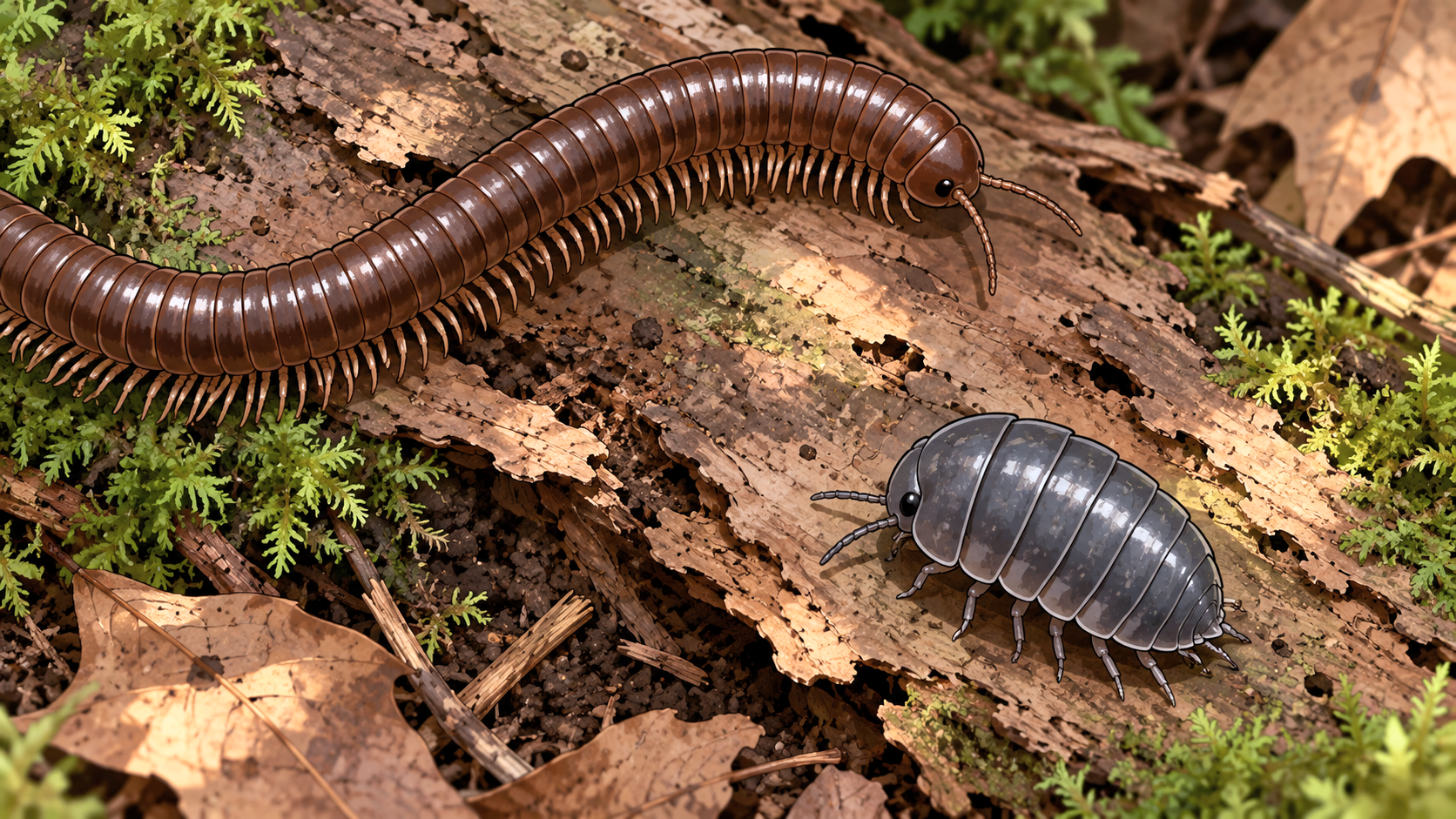
A roly-poly has seven pairs of walking legs and broad overlapping body plates, while a millipede has many more legs, with most adult trunk rings carrying two pairs. Ordinary millipedes are usually elongated, but pill millipedes can be short, rounded and capable of rolling into a ball, making leg arrangement the more reliable test. The comparison becomes much easier once you stop using “lots of legs” or “it rolled up” as the deciding feature. Roly-polies and millipedes belong to different branches of the arthropod family tree and build their superficially similar bodies in different ways.
A Long, Narrow Body Usually Settles the Question Immediately
Most millipedes have a body plan that looks nothing like a roly-poly. Their bodies consist of numerous rings arranged into a long cylinder or a somewhat flattened form, with rows of short legs continuing along much of the underside. A typical roly-poly is compact and oval, with a limited series of broad dorsal plates forming the familiar armored back. Its basic body structure includes seven leg-bearing thoracic segments, each carrying one pair of walking legs.
Millipedes have a different arrangement. Most of the trunk consists of diplosegments associated with two pairs of legs, and developmental work has shown that these structures arise through a complex relationship between dorsal and ventral segmentation. The visible rings therefore should not simply be counted as though each represents the same anatomical unit found in a pillbug. For identification, the useful feature is the dense succession of leg pairs beneath a millipede compared with the roly-poly’s seven pairs.
This works particularly well with the long millipedes commonly encountered beneath logs, mulch and stones. A cylindrical animal with dozens of legs extending down a long trunk is not a roly-poly, even if both animals were found in the same damp patch of ground.
Pill Millipedes Are the Exception That Makes This Comparison Difficult
Pill millipedes discard the elongated silhouette people usually associate with millipedes. Members of groups such as Glomerida have short, strongly convex bodies with broad dorsal plates, and they can roll themselves up when threatened. Glomeris marginata, a well-studied European species, has only about a dozen conspicuous dorsal plates despite having far more than the seven pairs of walking legs carried by an adult pillbug.
The resemblance is a striking example of unrelated arthropods arriving at similar protective body forms. Roly-polies are terrestrial isopod crustaceans, whereas pill millipedes belong to Diplopoda. The classification of roly-polies as isopods and crustaceans therefore remains completely separate from the millipede lineage despite their similar appearance.
A rolled specimen does not resolve this particular identification. Glomeris marginata can enclose itself in a compact defensive form, just as familiar pillbugs can curl their segmented bodies into a protective ball. If the animal is short enough to resemble a pillbug, inspect the underside and the arrangement of the dorsal plates instead.
Seven Pairs of Walking Legs Point to a Roly-Poly
An adult Armadillidium vulgare has exactly seven pairs of walking legs, one pair associated with each segment of the pereon. Its body continues behind those leg-bearing segments into the pleon, so counting visible plates from above is not a substitute for counting legs. Detailed descriptions of A. vulgare confirm the seven-segment pereon and seven corresponding leg pairs.
Adult pill millipedes carry considerably more. In G. marginata, females have 17 pairs and males have 19 pairs of legs. Millipede development complicates counts in juveniles because young animals add additional segments and legs as they molt, but even then their leg arrangement develops toward the characteristic diplopod pattern. The underlying body plan involves dorsal units associated with two ventral leg-bearing units.
You do not need to count every individual leg. A clear underside photograph can often show whether there are seven orderly pairs or a much denser series extending beneath the body. This is especially valuable when color, size and defensive posture are giving contradictory clues.
The Plates Look Different Once You Know Where to Look
A pillbug’s back consists of several similarly proportioned plates that create a repeated armored pattern from the front of the body toward the smaller abdominal region. The overall form is usually oval, and the visible segmented appearance is one of the strongest roly-poly identification features.
Pill millipedes organize their armor differently. In G. marginata, the plate immediately behind the small first dorsal plate is greatly enlarged, producing a broad shield near the front of the animal. The posterior end finishes with another large plate rather than the sequence of smaller structures visible toward the rear of a pillbug. Research on Glomeris development shows that its dorsal plates do not correspond one-for-one with its ventral leg-bearing segments because adjacent dorsal segmental units fuse during development.
Those proportions can be easier to see than the legs when the animal refuses to uncurl. A large front shield and broad terminal plate favor a pill millipede; the more regularly repeated plates of a familiar Armadillidium favor a roly-poly.
Color Is a Poor Shortcut
Gray and brown are common among roly-polies, but pillbug coloration can vary considerably. Pill millipedes also occur in dark and patterned forms. G. marginata, for example, is commonly dark with contrasting pale edges on its dorsal plates, while other pill millipede species can have conspicuous bands, spots or brighter markings.
Shininess is similarly weak evidence. A glossy black pill millipede may look different from the gray pillbug someone expects to find in a garden, yet neither sheen nor darkness identifies the larger group reliably. Structural characters remain useful across color variations that would otherwise produce a mistaken identification.
Size needs the same caution. Pill millipedes include species within the size range of common pillbugs as well as substantially larger forms. Juveniles further blur any size-based rule.
Habitat Will Not Reliably Separate Them
Both animals can turn up beneath logs, stones, bark and accumulated plant debris because humid ground-level refuges protect them from drying. Roly-polies commonly occupy moist environments with abundant organic material, while millipedes also favor sheltered habitats containing decaying vegetation. Finding both in the same patch of leaf litter is therefore entirely plausible.
Their feeding habits overlap enough to make location around decomposing leaves equally unhelpful. Roly-polies consume substantial amounts of dead and decaying plant material, and many millipedes feed on similar detritus. Habitat can support an identification already based on anatomy, but it cannot resolve the comparison by itself.
Use the Underside When a Rolled Animal Could Be Either One
If a small armored animal rolls into a ball, let it uncurl on its own rather than trying to force it open. Once it begins walking, examine the legs from the side or underside. Seven pairs indicate an adult terrestrial isopod of the pillbug body plan; numerous pairs arranged along the trunk indicate a millipede.
A photograph can make this easier. Capture the entire dorsal surface, then take a side view while the animal is walking. Magnification may reveal the plate arrangement without handling it. This approach avoids relying on a defensive behavior shared by both animals and keeps the identification focused on structural differences.
Questions That Resolve Less Obvious Roly-Poly and Millipede Sightings
Does a millipede always curl into a spiral instead of a ball?
No. Many elongated millipedes coil into a spiral, but pill millipedes can form a compact ball. Rolling behavior alone therefore cannot separate every millipede from a roly-poly.
Can a juvenile millipede have fewer legs than an adult?
Yes. Millipedes add segments and legs during development. Pill millipedes such as G. marginata begin with fewer leg pairs and acquire more through successive molts, so an unusually small specimen deserves closer examination rather than an identification based only on total size.
Are pill millipedes a type of roly-poly?
No. The resemblance is superficial. A pill millipede is a diplopod, while a roly-poly is a terrestrial isopod crustacean. The term “roly-poly” can be used loosely in everyday speech, but the animals are anatomically and taxonomically separate.
Can both appear around a house after wet weather?
Yes. Moist conditions can increase surface activity by terrestrial arthropods that normally remain in protected outdoor habitats. A roly-poly found inside often reflects the same moisture and entry conditions associated with accidental household sightings, while an elongated many-legged specimen requires identification as a different animal.