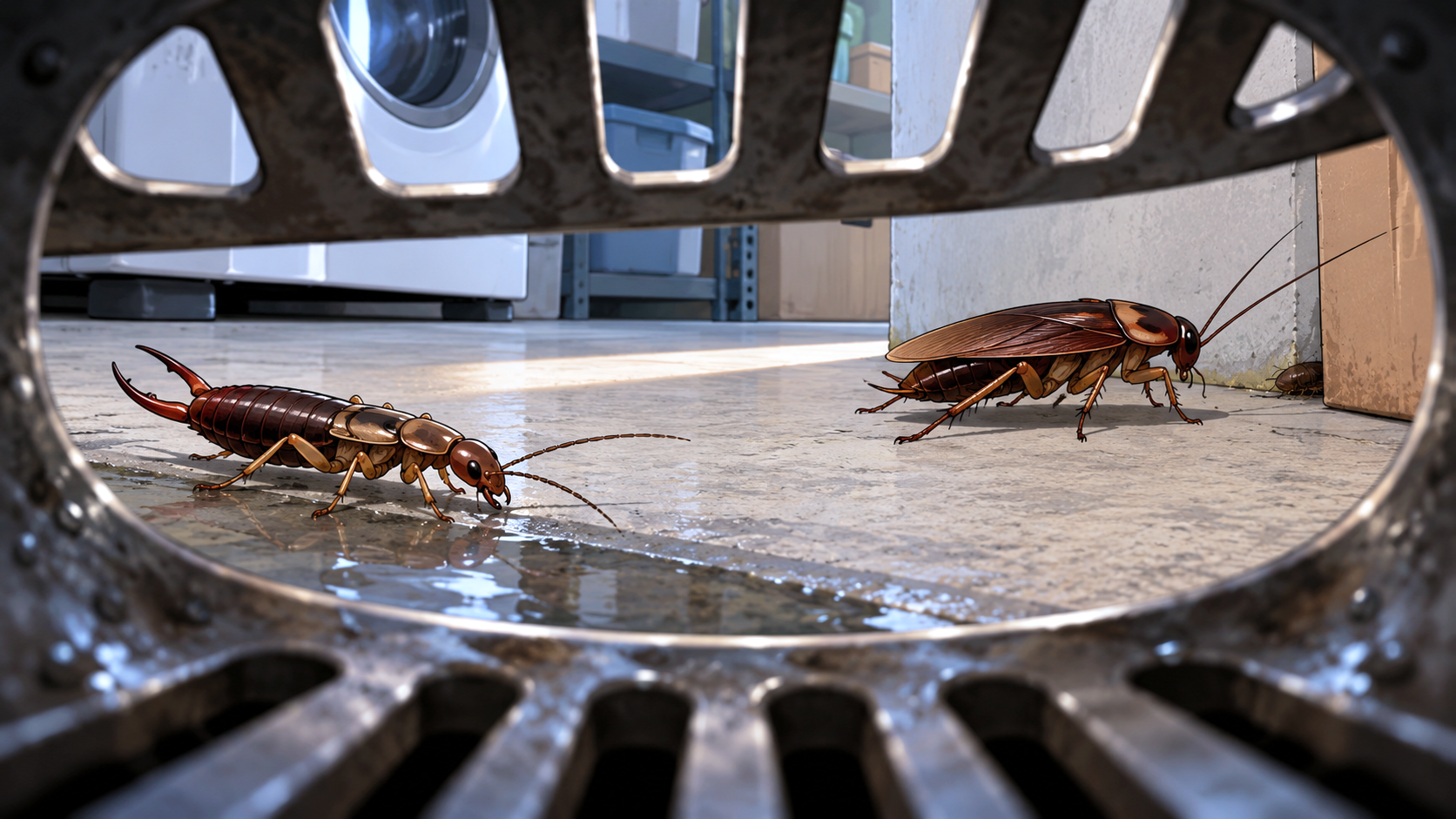
An earwig and a cockroach can both be brown, fast-moving insects that appear indoors at night, but they are easy to separate once you know where to look. Earwigs have a long, narrow body with obvious forceps at the rear. Cockroaches have a broader, oval, flattened body, very long antennae, and spiny legs. They are completely different groups of insects.
The fastest identification trick is to ignore color at first. Brown tells you very little. Look at the shape of the body and, above all, the end of the abdomen.
Earwig vs. Cockroach at a Glance
The feature we would check first is the rear of the insect. An earwig has a conspicuous pair of pincer-like appendages called cerci. In the common European earwig (Forficula auricularia), these can be strongly curved in males and considerably straighter in females. Those forceps make an earwig’s outline difficult to confuse once you get a clear look.
Cockroaches also have cerci, but theirs do not form the large forceps associated with earwigs. Instead, a typical household cockroach has a flattened, oval body with long antennae and six spiny legs. From above, the pronotum behind a cockroach’s head can obscure much of the head itself.
That gives you a much better comparison than color. Earwig means narrow body plus obvious rear forceps. Cockroach means broader oval body, exceptionally long antennae, and visibly spiny legs.
Earwigs Have Rear Pincers That Cockroaches Do Not
Nothing separates these two insects faster than the earwig’s forceps.
Earwigs belong to the order Dermaptera, and the pair of pincers at the end of the abdomen is one of the group’s most recognizable features. The structures are modified cerci. Earwigs use them in defense, and they can also help grab and hold prey.
The forceps can look surprisingly formidable on an adult male because they may curve inward like pincers. Females usually have straighter, more slender cerci. Our guide to male and female earwigs covers that difference in more detail.
A cockroach lacks those large terminal forceps. So, when you can clearly see two substantial pincers projecting from the back of the insect, you have an extremely useful clue that you are looking at an earwig.
There is one identification mistake worth avoiding. Do not assume the forceps are jaws simply because they look like them. An earwig’s actual mouthparts are at its head. The prominent “pinchers” are at the opposite end, and our guide to what earwig pincers are used for explains their functions separately.
Cockroaches Are Broader and More Oval
Body shape is the next feature we would use, especially when the rear of the insect is difficult to see.
An adult European earwig has an elongated, somewhat flattened body. Its abdomen remains relatively narrow from front to back before ending at the forceps. European earwigs are commonly reddish brown, and adults are around 5/8 to 3/4 inch long.
Cockroaches have a noticeably different silhouette. Their bodies are flattened too, but they are generally broader and more oval. The legs also project prominently from the sides, giving many cockroaches a wider overall appearance.
Size by itself is less helpful because cockroach species vary enormously. An adult German cockroach is only about 1/2 inch long, while an American cockroach can reach around 1 1/2 to 2 inches. That means a small cockroach can overlap with an earwig in length.
For that reason, we would never identify an earwig versus a cockroach from size alone. Shape and appendages give you far stronger evidence. If you need to judge the first insect specifically, our guide to how big earwigs get covers the size question without using it as a stand-alone identification test.
Cockroach Antennae Usually Look Much Longer
Both insects have antennae, so the mere presence of antennae tells you almost nothing. Their proportions are more useful.
Household cockroaches typically have long antennae about the length of the body. They can be among the first features you notice when a cockroach runs across an open surface.
European earwigs have antennae too, but their overall appearance is dominated much more by the long abdomen and terminal forceps. The antennae project from the head while the unmistakable pincers sit at the opposite end.
This gives you a useful front-to-back check. A suspected cockroach may appear to have extremely long feelers sweeping ahead of a broad body. An earwig presents a narrower profile with the distinctive paired forceps completing the other end.
Earwig and Cockroach Wings Look Different
Wings can help with adult insects, although they are not the feature we would check first.
Most earwig species have wings tucked beneath short, hardened forewings. The arrangement can make an adult earwig look almost wingless at first glance because the visible wing covers are so short. Earwigs also seldom fly.
Adult cockroach wings vary substantially by species and sex. German cockroach adults have wings, for example, while American cockroach adults have long wings covering the abdomen. Oriental cockroaches are different again. Males have shortened wings, while females have much smaller wing structures.
Immature insects complicate wing-based identification further. Cockroach nymphs are wingless, and immature earwigs also lack adult wings. Therefore, the absence of visible wings does not settle an earwig vs. cockroach identification.
The earwig’s rear forceps remain the much cleaner feature. Our dedicated article on whether earwigs have wings and can fly covers their unusual wing arrangement in more detail.
Where You Found the Insect Can Provide Another Clue
Location should support an identification, not replace one.
Earwigs are strongly associated with protected, damp outdoor spaces. During the day they commonly shelter beneath debris, boards, mulch, vegetation, and other dark cover. They are active mainly at night. Earwigs can also wander into homes and other buildings, sometimes in noticeable numbers.
Cockroach habitat depends heavily on the species. German cockroaches favor warm, humid indoor areas and commonly hide around kitchens and bathrooms. Oriental cockroaches favor cooler, dark, damp locations such as basements, crawl spaces, drains, and sewers. American cockroaches also favor warm, moist environments and can occur around basements, floor drains, pipe chases, and sewers.
That overlap is precisely why finding a brown insect in a damp basement or bathroom does not identify it. Both groups can appear in moist areas.
The difference becomes more meaningful when you consider the larger pattern. An earwig that wanders inside from outdoors is not equivalent to discovering an indoor pest cockroach population. Earwigs found inside are generally nuisance invaders, while several cockroach species can establish and reproduce inside buildings.
For recurring earwigs, our guide to why earwigs get into houses addresses that pattern specifically.
Finding an Earwig Indoors Is Not the Same as Finding a Pest Cockroach
This is the distinction that matters most after identification.
An indoor earwig can certainly be unwanted, but earwigs do not damage people, property, or food. They are considered nuisance pests when they wander indoors. Outdoors, the picture is different because some earwigs can damage flowers, seedlings, and other plants while also feeding on other insects.
Household pest cockroaches deserve a different response. Cockroaches can contaminate food, and their saliva, feces, and shed skins can contribute to allergy and asthma problems. Correct species identification also matters because the places they hide and the appropriate control strategy can differ among German, Oriental, American, and brown-banded cockroaches.
That is why mistaking one insect for the other can lead you in the wrong direction. Treating a single wandering earwig as proof of a cockroach infestation creates unnecessary alarm. Dismissing actual cockroaches as harmless earwigs creates the opposite problem.
When an insect lacks the identifying features described here, compare it against our broader guide to bugs that look like earwigs before deciding what you have.
Confirm the Insect Before Deciding What to Do
For a mystery insect, start with a clear view of the entire body rather than immediately reaching for a pesticide.
Look first at the rear. Large paired forceps strongly point toward an earwig. Then check the overall silhouette. A narrow, elongated insect fits an earwig better, while a broad, oval insect with very long antennae and conspicuously spiny legs fits a cockroach better.
A photograph from directly above can make those differences much easier to judge. Color and room location should come later because both can mislead you.
Once you have confirmed an earwig, there is no reason to use cockroach-specific advice against it. Repeated earwig sightings have their own causes, and our guide to getting rid of earwigs covers the appropriate control options.
Other Questions About Earwigs and Cockroaches
Can an earwig turn into a cockroach?
No. Earwigs and cockroaches belong to different insect orders. An immature earwig develops into an adult earwig, while a cockroach nymph develops into an adult cockroach.
Do baby cockroaches look more like earwigs than adults do?
Cockroach nymphs lack the fully developed wings seen on many adult cockroaches, which can change their appearance considerably. However, they still lack the large rear forceps that make an earwig so distinctive.
Can earwigs and cockroaches be found in the same house?
Yes. Their preferred conditions can overlap, particularly around dark and damp areas. Finding both in one building does not mean they are related or that one attracts the other.
Is a black insect with pincers an earwig or a cockroach?
Color alone cannot settle the identification. Some earwigs can appear very dark, while some cockroaches are dark brown to almost black. Large forceps attached to the rear of an elongated insect are much more useful evidence for an earwig than color.
One thought on “Earwig vs. Cockroach”