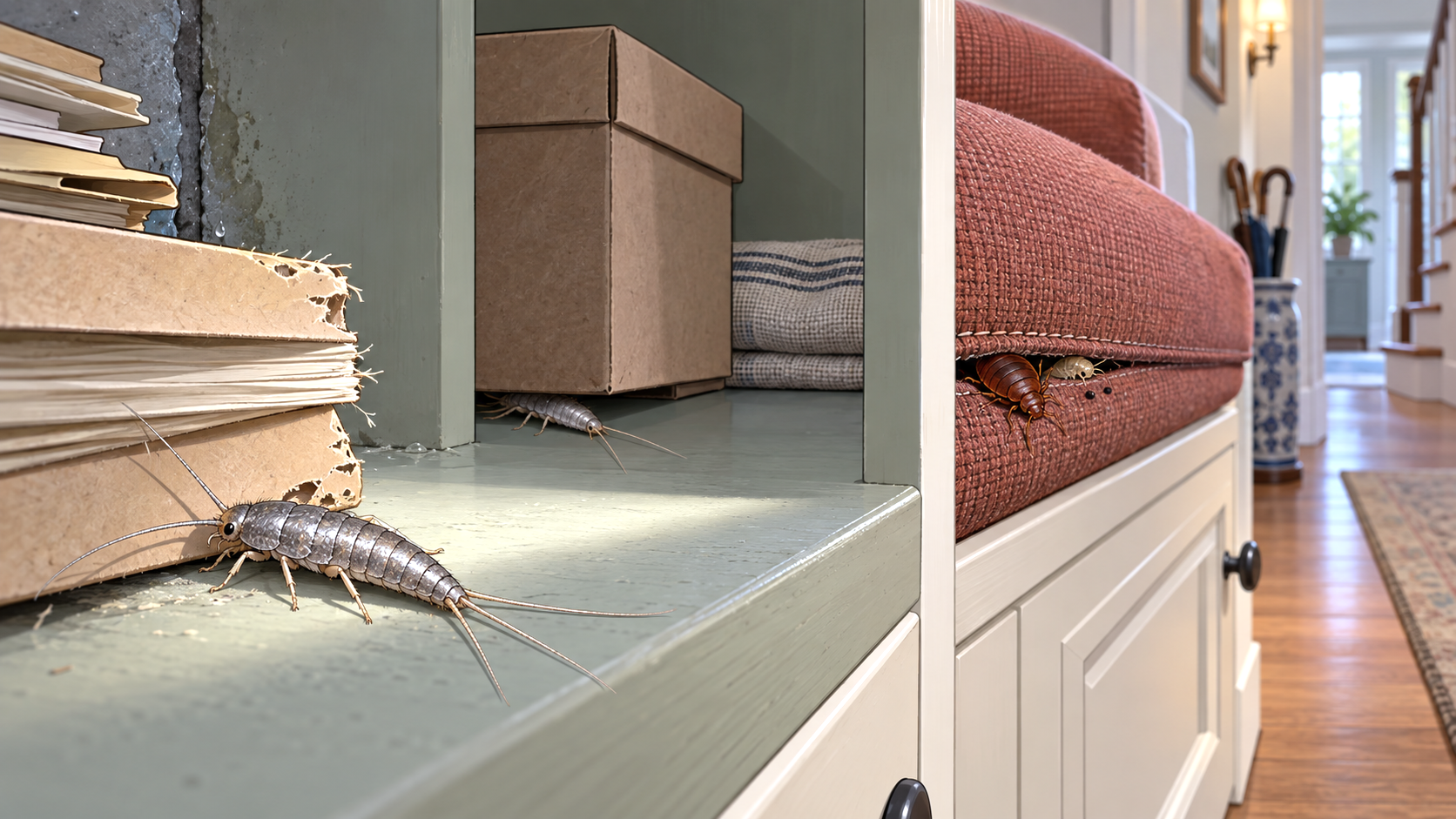
Nothing else that turns up in a bathroom or basement has three long, thread-like tails trailing off the back end. Once you’ve seen that feature once, you’ll never confuse a silverfish with anything else again, bed bug included.
Silverfish have a distinctive carrot-shaped body covered in silvery scales with three long, thread-like tails trailing from the rear, a feature no bed bug has at any life stage. They feed on starches, paper, and cellulose rather than blood, prefer damp bathrooms and basements over a bed, and don’t bite people at all.
Three Tails Settle This Before Anything Else
This is the single fastest, most unmistakable identification marker in this entire comparison. NC State Extension describes silverfish as having two long antennae attached to the head and characteristically three long tail-like appendages projecting from the tip of the abdomen. University of Maryland Extension confirms the same feature directly, describing these appendages as long, thin, and tail-like. A bed bug has nothing resembling this at any point in its life. Its body ends in a simple, rounded rear with no trailing bristles of any kind, which makes this one comparison where a single glance genuinely settles the question.
A Body Shaped Like a Carrot, Not an Apple Seed
Beyond the tails, the overall body shape points in a completely different direction too. University of Missouri Extension describes silverfish and their close relatives as carrot-shaped, somewhat flattened, and covered with grayish scales, typically around a half inch long. That tapering, carrot-like outline, wider near the head and narrowing toward the tail, looks nothing like a bed bug’s uniform, flat, oval body, which is more often compared to an apple seed than anything shaped like a vegetable. The silvery, scaled sheen itself is another giveaway, since a bed bug’s body is a plain reddish-brown with no shimmer at all.
Damp and Dark Beats Anywhere Near a Host
Where each pest actually turns up tells its own story. NC State Extension notes that silverfish prefer cool, damp areas, commonly found in bathrooms, basements, and bookshelves or other spots where rarely used items sit undisturbed. That preference for moisture has nothing to do with a bed bug’s actual motivation, which is simply staying close to a sleeping host regardless of how humid or dry that particular room happens to be. A silverfish sighting in a damp bathroom says something about that room’s moisture level. A bed bug sighting says something about where someone sleeps.
What It’s Actually Eating Instead of You
The diet difference explains the kind of damage each pest actually leaves behind. Silverfish feed on starches, carbohydrates, and materials containing cellulose, including paper, book bindings, wallpaper paste, and textiles, which is why an infestation often shows up as irregular holes or notches in stored books, cardboard, or fabric rather than anything resembling a bite mark. A bed bug has no interest in any of that, feeding exclusively on blood and leaving behind fecal spotting and shed skins rather than damaged paper or clothing.
A Genuinely Long Life for Something This Small
This is a detail worth appreciating on its own. Maryland Extension notes that silverfish can live for 2 to 3 years under good conditions, a genuinely long lifespan for an insect this size. That’s considerably longer than a typical bed bug’s life, which usually runs from several months up to about a year depending on feeding conditions. A silverfish problem that’s gone unnoticed for a while isn’t necessarily a fast-growing one, but it can be a persistent one simply because the individuals involved live so long.
Why Fixing the Humidity Solves This, Not Pest Treatment
Since silverfish are drawn specifically to moisture rather than a host, the actual fix looks nothing like bed bug treatment. Maryland Extension recommends eliminating sources of dampness such as leaky plumbing or condensation, sealing gaps around pipes, storing food in tightly sealed containers, and applying silica gel or boric acid dust directly into cracks and crevices where the insects hide during the day. That’s a moisture-and-exclusion strategy aimed at making a space less hospitable, which is a completely different approach from confirming and treating an actual bed bug infestation centered on a mattress or sleeping area.
Common Questions About Silverfish vs Bed Bugs
Can silverfish actually bite people or pets? No. Silverfish don’t bite, sting, or spread disease, since their mouthparts are built for scraping at starches and paper rather than piercing skin the way a bed bug’s are.
Do silverfish move differently than bed bugs? Yes. Silverfish move in quick bursts, darting rapidly and then stopping for short intervals, while a bed bug crawls at a slower, steadier pace toward or away from a host.
Does finding a silverfish in a bedroom mean there’s also a bed bug problem? No. Since silverfish are drawn to moisture and starchy materials rather than a sleeping host, finding one in a bedroom points toward humidity or stored paper and fabric in that room, not toward bed bugs.
How can you tell if damage to books or paper came from silverfish? Irregular holes, notches, or yellowish staining on paper, book bindings, wallpaper, or fabric are consistent with silverfish feeding, a kind of damage a bed bug never causes.