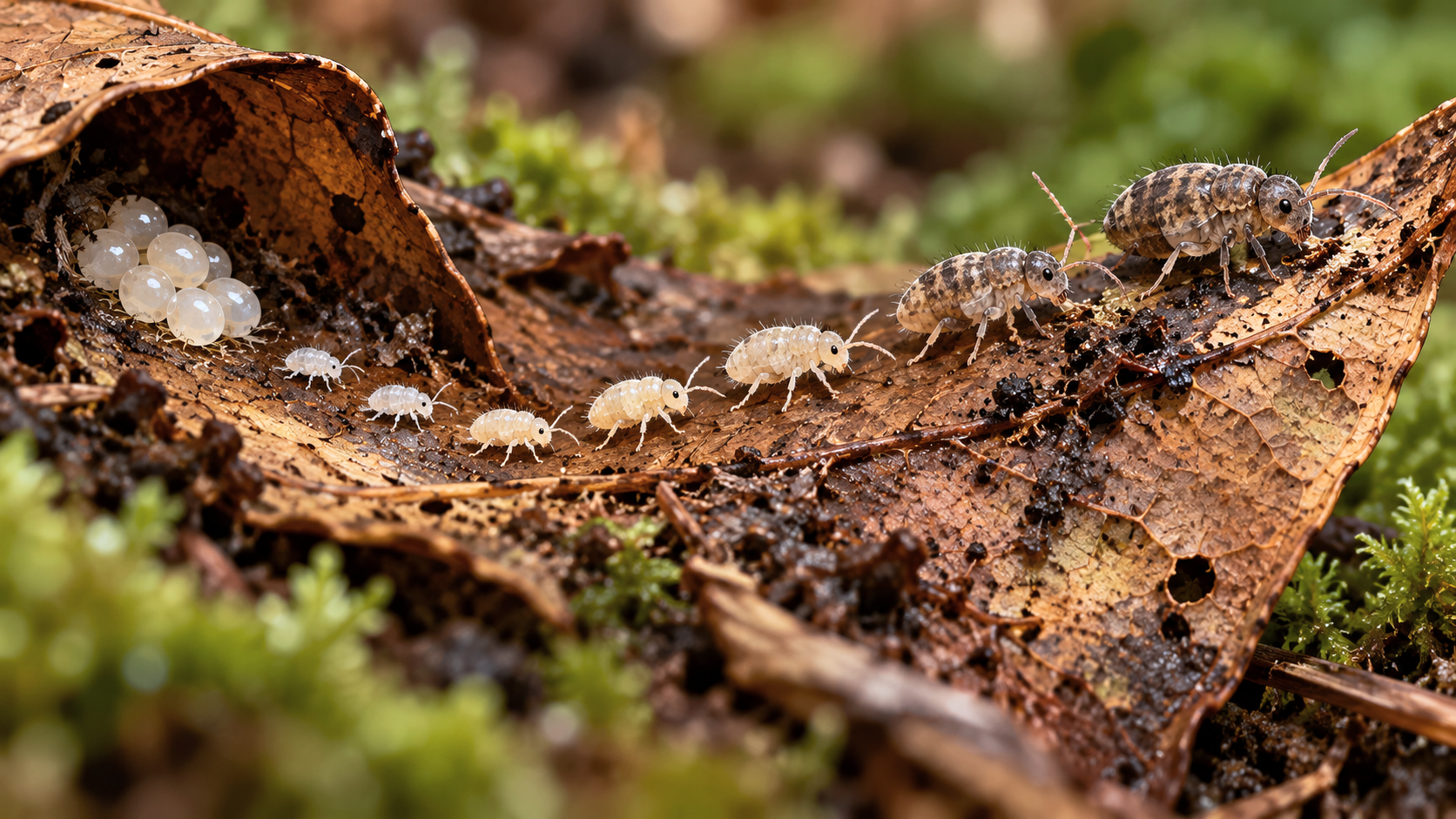
A springtail does not pass through a caterpillar-like larval stage or become a pupa before adulthood. Instead, a young springtail hatches looking much like a miniature adult. It grows through repeated molts until it reaches sexual maturity, and unlike most familiar arthropods, it can continue molting even after becoming an adult. The springtail life cycle can therefore be understood as three main stages: egg, immature springtail, and adult. This relatively simple development is called ametabolous development, meaning there is no major transformation in body form as the animal matures.
The Springtail Life Cycle Begins With an Egg
Springtails begin life inside tiny eggs. Depending on the species, females can lay eggs singly or in groups. Some species also cover their eggs after laying them. The exact reproductive behavior varies across Collembola, so there is no single egg-laying pattern that applies to every springtail.
The eggs themselves are extremely small. One extension reference describes them as spherical and about 0.2 millimeters in diameter, which helps explain why finding individual springtail eggs in soil is much harder than noticing a mass of active springtails on the surface. Under suitable conditions, eggs can hatch in about 10 days, although development time depends on temperature.
For a closer look at this first stage, our guide to what springtail eggs look like focuses specifically on their appearance.
Young Springtails Look Like Smaller Adults
What emerges from the egg is not a larva in the sense of a caterpillar, maggot, or beetle grub. An immature springtail already resembles the adult body form, although it is smaller and not yet sexually mature.
That makes the life cycle easy to misunderstand. Finding two springtails of noticeably different sizes does not necessarily mean you are looking at two different kinds. One may simply be less mature than the other. However, springtails vary substantially in adult size between species, so size by itself cannot establish life stage. Our guide to how big springtails are explains that variation in more detail.
The immature springtail grows by molting. Its outer covering cannot simply expand indefinitely as the animal develops, so it periodically sheds that covering and enters another instar. An instar is the developmental period between successive molts.
Springtails Molt Several Times Before Adulthood
The number of juvenile molts is not identical across every springtail species. Published extension references describe young springtails molting at least four times, while other references give ranges of about five to eight molts before adulthood.
With each juvenile stage, the animal moves closer to sexual maturity without undergoing the dramatic reconstruction seen in insects with complete metamorphosis. Its basic springtail form is already present. This is the key feature to remember when picturing the cycle. A springtail develops mainly by growing and molting, rather than passing through completely different-looking larval and pupal forms.
Development can also happen quickly under favorable conditions. One university resource describes eggs hatching after about 10 days and juveniles reaching adulthood after several molts in a short period, while another notes more generally that springtail life cycles can be completed rapidly when temperatures permit. Because species and environmental conditions differ, a single fixed egg-to-adult timeline should not be applied to every springtail.
Adult Springtails Keep Molting
Reaching adulthood does something unusual to the springtail life cycle: it does not end the molting process.
Springtails continue to molt periodically after reaching sexual maturity. That separates them from most familiar insects, which stop molting once they reach the adult stage. Some springtails may undergo dozens of molts over an entire lifetime.
Adult molting should not be mistaken for the springtail progressing into another major life stage. It is already an adult. In fact, adults that molt do not necessarily continue getting larger. Observations summarized by NC State Extension note that adults continue to molt from time to time without appearing to increase in size.
This is probably the most useful distinction between the springtail life cycle and the life cycles people learn for familiar insects. Adulthood marks reproductive maturity, but it does not mark the final molt.
Springtails Do Not Have a Pupal Stage
There is no springtail pupa between the immature and adult stages. There is also no radically different larval form that must transform into the adult body.
That means the springtail life cycle is fundamentally different from the egg → larva → pupa → adult development of butterflies, beetles, flies, and other insects with complete metamorphosis. Springtail development instead proceeds through egg → immature stages → adult, with repeated molts connecting those stages.
For homeowners, this also prevents a common identification mistake. You should not expect to find springtail “maggots,” caterpillar-like larvae, or pupae alongside adult springtails. A very small animal with the same general springtail shape can simply be an immature individual.
Moisture Helps Springtails Complete Their Life Cycle
The life cycle is closely tied to suitable environmental conditions. Springtails are strongly associated with moisture, and their development is most successful in humid environments. Cool, damp soil, leaf litter, decaying organic material, compost, and similar habitats can support substantial populations.
That connection matters indoors as well. A population repeatedly reproducing in a houseplant pot, for example, has more than just somewhere to stand. Persistently damp growing media can provide conditions where springtails survive and reproduce. This is why springtails often become conspicuous after watering and why letting overly wet potting soil dry appropriately can reduce their numbers.
If large numbers keep appearing inside your home, our guide to the signs of a springtail infestation can help you distinguish an established moisture-related population from a few stray individuals. The next useful step is usually finding what is attracting springtails, rather than trying to determine the exact age of each animal you see.
What the Springtail Life Cycle Tells You About an Indoor Population
Seeing springtails of several sizes in one damp location can be consistent with individuals at different developmental stages, but size alone is not enough to prove that they are reproducing there. Different springtail species naturally reach different adult sizes.
Instead, pay attention to the location and conditions surrounding repeated sightings. Springtails require moisture, and large indoor numbers commonly point toward damp conditions. Bathrooms, plumbing leaks, basements, and overly wet houseplant soil are typical places where those conditions can occur.
So the practical lesson from the life cycle is not to search your house for a hidden pupa or obvious nest. Neither is part of their development. When springtails persist indoors, investigating the moisture supporting them is more useful. Our guide to how springtails get into a house covers the other half of that problem.
Other Questions About the Springtail Life Cycle
Do springtails have larvae?
No. Springtails hatch as immature individuals that already resemble smaller versions of adults. They do not have a distinctly different larval stage followed by a pupa.
How many times does a springtail molt?
The number varies. Young springtails undergo several molts before reaching adulthood, and adults continue molting periodically afterward. Some references report that the lifetime total can reach dozens of molts.
Can adult springtails still molt?
Yes. Continuing to molt after sexual maturity is a distinctive part of springtail biology. An adult does not become a new life stage after these molts.
Do springtails reproduce all year?
There is no single schedule that applies to every springtail species and climate. Springtail development and population growth depend strongly on environmental conditions, particularly moisture and temperature. Some species can also overwinter as adults.
How long does an adult springtail live?
Longevity varies among species and environmental conditions. Some springtails can live for more than a year, so adulthood is not necessarily a brief final stage. For a closer look at longevity rather than development, see how long springtails live.
One thought on “The Springtail Life Cycle: Egg to Adult”