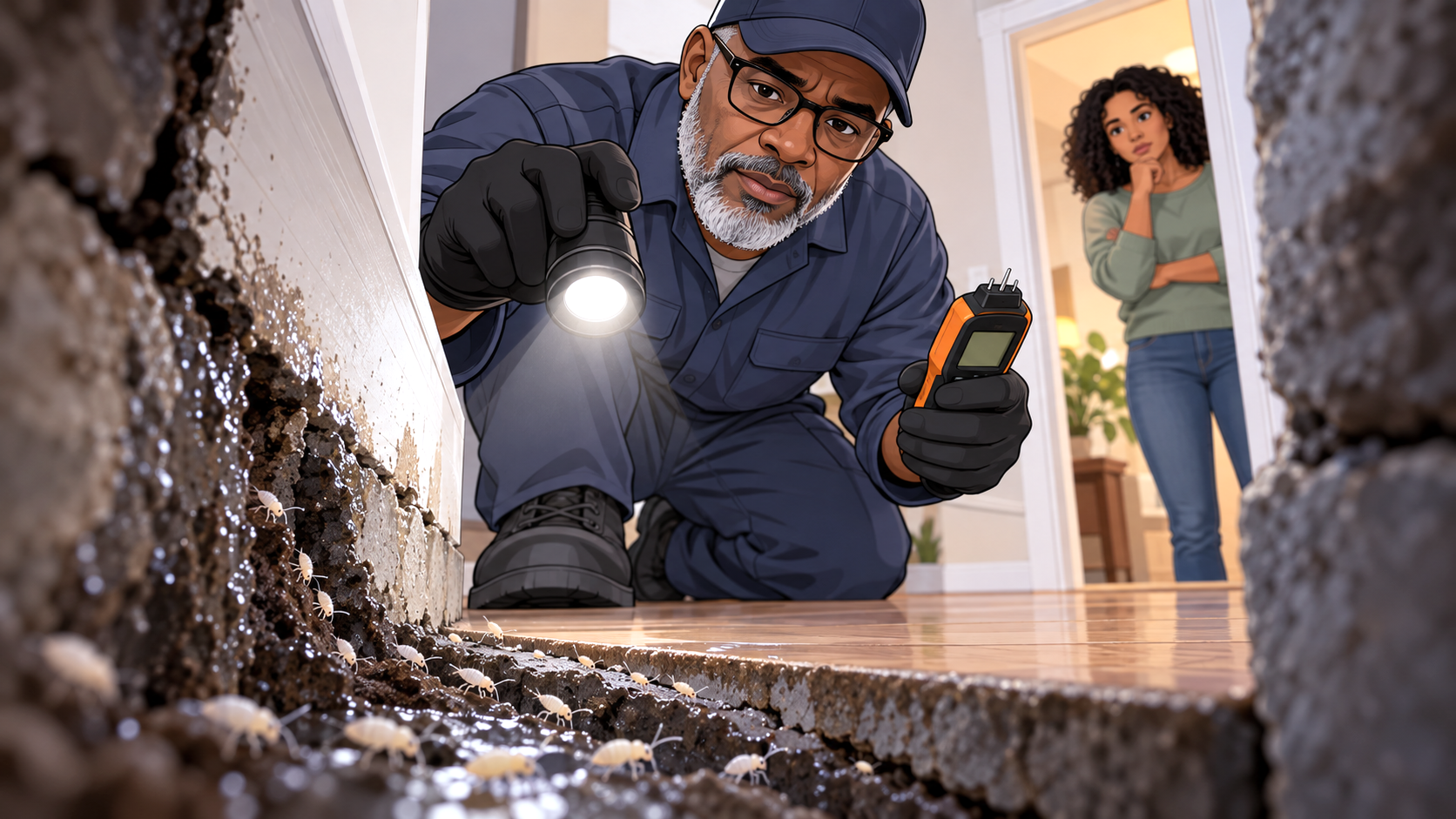
Most springtail sightings do not begin with a phone call to an exterminator. A few jumping around a damp flowerpot, appearing briefly in a bathtub, or wandering inside after wet weather can often be traced to moisture and handled without professional pest control.
The decision becomes harder when you have already done the obvious things and the springtails keep returning. You should consider calling an exterminator for springtails when large numbers keep entering your home, you cannot locate where they are coming from, the infestation continues after moisture problems have been addressed, or the affected area is difficult to inspect or treat safely. A professional can help identify the source, entry routes, and whether pesticide treatment is appropriate.
There is no magic number of springtails that turns a household problem into a professional one. What matters more is how long the problem lasts, where the insects are appearing, whether you can identify the source, and what you have already tried.
You Have Reached the Point Where Guessing Is Costing More Than the Service Call
One of the clearest reasons to bring in a professional is not that springtails are particularly dangerous. They are not. It is that you no longer know what you are treating.
You dry the bathroom and they return. You clean around the basement window and they return. You spray outside and they return. You seal one crack, only to find them gathering somewhere else three days later. At that stage, another bottle of pesticide may simply add one more experiment to a growing collection of unsuccessful ones.
Springtails depend on moist environments, and recurring indoor populations are often associated with excessive moisture. They can also migrate into buildings from large populations outdoors. University of Minnesota Extension recommends investigating plumbing leaks, drainage, excessive irrigation, wet wood, and other moisture sources when springtails occur indoors.
A pest professional can approach the problem from the opposite direction. Instead of starting with a product, the inspection can start with the distribution of the springtails and work backward toward their source.
That becomes especially valuable when you have already followed the basic steps in our complete guide to getting rid of springtails without finding an explanation for the continued activity.
A Thousand Springtails Outside Can Be Less Concerning Than Twenty in One Indoor Crack
Numbers alone can be deceptive.
Springtails can occur in enormous populations outdoors. Seeing a mass of them on damp soil, mulch, a patio, or another exterior surface can look alarming without necessarily meaning the house has a serious infestation. Outdoor populations may also become conspicuous during periods of unusual moisture or environmental stress.
A much smaller indoor concentration can deserve closer attention when it behaves differently.
Suppose you vacuum twenty springtails from the same basement baseboard every morning for two weeks. They are not scattered randomly through the house. They keep appearing along one short section of wall.
We would care more about the repetition than the count.
Something about that location may be providing moisture, access, or both. If the explanation is not visible from the room, professional inspection becomes reasonable. The insects may be associated with a wall void, foundation area, plumbing route, or exterior habitat that cannot be evaluated simply by watching the floor.
Our guide to signs of a springtail infestation can help you decide whether the activity has a consistent pattern before you make the call.
Call Sooner When the Source Is Somewhere You Cannot Sensibly Reach
There is a major difference between finding springtails in a flowerpot and suspecting they are emerging from somewhere behind a finished wall.
Accessible problems give you room to investigate. You can adjust watering in a plant. You can remove wet leaves beside the foundation. You can inspect a bathroom cabinet for a dripping pipe. You can watch a doorway during heavy outdoor activity.
Concealed areas are different.
Repeated springtails emerging around trim, wall penetrations, flooring edges, inaccessible crawl spaces, or other hidden locations may justify professional investigation, particularly when there are signs of persistent moisture. Springtails can occur in damp wall voids, and Penn State Extension notes that they may become established in structures where sufficiently humid conditions and fungal growth are present.
Pest control is not a substitute for a plumber, roofer, drainage contractor, or building specialist when the underlying problem belongs to one of those trades. A useful exterminator should be able to recognize when the insects are pointing toward a problem that requires someone else.
That referral can be more valuable than a pesticide application.
An Exterminator Makes More Sense After You Have Fixed the Obvious Moisture Problem but the Pattern Continues
Springtails do not disappear according to a household deadline. Drying damp materials takes time, and springtails already present may remain visible for a while after conditions begin improving.
However, persistent activity after the relevant area has genuinely dried deserves another look.
At that point, one possibility is that the source you corrected was not the only source. Another is that springtails are continually arriving from outdoors. There may also be an entry route that remains active even though the indoor conditions have improved.
UC IPM recommends reducing moisture and excess organic matter around foundations, repairing leaks, avoiding overwatering, drying indoor areas, and sealing openings through which springtails can enter. It also notes that pesticides alone do not provide long-term control when favorable conditions remain.
A professional inspection can help separate those possibilities. That is a better reason to call than simply wanting a stronger chemical.
If humidity itself was the suspected cause, our guide to whether a dehumidifier gets rid of springtails can help you judge whether you have actually addressed the relevant moisture before moving to professional treatment.
Large Exterior Migrations Are One Situation Where Scale Changes the Decision
There is a point where DIY removal becomes impractical even if you understand what is happening.
Springtails can migrate in very large numbers. Colorado State University notes that migrating populations can involve a continuous supply of new individuals, which can make control difficult.
Imagine springtails covering several stretches of foundation and repeatedly reaching doors, windows, or other openings. Vacuuming the handful that make it indoors addresses almost none of the population involved. Trying random household sprays around the property is not a particularly attractive alternative.
This is a situation where professional treatment may be worth considering, especially if habitat corrections and exclusion have not reduced the invasion.
An exterminator can determine whether a labeled exterior insecticide application is justified and select an appropriate treatment area rather than spraying indiscriminately. If you are still at the stage of determining whether chemical control makes sense, our review of sprays and insecticides for springtails explains the available options.
Professional pesticide treatment still does not replace fixing saturated landscaping, excessive irrigation, drainage problems, or wet organic debris. Those conditions can continue supporting the population after an application.
A Good Springtail Inspection Should Produce More Than a Spray Receipt
If you hire an exterminator, the most useful outcome is an explanation.
Where is the activity concentrated? Does the evidence point indoors or outdoors? Are there likely entry routes? Is excessive moisture present? Is pesticide treatment actually warranted? If so, what area is being treated and why?
Those are reasonable questions to ask.
Springtail management is unusually dependent on understanding the environment around the insects. University guidance consistently emphasizes moisture correction and habitat management, while indoor pesticide applications are generally unnecessary for ordinary springtail problems.
That makes an inspection-only or inspection-first visit potentially worthwhile. You are paying for diagnosis as much as extermination.
We would be cautious about a plan that consists solely of repeated indoor spraying without any discussion of moisture, exterior populations, or entry routes. Killing the springtails currently visible does not explain why they were there.
Sometimes You Should Call Someone Else First
Springtails can expose problems that fall outside pest control.
Water dripping beneath a sink needs plumbing attention. Rain entering through a damaged building component needs the appropriate repair. Poor grading or chronic water accumulation around a foundation may require drainage work. Persistent dampness in structural materials may deserve professional building or moisture assessment.
In those situations, an exterminator may confirm that springtails are present, but killing them does not repair the condition that produced the infestation.
The order of operations matters.
If the obvious problem is a leaking pipe, call the plumber. If the obvious problem is springtails invading from a huge exterior population and you cannot control the movement, pest control becomes more relevant. If you cannot tell which situation you have, an experienced pest professional may help identify what deserves investigation next.
Springtails themselves are not known for damaging buildings. Their presence should not be confused with termite activity simply because both can appear around damp structures. If the insects themselves are difficult to identify, compare springtails with termites before paying for treatment aimed at the wrong pest.
The Cheapest Professional Visit Is the One You Do Not Need
Before booking an exterminator, spend a little time looking at the pattern rather than trying another remedy.
If you find five springtails in a bathtub after several rainy days and they disappear once the room dries, professional treatment would usually be excessive. If they are confined to one overwatered planter, work on the springtails in the potted plant instead. If outdoor activity is modest and the insects are not repeatedly entering, simply having springtails in the yard does not create an extermination emergency.
The call becomes easier to justify when the situation stops being simple. Repeated indoor activity with no visible source, inaccessible damp areas, large migrations entering the structure, unsuccessful habitat correction, or uncertainty about where treatment belongs all increase the value of professional inspection.
At that stage, you are no longer hiring someone merely to kill a tiny jumping insect.
You are hiring them to find out why it will not leave.
Before You Book the Appointment
Should I call an exterminator after seeing only one springtail?
Usually not. A single springtail can wander indoors accidentally and does not establish an infestation by itself. Remove it and watch for continued activity before escalating the response.
How long should I try DIY springtail control before calling someone?
There is no universal number of days because the moisture source and scale of the problem matter more than the calendar. If you have identified and corrected an obvious cause, allow the affected materials time to dry while watching whether activity declines. Persistent or worsening activity despite meaningful corrections gives you a stronger reason to seek professional help.
Will an exterminator definitely spray for springtails?
Not necessarily. A sensible response may begin with inspection, moisture recommendations, exterior habitat changes, or exclusion. Pesticide treatment can be appropriate in some situations, but it should depend on the source, treatment site, and product label rather than being automatic.
Can an exterminator permanently guarantee that springtails will never return?
Springtails naturally live outdoors and can move in response to weather and moisture, so preventing every future springtail from ever reaching a property is unrealistic. Long-term control is better judged by whether the conditions producing repeated invasions have been corrected.
What should I tell the exterminator before the visit?
Explain where the springtails appear, when you first noticed them, whether activity changes with rain or watering, what moisture problems you know about, and what you have already tried. Photos or notes showing where activity is strongest can also make the inspection more focused.