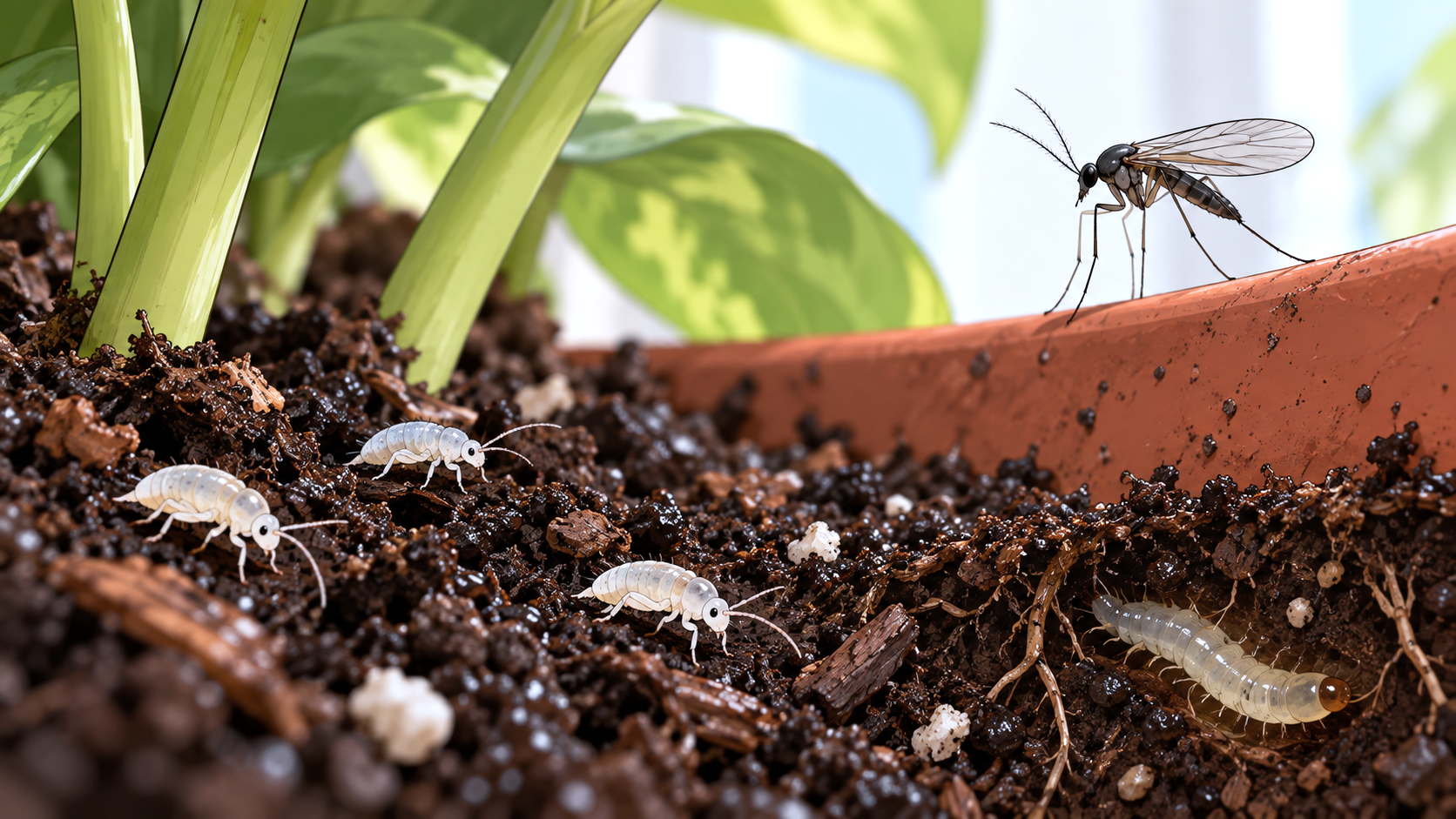
Springtails and fungus gnats often show up around the same damp houseplant soil, which makes the confusion understandable. The quickest distinction is movement. Springtails are wingless and jump, while adult fungus gnats are small, mosquito-like flies with wings. Fungus gnat larvae look completely different from either adult, appearing as translucent, wormlike larvae with dark heads.
Springtails vs. Fungus Gnats at a Glance
| Feature | Springtails | Fungus Gnats |
|---|---|---|
| Adult appearance | Tiny, usually elongated or rounded | Slender, mosquito-like fly |
| Wings | None | Yes |
| Typical movement | Crawl and jump | Walk, hop and fly |
| Common around houseplants | Yes | Yes |
| Develop in damp potting soil | Yes | Yes |
| Larvae | No larval stage | Translucent, wormlike larvae |
| Commonly seen near windows | Can occur indoors around moisture | Adults often collect around windows |
| Plant damage | Rare | Larvae can feed on roots |
| Main indoor clue | Tiny jumpers on damp surfaces or soil | Tiny flies hovering around plants |
The overlap in habitat is stronger than the overlap in appearance. Both thrive around moisture and organic material, and both can become noticeable in overwatered pots. Once the animals start moving, however, the difference usually becomes much clearer.
Flying or Jumping Usually Solves the Identification
A tiny animal springing away when you touch the pot or disturb the soil is likely pointing you toward a springtail. Springtails have no wings and cannot fly. Instead, many species use a forked appendage called a furcula to launch themselves into the air.
That jump can be surprisingly noticeable for an animal only a few millimeters long. Springtails use the furcula to propel themselves, so their movement can look like a speck suddenly vanishing and reappearing nearby.
Adult fungus gnats move differently. They are small, delicate flies with long legs and antennae. Their flight tends to be weak and erratic, so you may see them making short flights around a pot, crawling over the soil or collecting at a nearby window.
There is one wrinkle worth knowing. Fungus gnat adults can also hop or jump across the soil surface. Therefore, seeing one small hop is not enough to identify a springtail. Seeing actual wings or sustained short flights settles the question in favor of a fungus gnat, because springtails never have wings.
Fungus Gnats Look More Like Tiny Mosquitoes
Appearance becomes useful once you can get close enough to see the body. Adult fungus gnats are generally dark, slender and long-legged. The common houseplant-associated Bradysia species are about 1/8 inch long, and their forewings have a distinctive Y-shaped vein pattern.
You probably will not need to examine wing veins for a normal household identification. The overall mosquito-like silhouette is usually more practical. A fungus gnat has an obvious pair of wings extending over its body, relatively long legs and antennae, and the proportions of a tiny fly.
Springtails have a different body shape. Many are elongated, although some species have a more rounded form. Household springtails are also commonly around 1 to 2 millimeters long, making many of them smaller than a typical adult fungus gnat.
Color is a poor shortcut. Fungus gnat adults are usually dark, while springtails can be black, gray, brown, white or other colors. A dark speck on potting soil could therefore fit either group until you look at its shape and movement.
Fungus Gnat Larvae Cannot Be Mistaken for Adult Springtails Up Close
The comparison changes completely when you look inside the soil. Fungus gnats undergo a life cycle that includes a larval stage. Their larvae are slender, translucent and wormlike, with a visible black head capsule. They usually occupy the upper few inches of moist growing medium.
Springtails do not produce maggot-like larvae. Their life cycle develops directly from egg to immature springtail and then adult. Young springtails resemble smaller versions of the general adult body form rather than worms.
This gives you a useful second test when nothing is flying. A translucent worm with a dark head crawling through the potting mix fits a fungus gnat larva. A tiny six-legged animal moving over the soil surface, especially one that springs away when disturbed, fits a springtail much better.
Houseplant Soil Is Where Springtails and Fungus Gnats Overlap
Finding the mystery animal in a flowerpot does not settle the comparison because both groups can live there. Springtails prefer damp environments and commonly feed on fungi and decaying organic material. They can become particularly noticeable in moist houseplant soil, especially just after watering.
Fungus gnats also thrive in moist growing media. Adults lay their eggs in the potting medium, and the larvae feed primarily on fungi, algae and decaying plant matter. Larvae can also feed on plant roots. Consistently moist growing media are especially favorable to fungus gnats, which is why overwatered plants are such a common source of indoor populations.
That shared preference creates a simple identification mistake. Seeing tiny creatures around a wet pot tells you that moisture is relevant, but it does not tell you which organism you have. Look at movement and body form before using habitat as the deciding clue.
The Window Clue Points More Strongly Toward Fungus Gnats
A cluster of tiny dark insects at a window can initially look unrelated to the houseplants across the room. Fungus gnats make that connection surprisingly often.
Adults emerging from an infested pot are weak fliers, but they can disperse short distances. They frequently accumulate around window frames, so a windowsill full of tiny mosquito-like flies can lead you back to damp potting soil elsewhere in the room.
Springtails can also turn up around windows and other parts of a damp building, and some springtails respond positively to light. The window location alone therefore cannot make the identification.
The wings still decide it. Tiny flies resting on the glass or taking short flights are fungus-gnat candidates. Wingless specks crawling or springing across a wet sill require a different identification.
Plant Damage Matters More With Fungus Gnats
Springtails in houseplant soil are usually scavengers. They feed on fungi and decaying organic matter and rarely damage indoor plants. Their numbers may be annoying, but finding springtails does not automatically mean the plant itself is being attacked.
Fungus gnat larvae deserve more attention when a plant is struggling. Their primary diet includes fungi, algae and decaying plant material, but they can also feed on roots and leaves touching the growing-medium surface. Heavy larval populations can therefore contribute to plant injury.
We would not diagnose fungus gnats from a yellow or wilting plant alone. Those symptoms have many possible causes, including the excessive moisture that also favors fungus gnats. Seeing the larvae or identifying the adult flies gives you much stronger evidence than trying to identify a pest from plant symptoms.
A Simple Pot Test Can Confirm Fungus Gnat Larvae
When the adults are difficult to catch, the soil itself can provide another clue. A slice or wedge of raw potato placed on the surface of suspected growing medium can attract fungus gnat larvae. After a few days, lifting the potato may reveal the translucent larvae feeding underneath.
This test is particularly useful when tiny flies keep appearing but you cannot work out which pot is producing them. It targets the larval stage rather than relying on an adult that may have flown away from its original container.
Springtails may already be visible moving across damp soil, especially after watering. If disturbing the surface produces tiny jumping animals instead of translucent black-headed larvae beneath the potato, the evidence points in a different direction.
For either pest, the watering pattern is worth examining. Allowing the soil surface to dry appropriately between waterings can make the pot less favorable to both groups. The plant’s own watering requirements still come first, so the goal is to correct unnecessary moisture rather than deliberately dehydrating the plant.
What to Check Before Treating the Pot
We would identify the organism before choosing any control method because springtails and fungus gnats are not interchangeable pests. Yellow sticky cards can capture flying adult fungus gnats, which makes them useful for detecting and reducing the adults around houseplants. They do not solve a springtail problem in the same way because springtails do not fly.
Start by disturbing the soil gently and watching what happens. Short flights from mosquito-like insects point toward fungus gnats. Tiny wingless animals springing across the surface point toward springtails. Wormlike larvae with black heads in the growing medium add further evidence for fungus gnats.
Once springtails are confirmed, the more useful question becomes why the area remains damp enough to support them. Our guide to what attracts springtails covers that broader moisture problem, while persistent indoor populations can be approached through springtail prevention.
Other Questions About Springtails and Fungus Gnats
Can springtails and fungus gnats live in the same flowerpot?
Yes. Their habitat requirements overlap enough that the same moist, organic-rich potting medium can support both. Finding springtails therefore does not rule out fungus gnats, and finding adult gnats does not prove that every tiny animal moving on the soil is a gnat.
Are fungus gnat larvae visible without a microscope?
Mature fungus gnat larvae can be seen without a microscope. They are translucent, wormlike and have a contrasting dark head capsule. Their appearance is very different from the six-legged body of a springtail.
Why do tiny bugs appear right after I water my plant?
Water can make springtails living in the potting medium more conspicuous on the soil surface. Fungus gnat adults can also be disturbed around an infested pot. Watch whether the animals jump without wings or take flight rather than using watering alone to identify them.
Could the tiny flies around my computer screen be fungus gnats?
Fungus gnats can move away from the plant where they developed, so finding a small fly elsewhere in the room does not rule them out. Check nearby houseplants for adults around the soil and inspect the growing medium for larvae before assuming the screen itself is the source.
Do springtails turn into fungus gnats?
No. Springtails and fungus gnats are completely different animals. A springtail never develops wings or becomes a gnat. Fungus gnats pass through egg, larval and pupal stages before becoming winged adults, while immature springtails develop into adult springtails without a larval or pupal stage.
One thought on “Springtails vs. Fungus Gnats: How to Tell Them Apart”