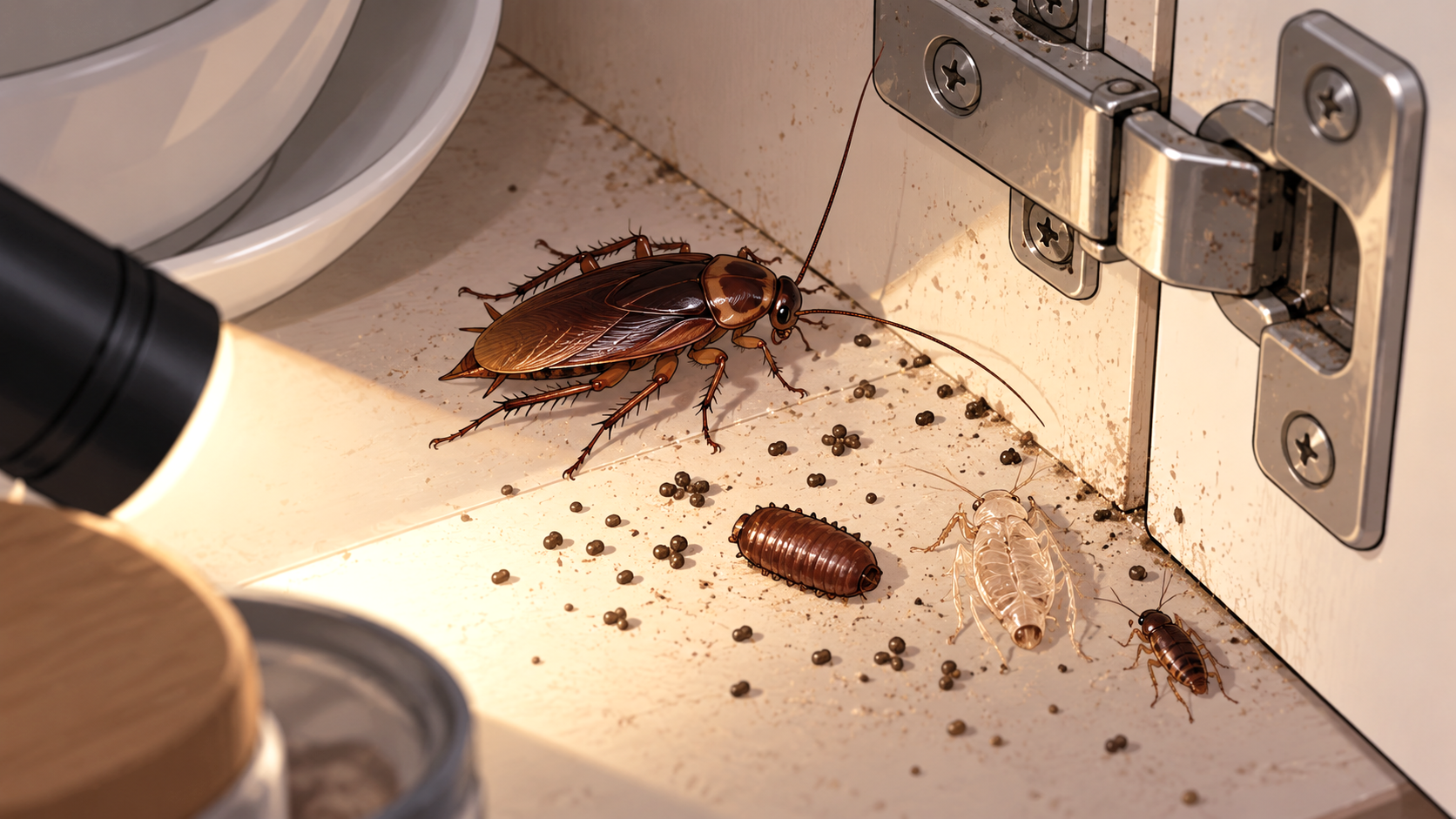
Cockroaches spend much of their time concealed, so an infestation can leave evidence in a room even when no insect is standing in the open. The strongest assessment comes from combining several clues and paying attention to where they occur. A single suspicious speck or an old egg case carries less weight than repeated evidence concentrated around active harborages.
Signs of a cockroach infestation include live cockroaches, repeated catches in monitoring traps, fecal spots or smears, egg cases, shed skins, dead cockroaches, and evidence concentrated around hiding areas. Finding several signs together, particularly cockroaches of different life stages, provides stronger evidence of an established population than one isolated clue.
Repeated Trap Catches Can Expose Activity You Never See
Sticky traps are particularly useful when cockroaches remain hidden during ordinary household activity. Placed against walls, beneath appliances, inside cabinets, and near suspected harborages, they intercept insects moving along their normal routes. Sticky traps can reveal both the presence and distribution of cockroaches, including low-level activity that a visual inspection may miss. Several traps also show whether activity is concentrated behind one appliance, spread across a kitchen, or occurring near an exterior entry point.
Numbers and locations are more informative than simply catching something once. Regular trap checks can identify areas with the greatest cockroach activity, and recording catches provides a baseline for seeing whether activity is increasing or decreasing. Species also affects interpretation because some cockroaches normally breed indoors while others frequently wander inside from outdoor populations.
Nymphs and Egg Cases Point Toward Reproduction
A mixture of adults and small nymphs indoors is important evidence because juvenile cockroaches are immature stages rather than a separate tiny species. The appearance of cockroach nymphs varies with species and age, but they generally resemble smaller wingless cockroaches. Finding several sizes repeatedly in the same protected area indicates that development is occurring there or very nearby.
Egg cases add another reproductive clue. Depending on the species, females may carry an ootheca until close to hatching or deposit it earlier in a protected location. Cockroach egg cases may be concealed in crevices or attached to protected surfaces. Their presence deserves more weight when accompanied by nymphs or live adults. An old, empty cockroach egg case can persist after activity has changed, so its condition and surrounding evidence are relevant.
Shed Skins Mark Places Nymphs Have Used
Growing nymphs leave their old exoskeletons behind when they molt. These cast skins can retain the cockroach’s legs, segmented body, antennae, and general outline while appearing pale, papery, hollow, or partly collapsed. Cast skins are among the physical signs used to locate cockroach activity.
Accumulations inside cabinet corners, appliance voids, cracks, or other protected spaces deserve attention because the skins were produced by developing cockroaches. They may remain after the insects move, however, so a cast skin cannot establish when the molt occurred. Understanding what a cockroach shed skin looks like helps prevent old exuviae from being mistaken for freshly dead insects.
Fecal Material Often Builds Up Around Favored Harborages
Cockroaches deposit feces where they travel, feed, and shelter. Depending on the species and circumstances, this material may appear as small dark deposits or smears and can accumulate around cabinet hinges, corners, cracks, appliance areas, and other frequently used locations. Fecal accumulations can help identify likely cockroach harborages, making their distribution more useful than an unexplained dark mark found by itself.
Cockroach feces also has a behavioral role. Research on German cockroaches has shown that microbial compounds in feces contribute to chemical signals that promote aggregation. Detailed identification still requires examining the material itself because food debris, mold, dirt, and droppings from other pests can create misleading spots. The appearance of cockroach droppings needs to be judged separately rather than treating every black speck as confirmation.
Where the Evidence Clusters Can Be More Revealing Than the Evidence Alone
Cockroaches favor protected spaces near the resources they need. Common inspection areas include cabinet cracks, spaces behind refrigerators and stoves, beneath sinks, around water heaters, plumbing penetrations, bathroom fixtures, stored materials, and other dark crevices. Health Canada notes that cockroaches can remain unnoticed because they are most active at night and occupy areas offering food, water, and shelter.
Finding droppings, skins, egg cases, and live nymphs repeatedly in one of these spaces forms a more coherent pattern than finding unrelated objects scattered throughout a building. A flashlight inspection of cracks and hidden surfaces can expose evidence that is invisible from the center of a room. The flattened shape of a cockroach allows it to occupy very narrow spaces, so inspecting only open shelves and floors can miss the main concentration.
Daytime Sightings Need Context
Many household cockroaches are primarily active during the night or periods of low disturbance. A cockroach walking across an exposed surface during the day can occur when harborages are disturbed, environmental conditions change, or insects are moving between locations. Daytime activity may also occur when populations are high, but the time of day alone cannot measure infestation severity reliably.
A daytime sighting becomes more informative when monitoring traps and hidden-area inspections also produce evidence. Conversely, one cockroach can sometimes be an accidental indoor visitor, particularly with species that normally live outdoors. The meaning of finding one cockroach depends on species, location, life stage, and whether additional evidence appears.
Odor Is Supporting Evidence, Not a Standalone Test
Heavy cockroach activity can produce a noticeable odor, partly because occupied harborages accumulate feces, secretions, shed material, and other biological debris. German cockroaches also communicate through chemical cues associated with occupied areas, including volatile compounds produced in association with fecal microbes.
Smell is too subjective to confirm an infestation by itself. Garbage, drains, moisture problems, spoiled food, mold, and other indoor sources can produce musty or unpleasant odors. A persistent unusual smell becomes more useful when its location corresponds with trap catches or visible cockroach evidence.
Questions That Can Clarify Suspicious Evidence
Can an empty apartment still have a cockroach infestation?
Yes. Removing occupants does not automatically remove harborages or every source of food and moisture. Cockroaches may also move within multi-unit buildings, so an apparently empty room should be assessed through inspection and monitoring rather than occupancy alone.
Can evidence remain after cockroaches are gone?
Yes. Empty oothecae, shed skins, dead insects, and old fecal material can persist. Fresh trap catches or live cockroaches provide stronger evidence of current activity than old debris alone.
Do cockroaches always stay in the kitchen?
No. Kitchens frequently provide favorable resources, but cockroaches can occupy bathrooms, utility areas, furniture, basements, wall voids, and other locations depending on species and conditions. Their distribution reflects shelter and available resources rather than a fixed requirement to remain near human food.
Can cockroaches arrive inside belongings?
Yes. Cockroaches and egg cases can be transported in items such as boxes, stored belongings, appliances, and furniture. Health Canada specifically recognizes shipping cartons and used items as possible routes into buildings. Finding evidence confined to a recently moved object may therefore warrant checking both the object and surrounding rooms before assuming activity is widespread.