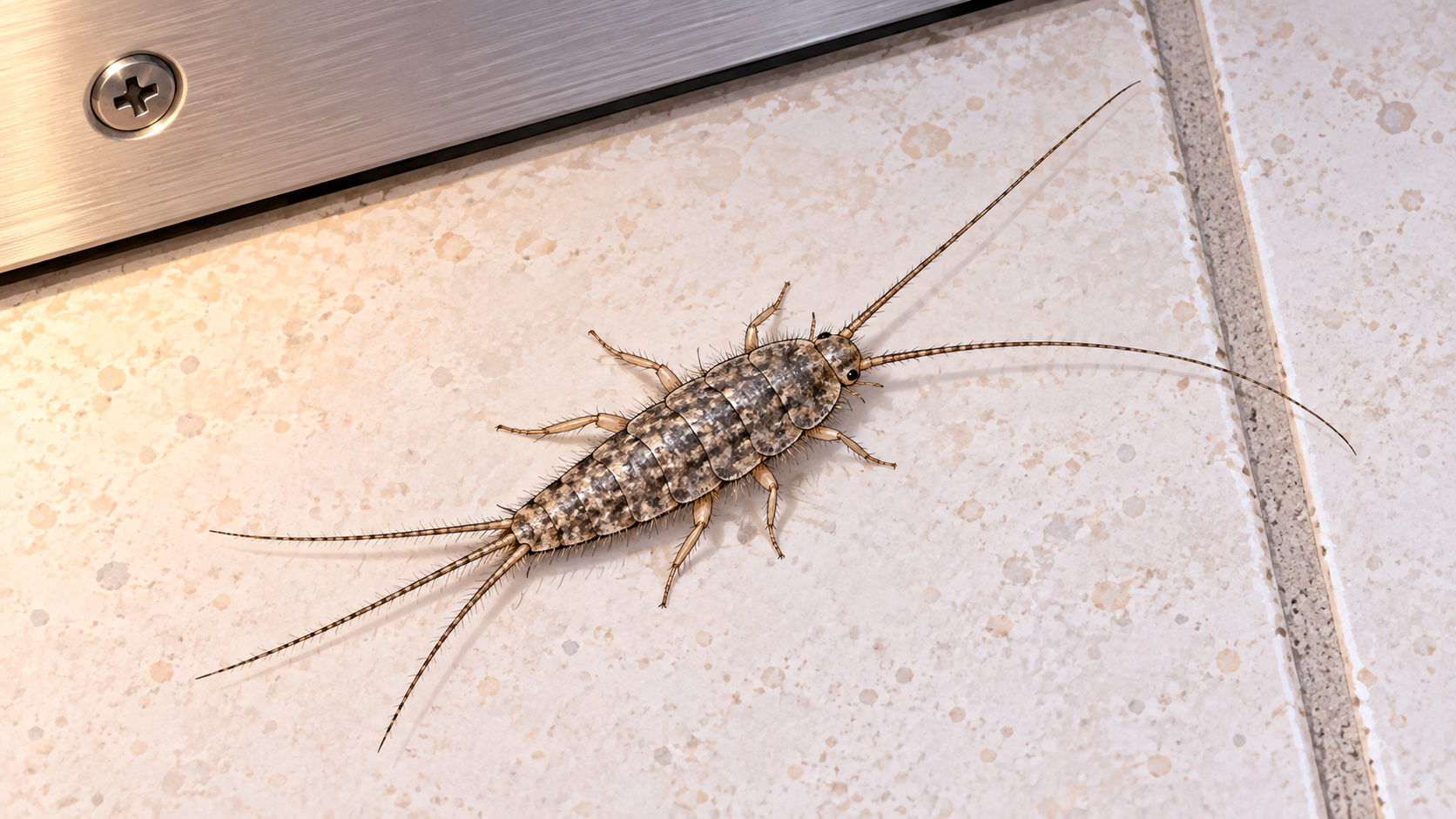
Firebrats are small, wingless insects with flattened, tapered bodies covered in mottled gray and brown scales. An adult is usually about 1/2 inch long, not including its long antennae and three tail-like appendages. Those features give a firebrat the same basic silhouette as a silverfish, but its mottled coloring is one of the easiest visible differences. If you get a reasonably clear look before it disappears into a crack, focus on four things: the tapered body, mottled scales, very long antennae, and three bristles projecting from the rear.
What Color Are Firebrats?
Firebrats are not uniformly silver. Their bodies have a mottled gray or brown appearance, created by scales covering the body. The University of California’s description of adult firebrats specifically distinguishes their mottled gray or brown coloration from the shiny silver or pearl-gray appearance of common silverfish.
The pattern can look patchy rather than forming neat stripes or spots. Penn State describes firebrats as having tufts of brown scales that produce this mottled appearance, while its school IPM material describes the pattern as patches of white and black. Lighting, viewing distance, and the tiny scales themselves can therefore affect exactly how the insect appears when you see one indoors.
Those scales are extremely small. The scales associated with firebrats are delicate and dustlike, and they can appear slightly iridescent when they catch the light. So a firebrat may look somewhat shinier in a close photograph than it does while racing across a floor.
What Shape Is a Firebrat?
A firebrat has a long, slender body that gradually tapers from the front toward the rear. It is also flattened rather than rounded or bulky. From above, the overall shape can resemble a narrow carrot with the broader end toward the head and the body narrowing toward the tail.
Adults are wingless and soft-bodied. Two long, slender antennae extend from the head, while three long, thin appendages extend from the opposite end. Those rear appendages are responsible for firebrats and their relatives being commonly called bristletails.
The antennae can be especially conspicuous. They are longer than the firebrat’s body, meaning the insect can look substantially larger if you judge it from the tip of an antenna to the end of a tail rather than measuring the body itself.
Viewed closely, the combination is quite distinctive: no wings, an elongated flattened body, two extremely long antennae at the front, and three obvious bristles at the rear.
How Big Are Firebrats?
Adult firebrats are roughly 1/2 inch long, or around 12 to 13 mm, when measuring the body rather than the projecting antennae and tail-like appendages. The University of Minnesota gives a range of about 1/4 to 1/2 inch, while UC IPM describes the common firebrat as approximately 1/2 inch long.
That makes the actual body quite small. However, a firebrat can appear longer at a glance because both ends carry lengthy appendages. Its antennae project well beyond the head, while the three rear bristles extend beyond the abdomen.
Size alone is therefore a weak identification method. A roughly half-inch insect is not automatically a firebrat, and estimating such a small animal while it is moving can be difficult. Body shape, coloring, antennae, and the three rear appendages provide a much stronger combination of clues.
What Does a Firebrat Look Like Up Close?
Up close, the feature that can be easy to miss with the naked eye is the covering of tiny scales. These scales create much of the firebrat’s mottled appearance and can give its surface a slightly reflective quality.
The insect does not have the hard, smooth wing covers you would expect on a beetle. Nor does it have visible wings folded over its back. Instead, the abdomen remains exposed beneath the scales and narrows progressively toward the three rear appendages.
A close photograph can also make the firebrat look more substantial than it really is. Keep its actual scale in mind: even an adult is generally only around half an inch in body length. If you are looking at a much larger insect with a superficially similar outline, size itself may be evidence that you are dealing with something else.
For an insect around this size, the most useful identification combination is therefore a mottled gray-brown, flattened and tapered body, no wings, two very long antennae, and three long bristles at the rear. If all of those features are present, a firebrat becomes a strong possibility.
Questions About Identifying Firebrats
Do firebrats have wings?
No. Adult firebrats are wingless. If the insect you are examining clearly has developed wings, it is not a firebrat.
Do firebrats have three tails?
They have three long, thin, tail-like appendages projecting from the rear of the abdomen. These bristles are one of their most recognizable features, although silverfish have them as well.
Are firebrats brown or gray?
They can appear both gray and brown because their scales create a mottled pattern rather than one uniform body color. This patchy appearance is more useful for identification than expecting a particular solid shade.
Can firebrats look silver?
Their scales can reflect light, but the common firebrat should have a mottled appearance rather than the more uniformly silver or pearl-gray coloration associated with common silverfish.
How can I identify a firebrat without catching it?
Try to confirm several visible characteristics rather than relying on one. Look for a roughly half-inch, flattened and tapered wingless body with mottled gray-brown coloring, two very long antennae, and three long rear bristles. A photograph taken before the insect disappears can make those features much easier to examine.
2 thoughts on “What Do Firebrats Look Like?”