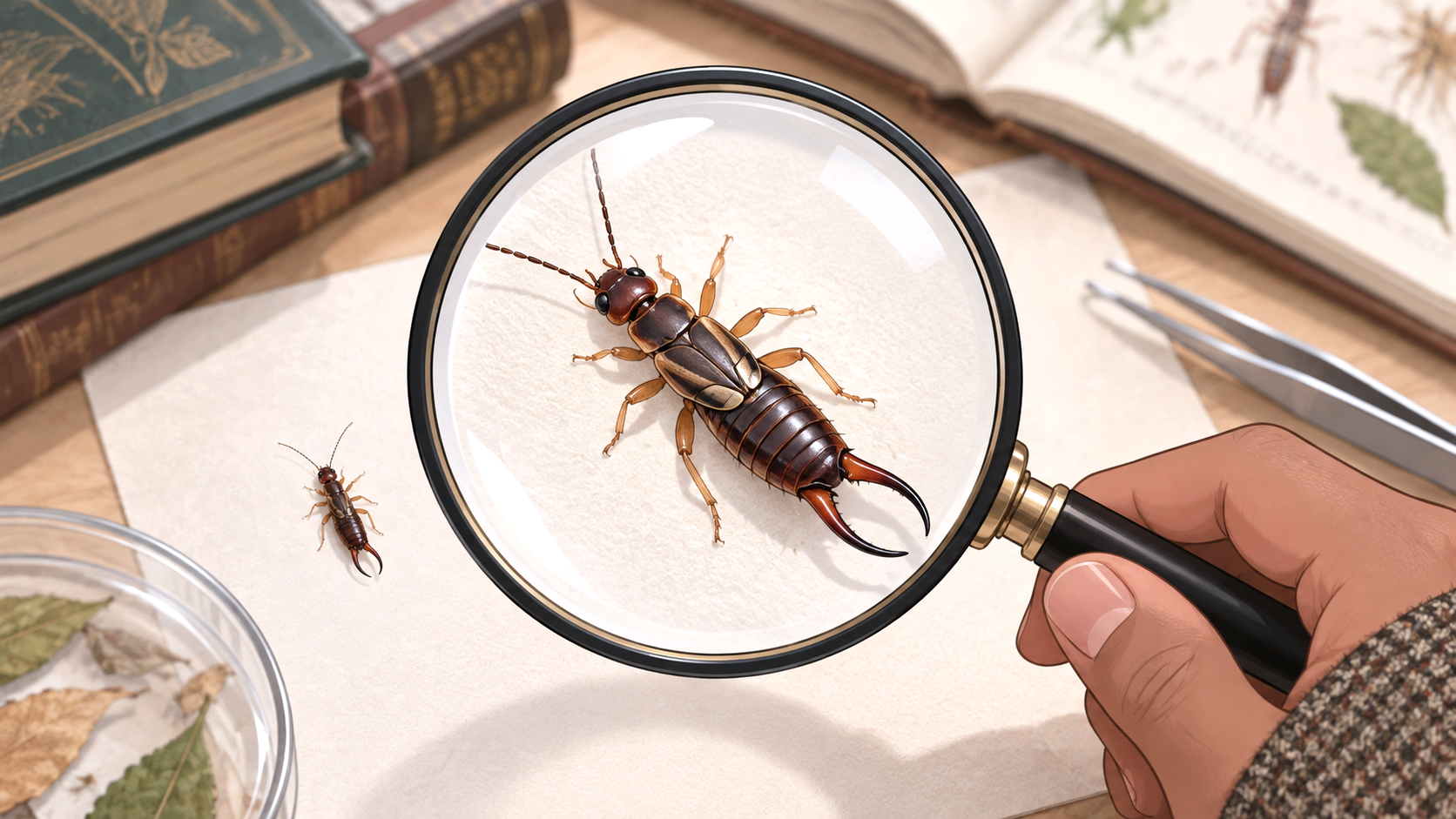
The scientific name for earwigs as a group is Dermaptera, the insect order that includes all earwig species. However, individual species have their own two-part scientific names. For example, the common European earwig is Forficula auricularia, while the ringlegged earwig is Euborellia annulipes.
The difference comes down to taxonomic rank. Dermaptera identifies the entire group of earwigs, whereas Forficula auricularia identifies one particular species. Calling every earwig Forficula auricularia would therefore be incorrect, even though that species is especially familiar in North America and Europe.
Dermaptera: The Scientific Name for Earwigs as a Group
Dermaptera is an insect order, a taxonomic category containing related families, genera, and species. The Integrated Taxonomic Information System (ITIS) recognizes Dermaptera as a valid scientific name at the rank of order, with earwigs as its English common name.
An order is broader than a family, genus, or species. Consequently, Dermaptera is appropriate when referring to earwigs collectively without identifying a particular kind.
The name comes from Greek: derma, meaning skin, and ptera, meaning wings. It refers to the short, thickened, leathery forewings characteristic of many earwigs. These structures cover the more delicate hind wings, which are intricately folded when not in use.
The Australian Museum’s account of Dermaptera explains this naming origin, while the Royal Entomological Society’s classification describes the unusual wing arrangement.
Not every earwig species possesses fully developed wings. Some are wingless, but they still belong to Dermaptera because taxonomic classification reflects shared evolutionary relationships and a combination of anatomical characteristics, not a requirement that every species display the feature behind the group’s name.
Unlike two-part species names, Dermaptera is written as a single capitalized word and is not italicized.
How the European Earwig Is Classified Scientifically
The European earwig provides a straightforward example of how an individual earwig fits within the broader classification system.
| Taxonomic rank | Scientific name |
|---|---|
| Kingdom | Animalia |
| Phylum | Arthropoda |
| Class | Insecta |
| Order | Dermaptera |
| Family | Forficulidae |
| Genus | Forficula |
| Species | Forficula auricularia |
The official ITIS classification of the European earwig places the species within the family Forficulidae and genus Forficula. The taxonomic sequence moves from broad categories containing many organisms to the particular species being named.
Animalia includes animals generally. Arthropoda contains animals with jointed appendages and external skeletons. Insecta includes insects, while Dermaptera narrows the classification to earwigs. Forficulidae is one of the earwig families, and Forficula identifies a smaller related group within that family.
The Harvard Museum of Comparative Zoology’s taxonomic record independently documents the same principal ranks for the European earwig.
The species name Forficula auricularia is therefore far more specific than Dermaptera. It is appropriate when discussing research, behavior, or observations that concern the European earwig rather than earwigs generally.
What Does Forficula auricularia Mean?
The genus name Forficula derives from Latin terminology associated with small shears or scissors, referring to the forceps at the end of an earwig’s abdomen.
The species epithet auricularia is associated with the Latin word auricula, meaning a small ear. Together, the two words form the scientific binomial used for the European earwig.
Although both the scientific name and the English common name contain references to ears, neither establishes that these insects deliberately seek human ears. The historical naming reflects appearance, language, and earlier associations rather than evidence of a particular habit.
The scientific name was established by Carl Linnaeus in 1758. Taxonomic authorities therefore often present it as Forficula auricularia Linnaeus, 1758.
The National Center for Biotechnology Information’s taxonomy record recognizes that scientific name and attributes it to Linnaeus. The author’s surname and year identify the original naming authority; they are not part of the italicized species binomial.
Scientific names are especially useful when different regions have several vernacular names for the same insect. They provide a standardized reference that does not depend on the language used to describe it.
Do Other Earwig Species Have Different Scientific Names?
Yes. Every formally recognized earwig species has its own scientific name. The names may share a genus when species are closely related, but belonging to Dermaptera does not mean they all belong to Forficula.
Examples include:
| Common name | Scientific name |
|---|---|
| European earwig | Forficula auricularia |
| Ringlegged earwig | Euborellia annulipes |
| Striped earwig | Labidura riparia |
| Maritime earwig | Anisolabis maritima |
The Global Biodiversity Information Facility (GBIF) recognizes Euborellia annulipes as the ringlegged earwig, while its records for Labidura riparia and Anisolabis maritima document the other two species.
These names are not interchangeable. A biological observation involving Labidura riparia should not automatically be attributed to Forficula auricularia, even though both insects are called earwigs.
The different types of earwigs encountered around homes and gardens may belong to separate genera and families. A common name such as striped earwig may also vary between regions or publications, making the scientific binomial particularly useful for identifying which species a statement concerns.
How Should You Write an Earwig’s Scientific Name?
Zoological nomenclature follows internationally recognized conventions. The International Commission on Zoological Nomenclature recommends formatting names so that readers can distinguish species, genera, and higher taxonomic groups.
For an earwig article, the conventions are straightforward:
- Order: Dermaptera, with an initial capital and no italics.
- Family: Forficulidae, also capitalized and not italicized.
- Genus: Forficula, capitalized and italicized.
- Species: Forficula auricularia, with the genus capitalized, the second word lowercase, and both words italicized.
- Abbreviated species name: F. auricularia, acceptable after the genus has been established and the abbreviation is unambiguous.
A species name should not normally be written as Auricularia, forficula Auricularia, or simply auricularia. The second word is the specific epithet, and it needs the genus name to form the complete scientific species name.
Similarly, Dermaptera should not be italicized as though it were a genus. The International Code of Zoological Nomenclature’s formatting recommendations reserve conventional italicization for genus- and species-level names.
These conventions apply whether the scientific name appears in a research paper, an identification guide, or a pest-control article.
Why Do Some Earwig Scientific Names Appear With Different Author Names or Dates?
Taxonomic records sometimes include an author’s surname and a year after the binomial. For example, the European earwig is commonly written as Forficula auricularia Linnaeus, 1758.
The additional information identifies the scientist credited with formally describing the species and the year of publication. It is not necessary in most general-interest writing, but it is useful in scientific catalogues where names and historical classifications must be distinguished.
Parentheses around the author and year carry a specific meaning. They generally indicate that the species was originally described under a different genus. The ringlegged earwig, for example, appears as Euborellia annulipes (Lucas, 1847), reflecting a subsequent change in its generic placement.
The ICZN’s nomenclatural guidance explains this convention and why authorship remains associated with a species even when its accepted genus changes.
Older publications may therefore use names that differ from those in modern databases. Such differences are not necessarily typographical errors; they may represent historical combinations, synonyms, or subsequent taxonomic revisions.
Does Every Insect Called an Earwig Belong to Dermaptera?
In standard zoological usage, earwigs are insects belonging to Dermaptera. The common name refers to that taxonomic group rather than to insects generally possessing pincers or elongated bodies.
However, casual descriptions can be imprecise. An insect may be called an earwig because it resembles one, even when its identity has not been established. Such informal usage does not alter its scientific classification.
Scientific names are especially valuable when describing an unfamiliar specimen. Calling something an earwig without confirming its identity can lead to incorrect assumptions about its behavior, while assigning a species binomial without sufficient evidence creates a different form of misidentification.
When the species is unknown but the insect has been reliably identified as an earwig, Dermaptera is the appropriate scientific name to use. A species-level name such as Forficula auricularia should be reserved for a specimen or discussion that genuinely concerns that species.