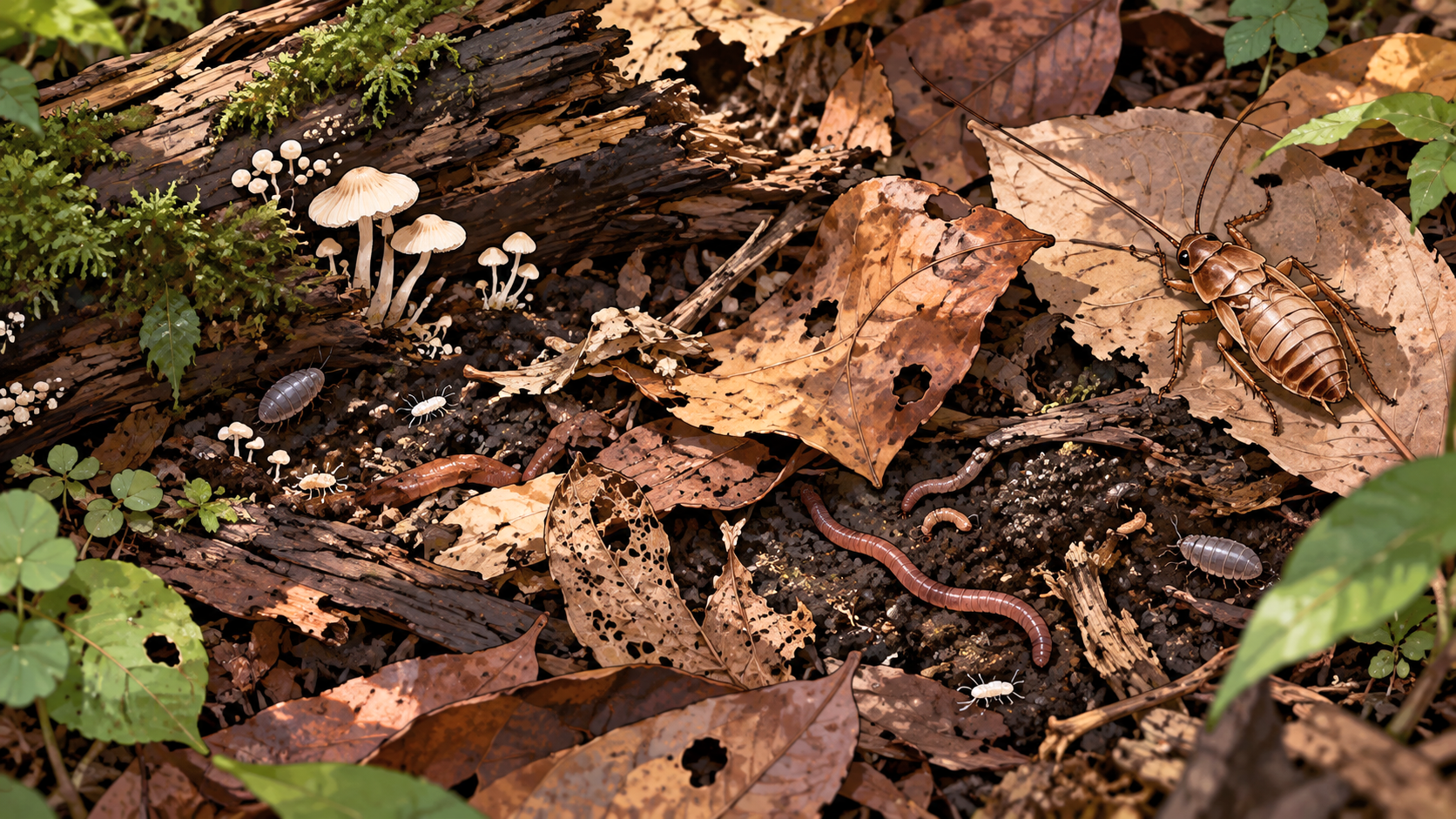
If every cockroach species disappeared, some ecosystems would lose important decomposers, certain predators and parasitic wasps would lose food or reproductive hosts, and a few plants would lose important pollinators. The consequences would be most pronounced in habitats where particular cockroach species maintain specialized relationships with other organisms.
However, cockroach extinction would not automatically cause forests to collapse or all decomposition to stop. Many ecological functions performed by cockroaches are also carried out by fungi, bacteria, and other invertebrates. The severity of the disruption would depend on how much an ecosystem relies on cockroaches and whether other organisms could compensate for their absence.
There is also an enormous difference between losing every wild cockroach and eliminating the small number of species responsible for most household infestations.
What If Only Household Pest Cockroaches Disappeared?
The disappearance of German, American, Oriental, and other common pest cockroaches would be far less disruptive than the extinction of every cockroach species.
The World Health Organization’s review of cockroach biology and control estimates that important household pests represent less than 1% of known cockroach species. Most cockroaches live independently of humans in natural habitats.
If only the major pest species disappeared, homes, restaurants, hospitals, and other buildings would experience fewer problems associated with cockroach contamination and allergens. The public-health burden associated with these insects would decline, although other indoor pests would remain.
Natural ecosystems would retain nearly all their wild cockroach diversity. Forest-floor decomposers, specialized wood-feeding species, and many of the cockroaches involved in ecological interactions would continue functioning.
Some organisms associated specifically with the eliminated pest species could nevertheless be affected. The emerald jewel wasp, for example, uses American cockroaches as hosts for its offspring. Losing that host without an alternative would threaten the wasp’s reproductive success.
The distinction between household pests and the wider diversity of cockroach species prevents a misleading conclusion: eliminating a handful of troublesome species would not be ecologically equivalent to removing an entire insect lineage.
Would Dead Leaves and Wood Stop Decomposing?
Forests would not become permanently buried beneath undecomposed leaves simply because cockroaches vanished.
Cockroaches contribute to the breakdown of organic matter, but they are members of much larger decomposer communities. Fungi, bacteria, earthworms, millipedes, springtails, termites, and other organisms also process dead vegetation.
Removing cockroaches would eliminate one contributor to these processes. Depending on their local abundance, the amount and type of organic material they consume, and the other decomposers present, decomposition rates could change.
A 2021 scientific review of arthropod–microorganism relationships describes the ecological diversity of wild cockroaches and their interactions with microbial communities. It also emphasizes how incompletely these relationships have been investigated.
Consequently, scientists cannot provide a credible global estimate of how much decomposition would slow following the extinction of all cockroaches.
The effects would probably differ substantially between habitats. A forest with abundant alternative detritivores might compensate for much of the loss, whereas a location containing specialized wood-feeding cockroaches could experience more significant changes in how particular materials are processed.
The ecological functions performed by wild cockroaches are therefore relevant to the extinction scenario, but those functions are not necessarily exclusive to them.
Could Other Insects Replace Cockroaches?
Some replacement would be possible, although it would not happen uniformly or immediately.
Ecologists use the term functional redundancy when different species perform similar ecological roles. If one disappears, others may continue providing some of its functions.
A 2020 review and meta-analysis published in Ecosphere examined how overlapping ecological roles influence ecosystem stability and resilience. The research provides a framework for understanding why the disappearance of one group does not necessarily eliminate every process in which it participates.
In the absence of cockroaches, other decomposers might exploit some of the resources previously consumed by them. However, sharing a broad ecological function does not mean two organisms are completely interchangeable.
For example, certain wood-feeding cockroaches contain complex intestinal communities capable of processing wood and supplying nutrients. Research on nitrogen-fixing microorganisms in Cryptocercus cockroaches demonstrates how specialized those associations can be.
Other organisms might process the same decaying wood, but they would not necessarily do so at the same rate or through identical microbial interactions.
The disappearance of cockroaches could therefore alter the composition of decomposer communities even where decomposition continued.
Which Predators Would Be Affected?
Animals that eat cockroaches would lose a potential food source. The outcome would depend on whether cockroaches represent an occasional meal or a substantial part of a predator’s available diet.
Generalist hunters could potentially shift toward other insects and invertebrates. Their responses would depend on the abundance, nutritional value, and accessibility of alternative prey.
A predator strongly dependent on cockroaches could face a more serious problem. Some parasitic wasps are especially vulnerable because cockroaches are not merely food for the adults; they provide the living hosts required for larval development.
The emerald jewel wasp (Ampulex compressa) offers a particularly clear example. Its reproductive strategy involves subduing an American cockroach, laying an egg on it, and allowing the developing larva to consume the host. A 2025 study of emerald jewel wasp development documents this close dependence on American cockroaches.
If the appropriate host disappeared and the wasp could not successfully reproduce using another species, its population would eventually fail.
Other parasitoids exploit cockroach egg cases. The ensign wasp Evania appendigaster, for instance, deposits its eggs inside the egg cases of certain cockroach species. The University of Florida’s account of ensign wasps documents this relationship and identifies several suitable hosts.
Losing all cockroaches would remove the reproductive resources used by these specialized insects. The broader network of animals that prey on cockroaches includes many less specialized predators, so their responses would be more variable.
Would Any Plants Lose Their Pollinators?
Some plants could experience reduced reproduction if their cockroach pollinators disappeared.
In the tropical forests of Sarawak, Malaysia, researchers found that cockroaches were the principal pollinators of Uvaria elmeri, a woody climbing plant. Fruit production depended on pollen transfer between flowers, with fruit flies serving as secondary visitors.
The 1997 study of Uvaria elmeri pollination showed that cockroaches played a substantial role in the plant’s reproductive biology.
An even more revealing example comes from French Guiana, where Amazonina platystylata pollinates a species of Clusia.
Researchers investigating the related plant Clusia blattophila found that cockroaches contributed an estimated 41% of successfully pollinated ovules, compared with 17% attributed to certain flies. Their 2019 experimental study of pollination efficiency demonstrated a measurable contribution from cockroaches.
If these insects vanished, the plants might experience reduced seed production. Other flower visitors could potentially compensate, but their presence alone would not guarantee adequate pollen transfer.
A reduction in reproduction could subsequently affect plant abundance and the organisms that depend on those plants.
It would be excessive, however, to predict the extinction of every cockroach-pollinated plant. The eventual outcome would depend on alternative pollinators, the plants’ reproductive biology, and whether populations could adapt to changing conditions.
Would the Changes Affect Entire Food Webs?
Removing all cockroaches would eliminate numerous feeding and reproductive relationships simultaneously. The resulting changes could extend beyond the organisms directly associated with them.
For example, a predator losing cockroaches as prey might increase its consumption of other insects. Those insects could then experience greater predation pressure, potentially influencing their own food sources and competitors.
This kind of indirect effect is sometimes called a trophic cascade, although it would be premature to claim that global cockroach extinction would necessarily produce one.
The direction and magnitude of change would depend on individual food webs. Some might adjust with relatively little disruption, while others could undergo substantial shifts in species abundance.
Cockroach extinction could also alter competition among organisms occupying similar habitats. Other detritivores might gain access to additional food or shelter, potentially changing which species dominate particular communities.
These possibilities are ecologically plausible, but there is no global experiment demonstrating exactly how ecosystems would respond to the disappearance of every cockroach.
The most defensible prediction is that effects would be uneven, with the greatest risks arising where cockroaches have unusually specialized or important relationships with other organisms.
Could Nature Recover From the Loss of Cockroaches?
Ecosystems are capable of changing after species disappear, but recovery does not necessarily mean returning to their original condition.
Alternative decomposers might increase in abundance, predators might change their diets, and plant communities might gradually adjust to the absence of certain pollinators. Such responses could preserve some ecological functions while changing the organisms responsible for them.
The pace of adjustment would depend on the availability of alternative species, the complexity of local food webs, and the environmental conditions surrounding the affected habitat.
Specialized relationships present a greater challenge. A wasp that can reproduce only using a particular cockroach host cannot simply survive by eating another insect as an adult. Similarly, a plant dependent on an effective cockroach pollinator may struggle if the remaining flower visitors transfer insufficient pollen.
For conservation purposes, maintaining ecological relationships before they disappear is generally more predictable than expecting other organisms to replace them afterward.
There is no scientific basis for claiming that cockroach extinction would necessarily destroy life on Earth. Equally, dismissing the loss as ecologically meaningless would ignore documented dependencies involving decomposition, pollination, and specialized host relationships.
The effects would be determined not by how unpleasant people find household cockroaches, but by the biological interactions that disappear with them.