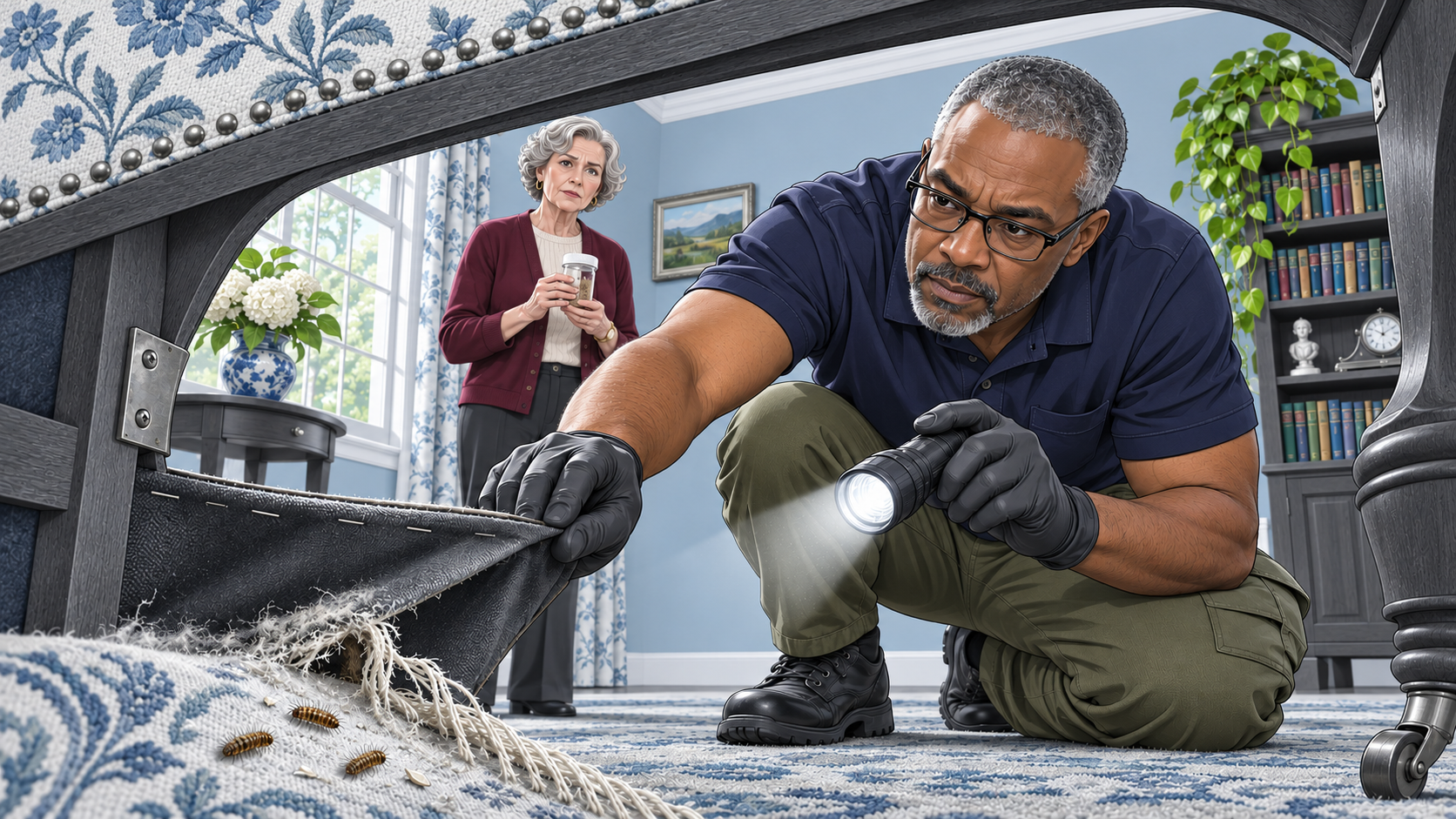
You should consider calling an exterminator for carpet beetles when you have confirmed larvae or fresh damage in several areas, cannot locate the source, or continue finding evidence of active development despite addressing accessible infested materials. Professional help is particularly worthwhile when carpet beetles appear to be developing inside furniture, building cavities, insulation, old animal nests, or other places you cannot safely inspect or treat.
You do not necessarily need an exterminator because you found one adult carpet beetle on a windowsill. Adults can fly indoors from outside, and a single sighting does not establish that larvae are breeding in your home. If you can identify and address a small infestation confined to one washable or removable item, professional pesticide treatment may not be necessary either.
The reason to hire a professional is not simply to obtain a stronger insecticide. A useful carpet beetle service should help establish what insects are present, where their larvae are developing, and whether any treatment beyond cleaning, removal, or exclusion is justified. Carpet beetles can exploit obscure food sources, so an accurate inspection is often more important than the amount of pesticide applied.
We would prioritize professional help when the infestation involves inaccessible sources, repeated evidence across several locations, extensive or valuable textiles, or a building where hidden development could continue unnoticed. A qualified exterminator can make a meaningful difference, but even professional treatment cannot guarantee that no carpet beetle will ever enter the property again.
When Is a Carpet Beetle Infestation Serious Enough for an Exterminator?
There is no universally accepted number of carpet beetles that automatically requires professional treatment. The decision depends more on the evidence of developing larvae, the location of their food source, and whether the affected materials can reasonably be inspected and managed.
A house with five adult beetles gathered at a window may be less concerning than one wool rug containing several larvae and fresh damage. The adults could have entered from outdoors, while larvae feeding inside the rug demonstrate a material that is already supporting development.
The following situations provide a practical way to decide how urgently professional help may be useful.
| What you are finding | Professional-help priority | Reason |
|---|---|---|
| One adult beetle on a windowsill, with no larval evidence | Usually low | An incidental outdoor introduction is possible |
| A few larvae confined to one removable, cleanable item | Often manageable without an exterminator | The affected material may be accessible and its infestation localized |
| Live larvae or fresh damage in several rooms | High | Multiple locations may indicate a wider problem or an overlooked source |
| Repeated larvae after accessible affected material has been addressed | High | Additional infested material or inaccessible harborage may remain |
| Activity associated with attic, wall, or ceiling spaces | High | Access and safety limitations can make professional inspection necessary |
| Suspected larvae deep inside valuable upholstery or large rugs | High | The infested material may require specialist assessment |
| Extensive damage in an archive, museum, or commercial textile collection | High | Continued feeding can affect numerous valuable or difficult-to-replace objects |
| Uncertain insect identification but repeated material damage | Moderate to high | Accurate identification is needed before additional treatment |
These are decision-making priorities, not formal infestation severity grades. The number of visible insects does not reliably measure how many are concealed inside a building or object.
Carpet beetles can be difficult to control because larvae find food in obscure locations and may disperse through a building. The management guidance for carpet beetles emphasizes that adult sightings alone should not trigger alarm, while confirmed larval development warrants attention.
The most useful threshold is whether there is an active problem you cannot confidently locate, reach, or address.
1. Call When Carpet Beetle Larvae Keep Appearing in Several Rooms
Repeated larval findings across multiple rooms deserve more attention than occasional adults at windows.
Carpet beetle larvae tend to remain associated with suitable food, but they can also wander. Finding larvae in several places may indicate more than one food source, a hidden primary source from which larvae disperse, or contaminated belongings moved between rooms.
A homeowner may notice larvae along a bedroom baseboard, inside a hallway closet, and beneath the living-room sofa. Treating each discovery as an isolated problem can lead to repeated surface cleaning without establishing where the insects are actually developing.
A professional inspection can help determine whether those locations contain independent infestations or whether the insects are connected to a less obvious source.
That investigation should include the materials that carpet beetle larvae are capable of feeding on, rather than limiting attention to carpeting. Wool, fur, feathers, animal hair, dead insects, and certain accumulations of organic debris are relevant potential food sources.
We would not wait for every room to show obvious fabric damage before seeking help if live larvae continue appearing across the property.
However, multiple adult sightings alone are less definitive. Adults may congregate near light or enter from outside. Confirmation of the insects and their life stages is an important part of deciding whether widespread treatment is necessary.
2. Call When You Cannot Find Where the Carpet Beetles Are Breeding
An inaccessible or unidentified larval source is one of the strongest reasons to involve a professional.
Carpet beetle larvae can develop in abandoned bird or rodent nests, accumulations of dead insects, animal remains, old fabric, and protected areas inside furnishings or building cavities. These sources may remain hidden while adult beetles appear elsewhere.
Consider a house where adult carpet beetles regularly collect near an upstairs window. You inspect the curtains, surrounding carpet, and stored clothing but find no obvious infestation. If beetles continue emerging, an attic nest or another sheltered food source may deserve investigation.
The range of carpet beetle breeding sites includes bird nests, wasp nests, dead insects in attics, and debris in inaccessible areas such as ventilation systems.
A pest management professional can assess which locations are plausible based on the identified species and the building’s construction. They may also recognize when inspection requires a wildlife specialist, building contractor, or other qualified service provider.
An exterminator should not automatically open walls or dismantle ventilation systems without a clear reason and the appropriate authorization. Destructive investigation can damage a building while failing to locate the source if it is based on guesswork.
If suspicious activity appears to originate in a sealed wall or ceiling space, explain exactly where and when the insects have been observed. That information can help the inspector narrow the search.
3. Call When Cleaning and Removing Accessible Sources Have Not Resolved Active Larval Activity
It is reasonable to seek professional assistance when confirmed carpet beetle activity persists despite a serious effort to address accessible affected materials.
The key is to distinguish continued evidence of living larvae from old damage or old shed skins. Holes do not repair themselves after an infestation is eliminated, and cast skins can remain in inaccessible corners long after the insects that produced them are gone.
Newly discovered evidence is not always newly produced evidence.
If you continue finding live larvae, new damage to previously unaffected materials, or repeat activity in the same locations, professional inspection becomes more useful.
You do not need to exhaust every home remedy or repeatedly apply insecticide before calling. In fact, repeated treatment without locating the source may create unnecessary exposure while leaving the important part of the infestation untouched.
An answer from a university extension pest specialist explains that persistent high carpet beetle numbers following thorough cleaning and vacuuming can justify working with a pest control company. It also emphasizes that pesticides alone do not permanently remove an infestation when the food source remains. The underlying source-removal priority for persistent carpet beetle activity is more important than simply escalating to a stronger chemical.
Determining exactly why a previous treatment failed requires a separate investigation. For that question, see why carpet beetles keep coming back after treatment. The hiring decision is simpler: if active development continues and you cannot identify or manage the source, getting a second set of qualified eyes on the property is reasonable.
4. Call When the Infestation Involves Furniture, Large Carpets, or Valuable Textiles
Large or delicate infested objects can present problems that ordinary household treatment cannot address adequately.
Some upholstered furniture contains animal hair, feathers, or other materials that can support carpet beetle larvae. Once insects are deep inside the stuffing, treating the external surface may not reach them.
Similarly, a large wool carpet may contain protected areas along its edges, underside, or backing. Moving or treating the entire object may be difficult, especially when it is valuable or susceptible to staining and other damage.
A professional can help establish whether the object is actually infested and whether it needs specialist treatment, cleaning, isolation, or removal.
The limits of surface treatment for infested upholstery are especially relevant here. Applying insecticide to the exterior of furniture does not reliably control larvae developing deep within its stuffing.
A reputable exterminator should explain those limitations rather than promise that one external spray will penetrate every layer of a couch or rug.
For an antique rug, valuable fur, historic textile, or upholstered heirloom, it may also be appropriate to consult a textile conservator or professional cleaner experienced with the material. Pest management and preservation are related but different specialties.
We would seek advice before using an insecticide that might stain or damage an expensive item, particularly if the treatment label does not expressly permit application to that fabric.
5. Call When an Attic, Wall Void, or Old Animal Nest May Be Involved
Hidden building spaces create both an access problem and a potential safety problem.
An attic may contain old bird nests, dead insects, animal hair, feathers, or other debris that supports dermestid beetles. Similar materials can accumulate in building cavities that a homeowner cannot see or clean.
Some older building materials may also contain animal-derived components that are susceptible to insect activity. A professional investigation can help distinguish those possibilities from ordinary household textile infestations.
Carpet beetles have been documented in hidden building locations, and professional help may be necessary when infested materials are extensive or difficult to access. This is particularly relevant to large furniture, entire carpets, and certain older forms of insulation.
Do not enter an unsafe attic, disturb unidentified insulation, or open wall cavities solely to search for beetles. Older construction may contain materials requiring special assessment, including asbestos or other hazardous dust. Animal nests and droppings can introduce additional contamination and wildlife concerns.
An active bird nest should not be disturbed or removed without checking the applicable wildlife protections. Where animals are still present, the appropriate response may involve a qualified wildlife professional before pest treatment can be considered.
A competent exterminator should know when the situation exceeds routine insecticide treatment and requires coordination with someone qualified to handle the structure or wildlife source.
6. Call When Damage Could Become Extensive Before You Can Inspect Everything
Carpet beetles can be especially consequential in properties with extensive collections of vulnerable materials.
A home containing a few wool sweaters presents a different management problem from a costume collection, museum storage area, theater wardrobe, upholstery workshop, or warehouse containing animal-fiber textiles.
The more materials there are, the more difficult it becomes to inspect everything regularly and identify the first point of infestation.
In larger collections, a professional can help establish a monitoring program, prioritize inspection areas, and coordinate treatment decisions with the people responsible for the objects.
The goal may be to prevent additional losses while preserving materials that cannot simply be washed, discarded, or replaced.
This does not mean every valuable garment requires an exterminator. A localized problem confined to one accessible item may still be manageable without whole-property treatment.
Professional involvement becomes more useful when the scale, value, or construction of the affected materials makes an ordinary homeowner inspection impractical.
When You Probably Do Not Need an Exterminator
Not every carpet beetle discovery requires professional pest control.
A single adult beetle near an open window may have entered from outdoors. If there is no supporting evidence of larvae, repeated emergence, or damage, arranging a whole-house insecticide treatment would usually be disproportionate.
A small infestation confined to one removable object is another situation where an exterminator may not be necessary. If the affected material can be isolated and appropriately cleaned or otherwise handled, the issue may be resolved without treatment of the surrounding room.
Likewise, old fabric damage does not establish a current infestation. A sweater may have acquired holes months or years before anyone noticed them.
The following comparison helps avoid treating every discovery as an emergency.
| Finding | What to do about professional help |
|---|---|
| One adult on a windowsill | Identify it and examine whether any larvae or affected materials are present before deciding |
| Old holes, no insects and no fresh evidence | Establish whether activity is current; do not hire solely because historical damage exists |
| A few larvae in one accessible infested item | Consider whether the item can be appropriately handled without professional treatment |
| Larvae repeatedly appearing in several places | Arrange a professional inspection if the source is not readily identified |
| Suspected deep upholstery or hidden-building infestation | Seek professional evaluation rather than relying on surface treatment |
| A proposed whole-house pesticide treatment without confirmed infestation | Request evidence and an explanation of why that scope is necessary |
A good exterminator should be able to tell you when an insecticide is unnecessary.
Long-term carpet beetle control depends on sanitation, exclusion, and eliminating the food source. Successful nonchemical management of carpet beetles may make pesticide applications unnecessary.
The purpose of hiring a professional is to solve a problem that exceeds your ability to identify, access, or manage it, not to purchase a chemical treatment regardless of the circumstances.
What Should a Professional Carpet Beetle Inspection Include?
A useful inspection should start with evidence and a clear explanation of what the technician is trying to establish.
The first task is identification. Carpet beetles belong to a group of related species, and their larvae can be confused with other small household insects. Clothing damage can also be caused by clothes moths, ordinary wear, or other factors.
A professional should examine a reliable specimen or supporting evidence before recommending a treatment directed at carpet beetles.
The second task is locating the developmental source. That can involve inspecting vulnerable clothing, wool rugs, upholstered furniture, stored animal-derived materials, accumulated hair and lint, and other areas indicated by the findings.
The third task is assessing access. An infestation in a washable garment requires a different response from larvae developing inside upholstery or an inaccessible building void.
Finally, the professional should explain what action is warranted, which parts of the work are within the company’s scope, and what evidence will be used to assess the result.
| Inspection component | What a useful professional assessment should establish |
|---|---|
| Pest identification | Whether the insects are carpet beetles and, where possible, which species or group is involved |
| Current activity | Whether evidence supports active larval development rather than only historical damage or incidental adults |
| Source investigation | Which material or location is supporting the infestation, or which sources remain suspected |
| Extent of activity | Whether evidence is localized or distributed through multiple areas |
| Accessibility | Whether the material can be safely inspected, removed, cleaned, or treated |
| Proposed response | Why the recommended method matches the pest, source and affected material |
| Safety and limitations | Which surfaces or spaces cannot be treated, what precautions apply and what outcomes are uncertain |
| Follow-up | What should be rechecked and who is responsible for it |
A professional cannot guarantee that every hidden cavity will be inspected without opening the structure. What matters is whether the technician can explain the evidence supporting the proposed treatment and the uncertainties that remain.
If no source can be established during the first visit, the company should be clear about that. A recommendation for additional inspection or monitoring may be more appropriate than treating every room by default.
What Does Professional Carpet Beetle Treatment Usually Involve?
Professional treatment does not necessarily mean spraying every carpet or baseboard.
A suitable plan should reflect where the larvae are developing. When the source is accessible, the work may center on removing infested debris, arranging appropriate cleaning, and protecting vulnerable materials.
Where a registered insecticide is warranted, a licensed professional may recommend localized treatment of permitted areas rather than indiscriminate application throughout the house.
More difficult situations may require specialist handling of an infested object or coordination with building-maintenance personnel. The exact approach depends on the confirmed pest, site, materials, product labeling, and local regulations.
Pesticide use cannot replace source removal when larvae continue to feed inside untreated material. The guidance on treating carpet beetle infestations specifically emphasizes that sanitation and exclusion can resolve problems without chemical treatment and that pesticides must be matched to accessible, label-authorized locations.
There is no reason to assume that more extensive treatment is automatically more effective.
A credible recommendation should explain which insects the proposed action can reach and which ones it might miss.
What if the company recommends spraying the whole house?
Ask what evidence justifies treating each proposed area.
Widespread activity could sometimes warrant a broader intervention, but the recommendation should follow the inspection findings rather than the size of the property alone.
If larvae are confined to one infested wool rug, the case for spraying unrelated rooms is weak unless the inspector identifies additional sources or evidence.
If the technician cannot explain which pest is being targeted, which surfaces are authorized by the pesticide label, or why the entire house needs treatment, seek another opinion.
The detailed application methods belong in how to spray for carpet beetles. The decision here is whether the professional’s plan is proportionate to the evidence.
How to Choose an Exterminator Who Understands Carpet Beetles
Not every pest control company has the same experience with fabric pests.
A provider may handle ants, cockroaches, rodents, and termites every day but encounter carpet beetle infestations less frequently. That is not automatically disqualifying, but it makes the questions you ask more important.
We would look for a company that can explain its inspection process, identify which materials might support larvae, and describe when nonchemical source removal is preferable to pesticide treatment.
Licensing should also be checked. In the United States, pesticide applicator licensing and certification requirements vary by state and service category. A company should be able to identify the people performing the work and provide the applicable credentials.
The criteria for selecting a pest control service include checking qualifications, requesting labels for proposed pesticides, understanding the planned treatment, and obtaining a written agreement.
In Canada or other countries, check the applicable provincial, territorial, or national requirements rather than relying on a US license designation.
The following questions can reveal whether the company has a meaningful plan for carpet beetles.
How will you confirm that the insects are carpet beetles? A reliable provider should be willing to examine specimens and explain the identification.
Will you investigate the larval food source? A proposal based entirely on where adults were seen may miss the material responsible for the infestation.
What areas will you inspect before recommending treatment? Ask whether vulnerable textiles, furniture, carpet edges, and suspected concealed sources are included.
What evidence justifies the treatment you propose? The response should connect the selected areas and methods to inspection findings.
Which steps can be done without pesticides? An integrated pest management approach should consider cleaning, removal, exclusion and monitoring where appropriate.
What pesticide products would you use, if any? Request their exact names, labels, and applicable safety precautions.
What preparation and reentry restrictions apply? The requirements should account for children, pets, aquariums, and anyone who may have difficulty leaving the treatment area.
What happens if live larvae are found after the service? Ask what follow-up assessment is included and what conditions would trigger further investigation.
Will the findings and proposed work be documented? A written record makes it easier to understand what was established and what remains uncertain.
Are any affected materials outside your treatment capabilities? A company should be willing to identify situations requiring specialist textile care, building access, or wildlife services.
You should not need to accept a verbal promise that all carpet beetles will be gone forever. A specific explanation of findings, treatment scope, and follow-up responsibilities is more useful.
Warning Signs of a Poor Carpet Beetle Extermination Service
Be cautious when a provider recommends extensive treatment before identifying the insects or examining the suspected source.
An immediate whole-house spraying recommendation may sound decisive, but it is not evidence of a well-targeted plan.
We would also question a technician who treats carpet beetle larvae as though they necessarily originate in the carpet. The name can be misleading. Larvae may develop in clothing, furniture, dead insects, nests, and other materials that are not part of the flooring.
A company that promises permanent prevention of every future carpet beetle introduction is making a claim that cannot realistically be supported. Adults can enter later through doors, windows, flowers, or incoming belongings.
Other warning signs include refusing to explain the proposed chemicals, dismissing questions about pets or reentry, recommending pesticide applications directly to garments without appropriate label authorization, and failing to describe how the source will be addressed.
The consumer guidance for evaluating pest management companies recommends checking qualifications, understanding proposed methods, and taking enough time to compare providers rather than accepting pressure to commit immediately.
A useful professional should be able to explain both what the service can do and what it cannot reliably accomplish.
What Should You Tell the Exterminator Before the Visit?
The quality of an inspection can improve when you provide accurate details about the activity you have observed.
Describe where the insects were found, whether you saw adults or larvae, and whether clothing, rugs, or furniture show suspicious damage. Mention whether the affected materials are wool, fur, feathers, or other animal-derived substances.
Photographs and preserved specimens may help with identification. A specimen should be kept in a suitable sealed container rather than carried loose through the house.
Explain which areas have already been cleaned, which infested objects were removed, and whether pesticides were previously applied. Product names and application dates are relevant because the inspector needs to understand what has already happened and what surfaces may contain residues.
If the suspected source is in an attic, building cavity, shared wall, or other difficult location, identify the exact area and any access concerns.
It also helps to disclose sensitive household circumstances before an application is proposed. Pets, aquariums, young children, respiratory concerns, and valuable or delicate fabrics can all affect the suitability of particular treatment methods.
You do not need to diagnose the infestation for the technician. Your job is to describe what you observed, preserve useful evidence, and explain where access or material safety might be limited.
Should You Call Your Landlord or Building Manager First?
If you rent an apartment or live in a building with shared walls, attics, storage spaces, or ventilation systems, property management may need to be involved before a professional can inspect or treat the relevant areas.
The infestation source may lie outside your unit. For example, a concealed source in a shared building space could be inaccessible to an individual tenant, even if beetles are appearing inside the apartment.
Report the observations in writing and include photographs, locations, and the dates of repeated findings when possible. Ask how building access and professional inspection can be coordinated.
Responsibility for arranging and paying for treatment depends on local law, lease provisions, and the circumstances of the infestation. Those issues should not be assumed from general pest-control advice.
For an owner-occupied condominium, the same access question may involve the property manager or condominium association if common elements are implicated.
A pest control provider should not enter or alter common building spaces without proper authorization. Coordinated assessment is more useful than having several residents independently spray their own units while the shared source remains untouched.
How Long Should Professional Carpet Beetle Control Take?
There is no single period within which every carpet beetle problem should disappear.
A localized infestation involving one removable item may be resolved more simply than a case involving several rooms or an inaccessible source. An inspection may identify the affected material during the first visit, or it may establish that further investigation is necessary.
Visible adult beetles may also continue appearing for reasons that do not automatically mean treatment has failed. Some could be emerging from an overlooked site, while others may enter from outdoors.
A good provider should explain what progress can reasonably be assessed after the proposed work and which observations should prompt follow-up.
We would be cautious about guarantees that every adult beetle will disappear within a fixed number of hours or days. Such promises may ignore differences in species, development, season, and source accessibility.
The service should instead describe a realistic process: identify the source, address accessible affected material, apply additional controls only where justified, and inspect again if activity continues.
That approach provides a basis for evaluating whether the infestation has been addressed without inventing a universal elimination timetable.
Will an Exterminator Get Rid of Carpet Beetles Permanently?
A professional can help eliminate an existing infestation, but no pest control company can guarantee that a carpet beetle will never enter the property again.
The difference lies between controlling insects currently developing in the building and preventing every future introduction.
Even a carefully inspected and treated property can receive adult carpet beetles through open windows and doors. An infested rug, secondhand chair, or other incoming belonging can also introduce insects later.
The most durable results come from addressing the present larval source and reducing the conditions that would support another infestation.
That includes appropriate storage of vulnerable animal-fiber materials, removal of accumulated hair and dead insects, and maintenance of accessible building openings.
The principle behind preventing carpet beetle reinfestation is based on sanitation, exclusion, and protection of susceptible items rather than permanent chemical barriers.
A service contract may promise retreatment under specified conditions. That is different from guaranteeing a building will remain free of every newly introduced beetle.
For ongoing household maintenance after an infestation has been addressed, see how to prevent carpet beetles from coming back.
Our Recommendation: Hire for Source-Finding, Not Just Stronger Chemicals
We would call a qualified exterminator when confirmed carpet beetle larvae continue appearing in multiple locations, when the source cannot be found, or when inaccessible building spaces and valuable materials make an ordinary inspection impractical.
We would be less inclined to hire for one incidental adult beetle or a localized problem confined to an item that can be safely removed and handled.
The most useful professional visit should give you a clearer picture of the infestation. It should establish what insect is present, identify the source when possible, explain any remaining uncertainty, and recommend a response suited to the actual materials and locations involved.
Ask for evidence before accepting widespread pesticide treatment. Check credentials, request product labels and safety instructions, and make sure follow-up responsibilities are documented.
The right time to call an exterminator is when the infestation exceeds what you can reliably identify, reach, or manage yourself. Professional assistance can be highly worthwhile in those circumstances, especially when the alternative is repeated spraying without knowing where the larvae are developing.
The realistic goal is lasting control of the current infestation, supported by source removal and sensible prevention. It is not a promise that carpet beetles can never enter the property again.