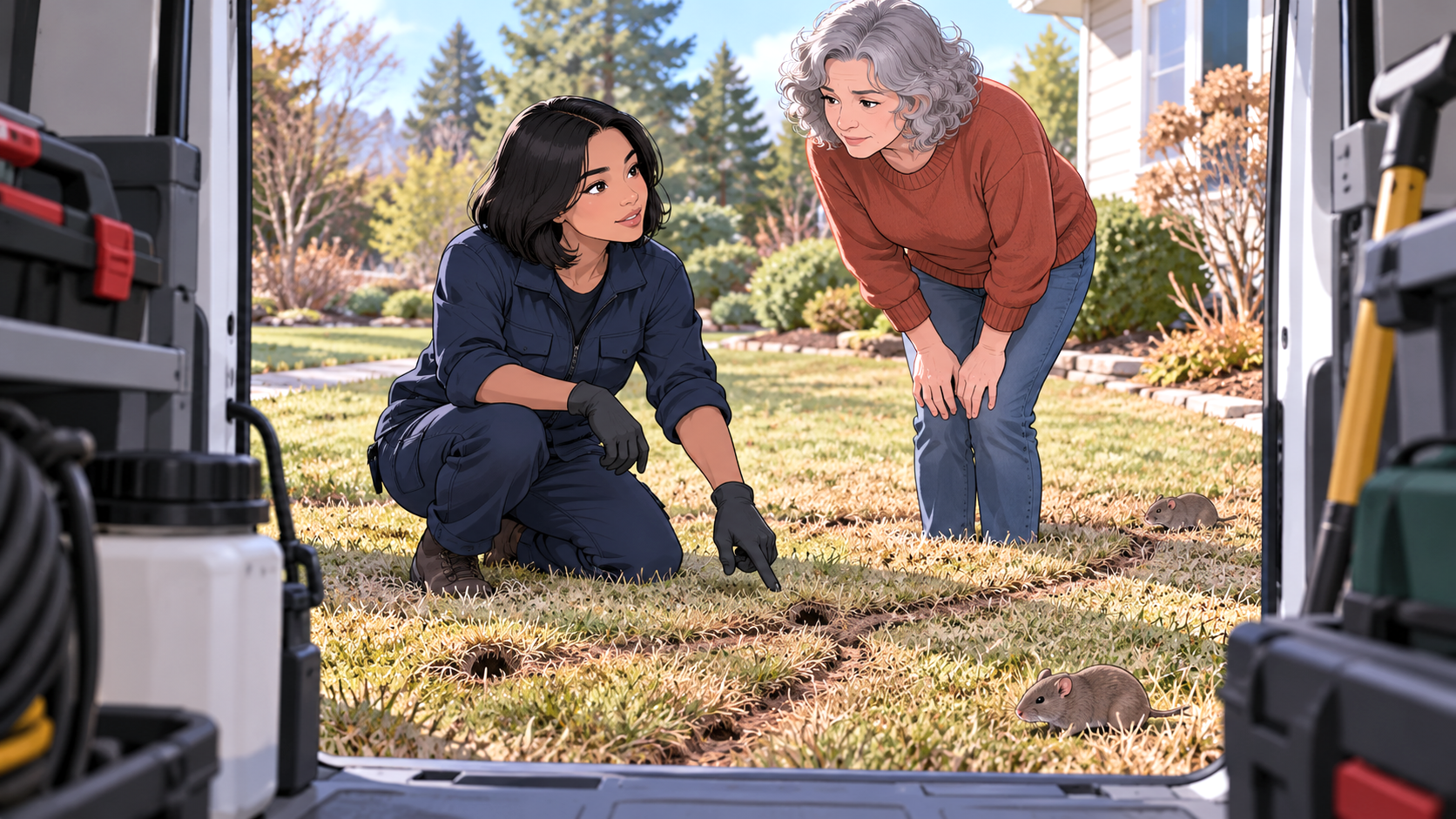
Call an exterminator for voles when damage continues despite reasonable preventive measures, valuable trees are at risk, activity extends across several areas, or you cannot confidently identify the animal responsible. Professional help is also worthwhile when treatment would involve restricted pesticides, regulated wildlife, or equipment that cannot be used safely around pets and other animals.
One vole sighting does not automatically justify hiring someone. A few old runways in an otherwise healthy lawn may need nothing beyond observation. Repeated losses involving young fruit trees, garden crops, or expensive landscaping present a different decision, particularly when the source of activity remains unresolved.
Fresh Tree Damage Deserves Prompt Professional Attention
A young tree can suffer significant injury before a large number of voles becomes noticeable. Feeding around the trunk may interrupt the tissues responsible for transporting water and nutrients. Complete girdling can kill a tree, making additional damage potentially more consequential than the presence of numerous lawn trails.
Contact a vole-control specialist when fresh feeding continues around valuable trees and existing protection is inadequate. The pest professional can assess whether voles remain active and where they are gaining access. If the trunk is already extensively damaged, a qualified arborist should also evaluate the tree’s condition. Removing the animals does not repair injured bark or restore severed tissues.
Commercial orchards warrant particular attention because losses can affect multiple trees and future productivity. Vole feeding can damage both trunks and roots, and underground injury may become apparent only after tree health deteriorates. An inspection should consider the extent of the planting rather than concentrate exclusively on the first visibly damaged tree.
Professional intervention is most useful before serious injury spreads. Waiting for numerous trees to decline can turn a manageable access problem into a much larger replacement expense.
Persistent Damage Is More Important Than the Number of Voles Seen
Repeatedly discovering fresh feeding after taking reasonable preventive measures suggests that the underlying activity has not been adequately addressed. A professional assessment becomes worthwhile when continued losses exceed what you are prepared to tolerate or when the affected area keeps expanding.
There is no universal vole count that requires professional treatment. Populations fluctuate, animals spend considerable time concealed, and sightings provide an incomplete picture of how many are present. Vole population increases can produce substantial damage before animals become conspicuous.
The type and value of the affected plants are more useful than an arbitrary population threshold. A few voles damaging newly planted fruit trees may justify professional involvement sooner than a larger population traveling through a remote, unmanaged portion of a property.
A contractor should be able to explain why intervention is warranted rather than treating every indication of vole activity as an emergency. An integrated pest management approach uses monitoring and acceptable damage thresholds to determine whether treatment is necessary.
Uncertain Identification Is a Good Reason to Seek an Inspection
Different burrowing animals can leave overlapping evidence. Voles, pocket gophers, moles, and other small mammals may all be suspected when a lawn develops holes, disturbed soil, or damaged plants. Their treatment requirements are not interchangeable.
A reliable inspection should examine the relationship between openings, travel routes, fresh feeding, and the surrounding habitat. Vole runways commonly connect shallow burrow entrances, while other burrowing mammals may create more prominent soil mounds or different underground structures.
Photographs can help with preliminary identification, but the person inspecting the property may need direct evidence. Accurate pest identification prevents inappropriate treatment and can avoid unnecessary spending on equipment or chemicals intended for another animal.
Professional identification becomes particularly valuable when no animal has been seen and the suspected damage is expensive. A contractor proposing treatment before examining the evidence should be able to justify that decision.
What a Professional Vole Inspection Should Establish
An exterminator experienced with voles should leave you with more than confirmation that small rodents are present. The inspection should establish where current activity is concentrated, which plantings are vulnerable, what may be allowing repeated access, and which interventions are appropriate for the property.
For a residential landscape, that may involve examining damaged plantings, checking suspected travel corridors, assessing vegetation along property boundaries, and identifying opportunities for exclusion. In larger plantings, structured monitoring can help establish whether vole activity is increasing or declining.
Commercial orchard management sometimes uses standardized activity indexing to evaluate vole pressure before and after treatment. A suburban garden does not necessarily require the same sampling intensity, but the principle is useful: observations should be consistent enough to establish whether the chosen measures are working.
A professional assessment should distinguish these findings:
| Inspection finding | What it means for the treatment decision |
|---|---|
| Old runways without current damage | Monitoring may be sufficient |
| Fresh activity limited to one planting | Localized protection may be appropriate |
| Repeated injury despite existing barriers | The access problem requires reassessment |
| Several active areas across the property | A broader management plan may be justified |
| Uncertain animal identification | Further identification is needed before treatment |
| Possible protected wildlife or restricted pesticide use | Legal authorization must be established first |
This assessment is also where professional judgment adds value. Treating the entire property may be unnecessary when only one small planting is vulnerable. Conversely, repeatedly addressing isolated symptoms may achieve little when activity extends through connected areas.
What Can an Exterminator Do Differently?
Professional service should offer better diagnosis, access to appropriate equipment, knowledge of applicable regulations, and a plan for monitoring results. It should not be defined simply by whether the technician can apply a pesticide.
A suitable plan may emphasize exclusion and habitat changes, with additional control considered only when justified. Integrated pest management combines prevention, monitoring, and targeted interventions rather than automatically choosing the most aggressive available treatment.
Professional pesticide work also carries responsibilities that homeowners may not be equipped to manage. Products differ in their approved target species, treatment sites, user qualifications, and environmental restrictions. In the United States, pesticide labels govern how products may legally be used. Other countries have their own registration and licensing systems.
Wildlife restrictions require separate consideration. A vole species that may legally be controlled in one jurisdiction can receive protection elsewhere. The contractor should establish the species and applicable capture, killing, or relocation rules before proposing lethal work.
A licensed applicator is not automatically a vole specialist. Relevant experience with outdoor rodent populations, landscape damage, and the particular property type matters more than a company’s general experience treating indoor mice.
Questions to Ask Before Authorizing Treatment
The consultation should establish what you are paying the provider to accomplish and how success will be measured. A reputable company should be willing to explain its findings, discuss alternatives, and identify the risks associated with its proposed methods.
Ask the company to address the following points:
- Identification: What evidence confirms voles, and can the technician identify the species where legally relevant?
- Extent: Which areas show current activity, and which contain only historical damage?
- Treatment: Why is the recommended method suitable for this property?
- Authorization: Does the technician hold the required license, and are the proposed activities legally permitted?
- Safety: How will children, pets, livestock, and non-target wildlife be protected?
- Monitoring: What evidence will show whether the treatment has reduced damage?
- Follow-up: What happens if fresh feeding continues after the initial service?
Licensing, insurance, technical qualifications, and willingness to discuss treatment choices are reasonable considerations when selecting a pest-control company.
Request a written description of the work before authorizing it. The document should identify the treatment area, proposed methods, any products to be used, site preparations, safety restrictions, and follow-up arrangements. A vague promise to eliminate all rodents without describing the actual service provides little basis for evaluating the proposal.
Be Careful With Guaranteed Permanent Elimination
Voles can move into suitable habitat from adjoining vegetation, and populations can increase again after an earlier decline. A service may successfully reduce current activity without permanently preventing new animals from arriving.
Claims of permanent eradication deserve scrutiny, particularly when a property borders fields, unmanaged grass, or other suitable habitat. Vole populations can recover quickly under favorable conditions, and treating one property does not control animals throughout the surrounding landscape.
A meaningful service guarantee should specify what is covered. For example, a contractor might offer another inspection or defined follow-up treatment if new damage appears within an agreed period. That is different from promising that no vole will ever enter the property again.
The terms should also distinguish between continued activity and old damage. A runway remaining visible after treatment does not by itself demonstrate failure, while fresh injury to a protected planting may justify reassessment.
When Professional Treatment Is Not Necessary
A lawn with a few exposed trails after snowmelt may recover without specialized treatment. Likewise, an occasional vole sighting in a large landscaped area does not justify an exterminator when nothing valuable is being damaged.
For minor or uncertain activity, a limited period of observation is reasonable. Look for new feeding rather than repeatedly reacting to old marks. If the affected plants remain healthy and the activity does not increase, the cost and disruption of professional intervention may provide little benefit.
A consultation can still be useful without committing to treatment. Some homeowners need confirmation of the animal responsible or an assessment of a damaged tree rather than a full control program.
Where fresh damage involves valuable plants, the priority changes. Seek a professional who can demonstrate the connection between observed activity and the proposed work, identify legal and safety constraints, and establish an appropriate monitoring plan. Paying for those specific services is more defensible than buying a generic extermination package based solely on the discovery of a vole.