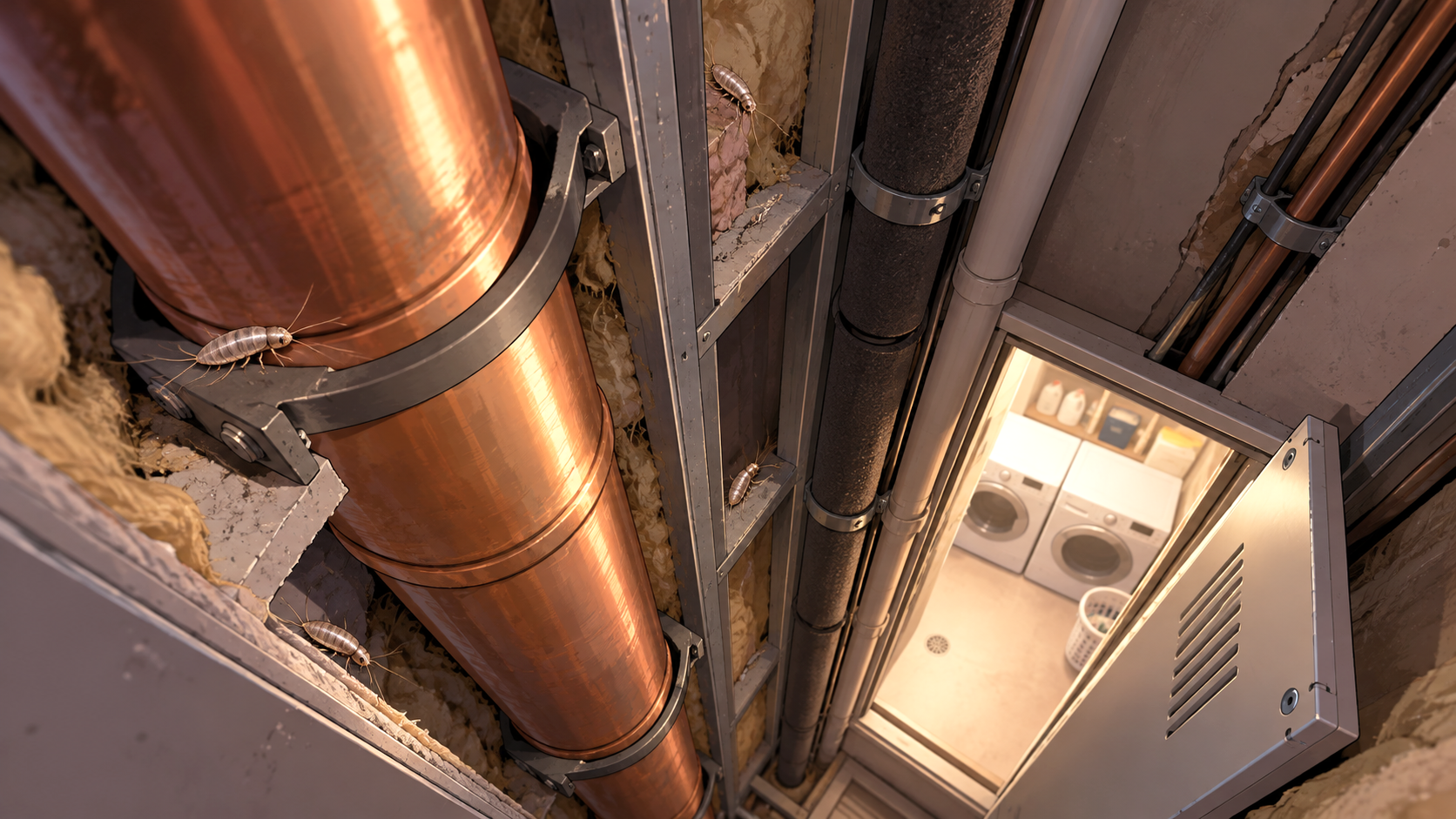
Firebrats (Thermobia domestica) are now found around the world, particularly in warm environments associated with buildings. Rather than belonging to one easily defined modern geographic region, the species has become cosmopolitan indoors, meaning established populations occur widely wherever suitable heated habitats are available.
What defines a firebrat’s habitat more clearly than geography is heat. These insects are unusually well adapted to very warm conditions. They thrive in places above 90°F (32°C), with an optimum temperature of roughly 98°F to 102°F (37°C to 39°C). That preference explains why firebrats are repeatedly associated with furnaces, ovens, heating pipes, fireplaces, boiler areas, and other places where sustained warmth creates a suitable microhabitat.
Firebrats Are Closely Associated With Human Buildings
The scientific name Thermobia domestica provides a useful clue to the insect’s ecology. The genus name Thermobia comes from Greek roots referring to living in warmth, while firebrats are now strongly associated with heated human structures. They can persist indoors throughout the year when those structures provide the temperatures and shelter they need.
This association is particularly strong because buildings can create small pockets of heat far warmer than the surrounding environment. A room does not need to feel exceptionally hot for a firebrat to find suitable conditions. The space beside a furnace, beneath an oven, around a steam or hot-water pipe, or inside insulation surrounding heating equipment can have a very different microclimate from the rest of the building.
That helps explain why firebrats occur even in regions with cold winters. Their distribution is not limited to climates where outdoor temperatures remain hot throughout the year. Heated structures can provide localized warmth regardless of the weather outside, allowing a species strongly associated with heat to maintain populations in much cooler parts of the world.
Their Ideal Habitat Is Much Hotter Than a Typical Room
Firebrats tolerate a surprisingly broad temperature range, but tolerating a temperature and thriving at it are different things. They can survive from around freezing to well above 100°F, while their preferred conditions are considerably narrower. Their best conditions occur at temperatures above 90°F and relative humidity as low as 30%, with the optimum temperature falling close to normal human body temperature.
That preference separates their habitat from the damp, moderately warm places commonly associated with ordinary silverfish. Silverfish generally favor warm and humid environments, whereas firebrats can thrive under much hotter and comparatively drier conditions. The two insects are closely related and easily confused, but their preferred microhabitats are an important ecological difference. Their physical differences are covered separately in firebrats vs. silverfish.
Humidity still matters to firebrats, however. Calling them heat-loving does not mean they require completely dry surroundings. They need access to water, and some parts of their reproductive biology depend on moisture. Their ability to tolerate substantially lower relative humidity than silverfish simply allows them to occupy hot locations that would be less suitable for their familiar relative.
Furnaces, Ovens and Hot Pipes Create Classic Firebrat Habitat
The name “firebrat” becomes quite literal when you look at where the insect tends to establish itself. Furnaces, fireplaces, heating units, hot-water pipes and ovens can all create the concentrated heat firebrats prefer. Attics may also become suitable during hot weather, while furnace areas can remain favorable during colder months.
Commercial buildings can provide similar conditions on a larger scale. Bakeries and other facilities containing continuously heated equipment have historically been strongly associated with firebrats because machinery, ovens, pipes, and protected structural spaces can maintain high temperatures for long periods. These are not merely convenient hiding places. Their thermal conditions closely match the biology of the insect.
Firebrats also need shelter close to these warm areas. Their flattened bodies allow them to occupy narrow cracks, crevices, insulation, and other protected spaces where they can remain concealed during periods of inactivity. They are primarily nocturnal and normally emerge from shelter to search for resources after dark. This habit means the visible insect may be only briefly outside the warmer hidden space where it spends much of its time.
Firebrats Can Live Beyond the Hottest Part of Their Habitat
A firebrat found several feet from a furnace or oven does not contradict its preference for heat. Individuals can leave their main hiding areas while searching for food and water, so the place where you spot one is not necessarily the place where it spends most of its time.
Food availability also broadens the usable habitat around a warm refuge. Firebrats consume materials rich in carbohydrates or protein, including certain stored foods, paper-associated adhesives, book bindings, debris, dead insects, and fungi. Those feeding habits are covered in more detail in what firebrats eat, but they help explain why an insect centered around a heating system may still turn up elsewhere in a building.
The same distinction is useful with other indoor pests. Habitat is not always identical to the surface where an insect happens to be seen. For example, several unrelated household arthropods move away from their preferred shelters while searching for resources, which is why a single sighting should not automatically be treated as proof of where a population is centered.
Are Firebrats Native to One Particular Country?
There is no well-supported modern answer that lets us point to a single country and say that this is where Thermobia domestica originally came from. Reliable contemporary references describe the firebrat as cosmopolitan, reflecting its extremely broad association with human structures rather than assigning it a simple native range.
That distinction is worth preserving because “Where do firebrats come from?” can mean two different things. If the question is about their present geographic range, they occur widely around the world. If it means their precise evolutionary or ancestral geographic origin, the authoritative pest references available to us do not establish one specific country strongly enough to present it as fact.
What is much clearer is the type of environment the species has successfully occupied. Wherever humans create persistent pockets of intense warmth, firebrats can find conditions resembling their preferred habitat. That relationship with heated structures has allowed them to become a widely distributed indoor insect rather than one confined to a narrow modern range.
Where Should You Expect Firebrats to Be Living?
If you are trying to work out where a firebrat population is centered, think in terms of localized heat rather than entire rooms. Areas around furnaces, boilers, fireplaces, ovens, hot-water lines, heating pipes, and warm insulation deserve more attention than simply searching whichever room contained the first insect.
However, finding firebrats indoors raises a different question from understanding their preferred habitat. Their natural habitat requirements tell you where they can thrive, while the route and circumstances that brought them into a particular building concern what causes firebrats to get into a house. Keeping those questions separate makes it easier to identify whether you are looking for the population’s preferred hiding environment or trying to determine how the insects arrived there.
Questions About Where Firebrats Come From
Are firebrats found worldwide?
Yes. Thermobia domestica is considered cosmopolitan and is widely associated with indoor environments around the world.
Do firebrats come from hot climates?
Firebrats are strongly adapted to heat, but their modern distribution is not restricted to naturally hot climates. Heated buildings can provide suitable microhabitats even where outdoor winters are cold.
Can firebrats live outside?
Firebrats belong to a broader group of bristletails whose members can occur outdoors, but Thermobia domestica is particularly strongly associated with hot indoor environments. Its widespread modern distribution is largely described in relation to buildings.
Why are firebrats found around furnaces?
Furnaces create exactly the kind of sustained high-temperature environment firebrats favor. Protected cracks and insulation around heating equipment can also provide nearby shelter.
Are firebrats only found near fire?
No. The name reflects their preference for heat, not a requirement for flames. Ovens, hot-water pipes, heating units, warm attics, boilers, and other consistently hot locations can all provide suitable habitat.
One thought on “Where Do Firebrats Come From?”