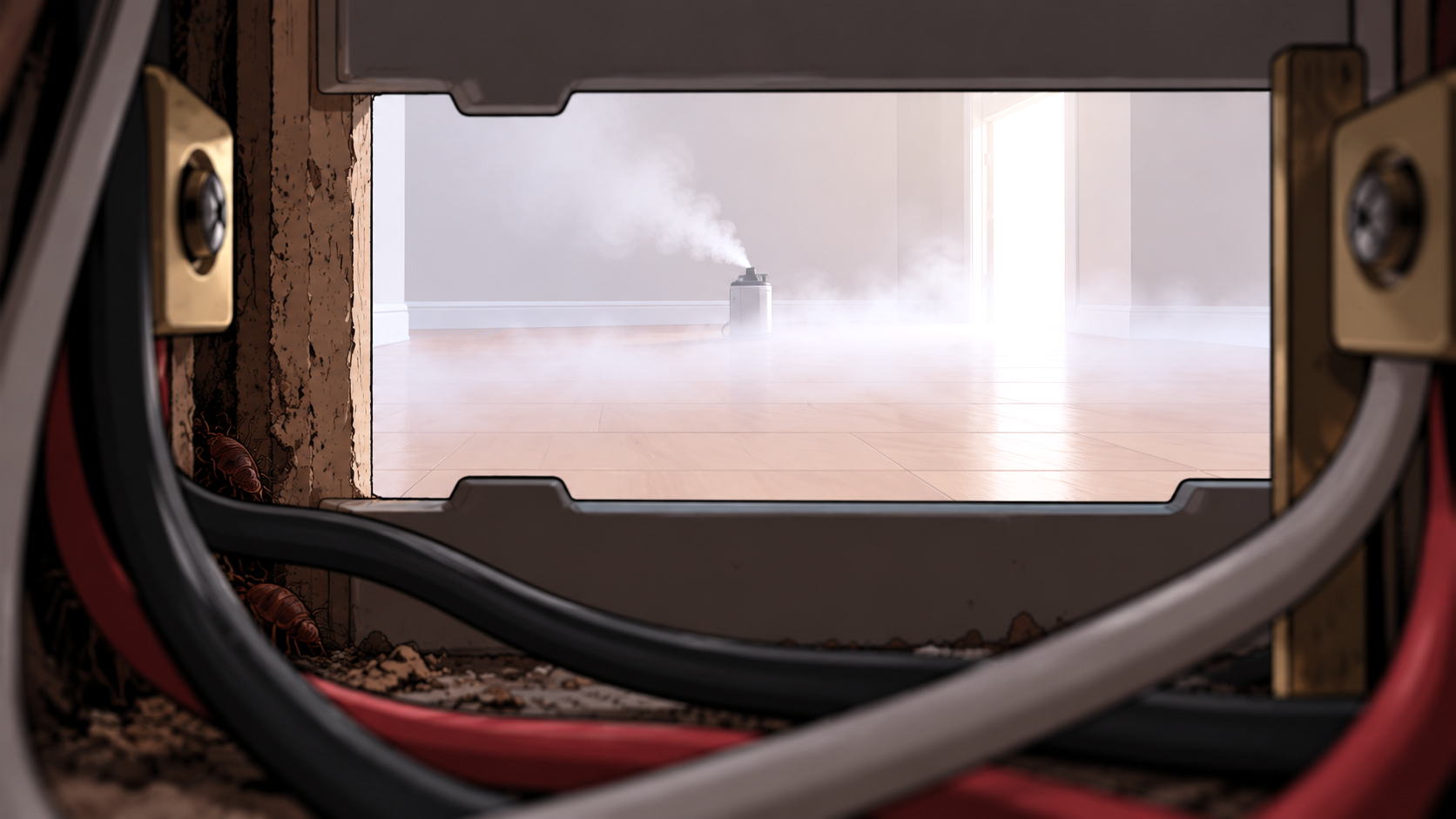
Bed bug bombs sound appealing because one canister appears capable of treating an entire room at once. The problem is that bed bugs spend much of their time in exactly the places the released insecticide has difficulty reaching.
Bed bug bombs and total-release foggers are not reliable standalone treatments for bed bugs. A peer-reviewed study testing three over-the-counter foggers found them ineffective as bed bug control agents, while EPA says foggers should not be used as the sole method of control because the pesticide may not reach bed bugs hiding in cracks and crevices. Improper use can also cause pesticide exposure, fire, or explosion.
That combination of poor access to hidden bugs and meaningful safety risks makes foggers a particularly weak option for an infestation that already demands thorough treatment.
Researchers Directly Tested Bed Bug Foggers
This question has unusually direct experimental evidence behind it.
A 2012 study published in the Journal of Economic Entomology tested three over-the-counter total-release foggers against bed bugs: Hotshot Bedbug and Flea Fogger, Spectracide Bug Stop Indoor Fogger, and Eliminator Indoor Fogger.
Field-collected bed bugs showed little or no adverse effect after two hours of direct exposure to the aerosolized pyrethrins or pyrethroids from the products in most of the experiments.
One field population showed significant delayed mortality from one fogger when the insects remained completely exposed. Give the bugs somewhere to hide, however, and mortality remained low.
The researchers concluded that the three tested foggers were ineffective as bed bug control agents.
That conclusion rested on two problems. Many field-collected bed bugs showed resistance to the insecticides being delivered, and the aerosol had little ability to penetrate the protected harborages where bed bugs normally hide.
Even a Thin Cover Protected Bed Bugs From the Fog
The harborage experiment is probably the most useful part of the study for understanding what happens in a bedroom.
Researchers included a laboratory bed bug strain known to be susceptible to pyrethroids. When those bugs were exposed in the open, some of the tested foggers could kill them.
But when the susceptible bugs were protected beneath a thin cloth layer, they survived.
The researchers found minimal, if any, penetration into this simple harborage. A real bedroom gives bed bugs much better hiding places than a thin piece of cloth, including mattress seams, bed frames, furniture joints, baseboards, and narrow cracks.
EPA’s current guidance explains the same limitation: the pesticides released by foggers must reach the bed bug to kill it. If the material does not penetrate the crack or crevice where the insect is hiding, that bed bug escapes the exposure.
Pesticide Resistance Creates Another Problem
Poor penetration was not the only reason the tested products performed badly.
The field-collected bed bugs in the study were exposed to foggers containing pyrethrins, pyrethroids, or combinations of those insecticides. The researchers found that many of the field populations were resistant to pyrethroids and were little affected by the brief, low-concentration exposure delivered by the foggers.
That distinction matters because simply putting a bed bug on an exposed surface does not guarantee that a particular insecticide will kill it.
Resistance varies among populations and insecticides, so it should not be treated as proof that every pyrethroid fails against every bed bug. But it does add another weakness to a delivery system already struggling to reach the insects.
The broader issue is covered separately in why bed bugs become resistant to pesticides.
Foggers Can Cause Fires, Explosions and Pesticide Exposure
The effectiveness problem would be enough to make us cautious about foggers. Their safety record makes the tradeoff worse.
Total-release foggers contain aerosol propellants, and EPA warns that these propellants are typically flammable. Improper use can therefore cause a fire or explosion. Ignition sources such as pilot lights are a particular concern.
Exposure can also make people ill.
CDC surveillance identified 466 cases of acute pesticide-related illness or injury associated with total-release foggers in eight states between 2001 and 2006. Problems commonly arose when people failed to leave before discharge, returned too soon, used too many foggers for the space, or failed to notify other people nearby.
Most cases were classified as low severity, but 18% were moderate and 2% were high severity. The data establish that fogger injuries are not merely hypothetical accidents.
Using More Foggers Doesn’t Fix the Coverage Problem
A persistent infestation can make using several foggers seem more logical than using one. It isn’t.
The fundamental problem is access to harborages. Increasing the amount released into a room does not turn a total-release aerosol into a targeted crack-and-crevice treatment.
Meanwhile, EPA specifically warns that using more foggers than necessary can create an explosion hazard. The CDC investigation also identified excessive fogger use as one of the circumstances associated with reported illnesses and injuries.
So “more” creates additional exposure and ignition risk without solving the physical reason hidden bed bugs survive.
EPA Doesn’t Recommend Foggers as a Standalone Bed Bug Treatment
There is an important distinction between saying foggers are unreliable and saying every fogger is illegal for bed bugs.
Some total-release foggers are EPA-registered and labeled for bed bugs. Others are not. A pesticide should never be used against a pest that is not listed on its label.
Even when bed bugs are listed, EPA says foggers should not be the sole source of bed bug control.
Instead, bed bug control generally requires an integrated approach combining methods suited to different parts of the infestation. Depending on the situation, that can include inspection, heat, vacuuming, encasements, monitoring, appropriately registered pesticides, and professional treatment. The wider process is covered in how to get rid of bed bugs, rather than trying to make a fogger perform a job it is poorly designed to do.
Questions About Bed Bug Bombs and Foggers
Can a fogger kill a bed bug sitting completely exposed?
Potentially, depending on the insecticide, product, exposure, and susceptibility of the particular bed bug population. The 2012 experiment obtained mortality under some open-exposure conditions. That did not translate into effective control once bed bugs had access to hiding places.
Could a newer fogger work better than the three products tested in 2012?
The study directly establishes the poor performance of the three formulations it tested, not every fogger manufactured since then. EPA’s current guidance nevertheless continues to identify the same fundamental limitation: fogger pesticide must reach hidden bed bugs to kill them, and cracks and crevices can prevent that contact.
How long do you have to leave after setting off a fogger?
There is no universal reentry time. Follow the exact product label. EPA warns against returning before the time specified on the label and before completing any required ventilation.
Can I set off several bed bug bombs in the same room?
Never exceed the quantity permitted by the product label. EPA specifically warns that using too many foggers can cause an explosion.
3 thoughts on “Do Bed Bug Bombs and Foggers Actually Work?”