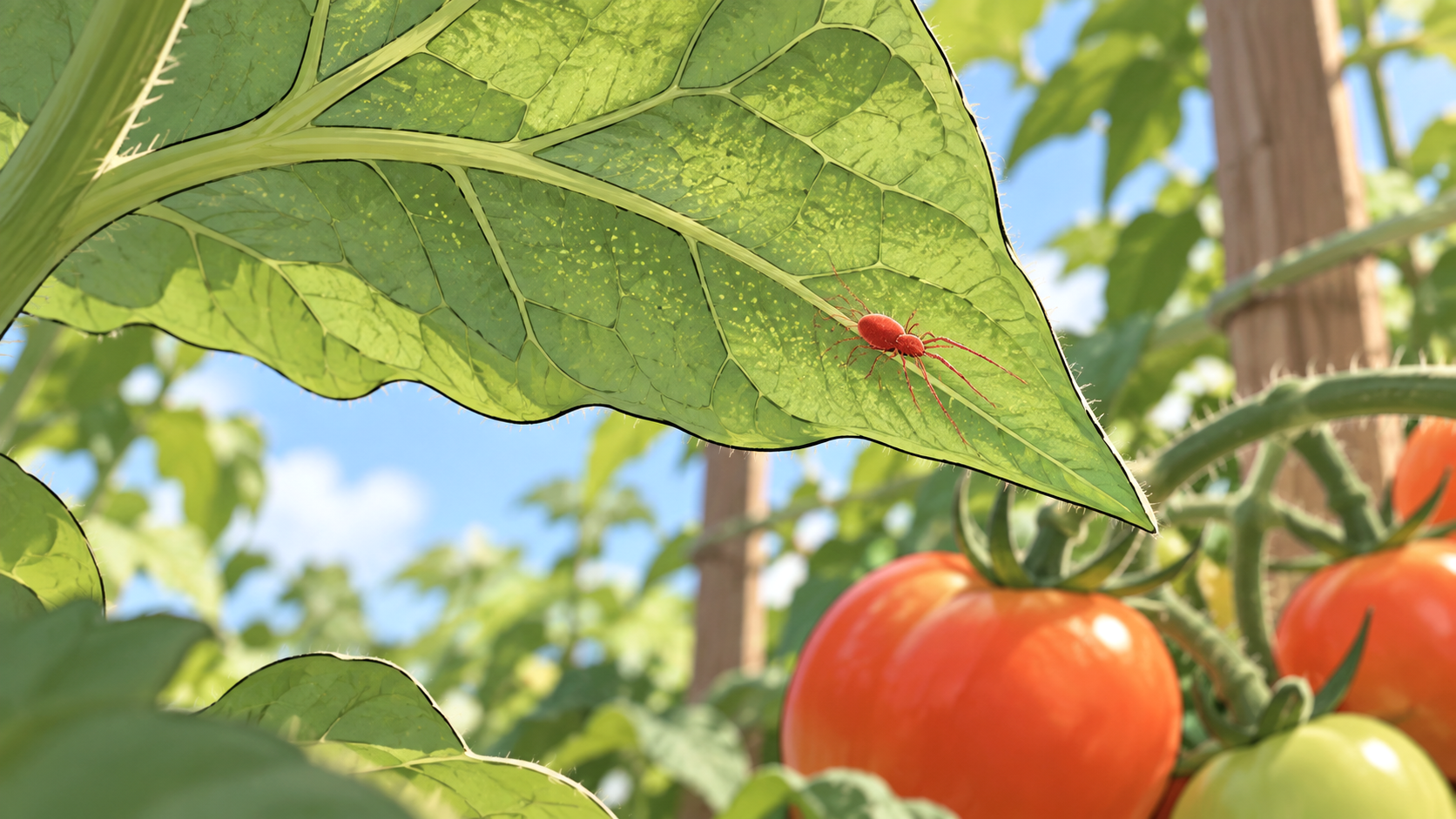
Finding clover mites on a tomato plant is not automatically a case of harmless wandering. Tomatoes are a documented host of clover mites, Bryobia praetiosa, and the mites can feed and develop on tomato leaves. What is much less clear is whether tomatoes have any unusual susceptibility to them. Current authoritative information supports tomato as a host, but not the stronger idea that clover mites are normally a major tomato pest.
That makes population size more useful than the simple presence of a mite. A few clover mites discovered on otherwise healthy tomato foliage do not establish that the plant is in trouble. Large numbers actively feeding deserve more attention because clover mites are genuine plant feeders, and heavier populations can injure susceptible vegetation. The broader question of how harmful clover mites can be to plants is covered separately rather than assigning those general effects specifically to tomatoes.
Tomatoes Really Are on the Host List
Tomato is not an assumed host based merely on clover mites having a broad diet. Bryobia praetiosa has specifically been reported feeding and developing on tomato leaves, alongside beans, strawberries, clover, grasses, and other herbaceous plants. Clover mites as a species feed across a wide range of vegetation, with additional documented hosts including ornamental flowers, dandelion, daffodil, salvia, alyssum, and primrose. Their ability to use tomato therefore fits a much broader host range rather than identifying tomato as a preferred or uniquely vulnerable crop.
The mites feed by puncturing plant tissue and removing cell contents. General clover mite feeding can produce small irregular silver marks on leaves, while other references describe affected foliage as bronzed or silver. Those are useful clues when investigating a tomato plant, but they are not tomato-specific symptoms and can resemble injury caused by other pests or plant problems. Our guide to identifying clover mite plant damage covers that diagnosis without duplicating it here.
Do Not Assume Every Mite on a Tomato Is a Clover Mite
Tomatoes can host several mites, and confusing them can send treatment in the wrong direction. Clover mites are extremely small and have a conspicuously long first pair of legs, a feature covered in our guide to what clover mites look like. A hand lens makes that feature much easier to check.
Webbing deserves particular attention on tomatoes. Clover mites do not produce the conspicuous silk associated with some other plant-feeding mites. If a tomato plant has fine webbing together with extensive mite activity, compare the specimens carefully rather than treating their reddish color as proof of clover mites. The dedicated clover mite versus spider mite comparison is more useful for resolving that identification.
Treat the Infestation You Actually Find
There is no good basis for treating a healthy tomato plant merely because one or two confirmed clover mites appear on it. Check several leaves and determine whether mites are numerous and feeding before deciding that control is warranted. Clover mite IPM guidance recommends treatment of affected plants when active populations require management, including options such as insecticidal soap, but tomatoes are an edible crop, so any pesticide used on them must be specifically permitted by its current label for that crop and use.
Avoid transferring a product recommendation from lawns, foundations, ornamentals, or building perimeters onto tomatoes. Pesticide legality and safe use depend on the label, not simply on whether an active ingredient can kill mites. If treatment becomes necessary, follow the registered product’s crop, application, harvest-interval, and other label directions exactly. General product comparisons belong in our clover mite insecticide guide rather than being repeated as tomato recommendations here.
Tomato-Specific Questions
Should you remove a tomato plant because you found clover mites on it?
No. Finding a documented plant-feeding mite on the foliage does not by itself justify discarding the plant. Confirm how extensive the infestation actually is before deciding what response is appropriate.
Can clover mites remain on tomato leaves long enough to develop?
Yes. Tomatoes are among the plants on which clover mites have been reported both feeding and developing.
Can you eat tomatoes from a plant that has clover mites?
The presence of clover mites on foliage does not itself determine whether fruit is suitable to eat. If a pesticide has been applied, follow its label instructions for edible crops and any specified preharvest interval before harvesting fruit.
Are tomatoes a preferred host for clover mites?
The available authoritative material confirms tomato as a host, but it does not establish tomatoes as a preferred host. Claims that clover mites particularly favor tomato plants would therefore go beyond the evidence.