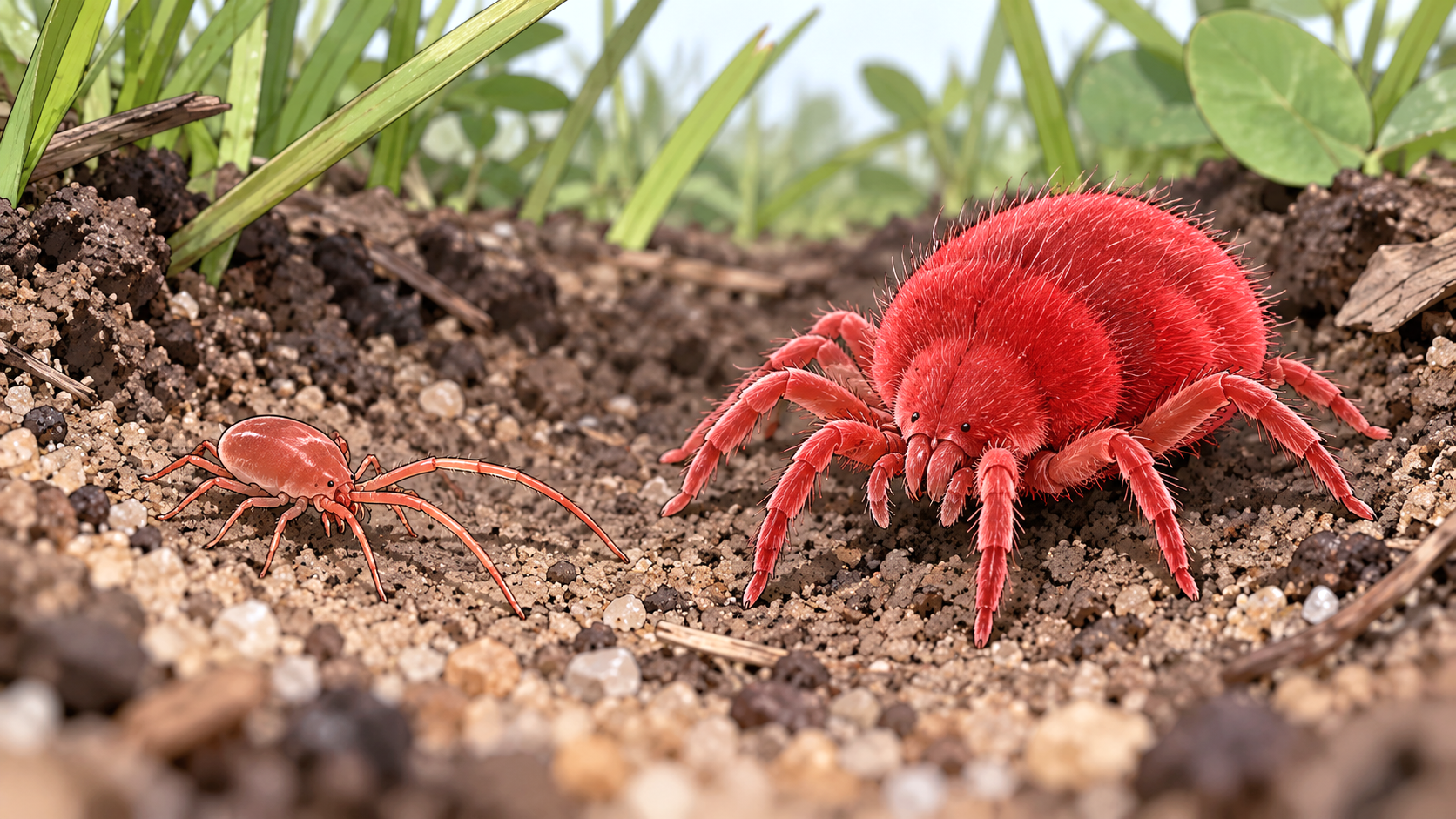
Red velvet mites can look enormous beside clover mites, even though both are small arachnids. Clover mites are minute plant feeders with exceptionally long front legs. Red velvet mites are generally larger, visibly fuzzy or velvety, and their later active stages prey on other arthropods. A bright-red body is one of the least useful features for separating them because both groups can wear that color convincingly.
“Red velvet mite” is also a broader common name than “clover mite.” Clover mites commonly encountered around buildings are associated with Bryobia, particularly Bryobia praetiosa, while velvet mites include numerous species within groups such as Trombidiidae. Their biology therefore varies somewhat by species.
Velvet Texture and Size Give Red Velvet Mites Away
An adult clover mite is usually less than 1 mm long. Its body is oval, and the first pair of legs extends conspicuously forward, reaching roughly twice the length of the other legs. Those unusually long front legs are useful enough that a hand lens can turn an uncertain red speck into a fairly recognizable clover mite. Depending on feeding and other factors, clover mite coloration can include reddish brown, dark green-brown, and related shades rather than a uniform scarlet.
Many red velvet mites are noticeably larger. Common velvet mites can reach roughly 1/16 to 1/8 inch, while some species are larger still. Their bodies carry dense hairs that produce the characteristic velvety appearance behind the name. A Canadian agricultural identification guide describes Trombidium holosericeum, for example, as a bright-red mite about 4 mm long with a velvety body. The difference can be striking when a mature velvet mite is compared directly with a clover mite.
| Feature | Clover mite | Red velvet mite |
|---|---|---|
| Typical adult appearance | Minute, oval mite | Larger, visibly hairy or velvety mite |
| Strong identification clue | Extremely long first pair of legs | Dense red or orange-red body hairs |
| Adult diet | Plant material | Mostly small arthropods and their eggs |
| Larval behavior | Plant feeding | Often parasitic on other arthropods |
| Common setting | Turf, vegetation, walls, windows and buildings | Soil, leaf litter and other outdoor habitats |
| Household nuisance | Can invade in very large numbers | Not a typical mass household invader |
One Feeds on Plants; the Other Can Feed on Plant Pests
The ecological roles are nearly opposites. Clover mites obtain nutrients from plant tissue and commonly use grasses and other low-growing plants as food. High populations can sometimes produce silvery feeding injury in turf, although homeowners often notice the mites only after they leave vegetation and begin crawling over structures.
Postlarval red velvet mites are predators. They consume small arthropods and their eggs, including organisms that may themselves be plant pests, which is why velvet mites are often considered beneficial. Their life cycle adds another unusual feature: larvae of many trombidiid velvet mites live as external parasites of insects and other arthropods, while later active stages become free-living predators. A velvet mite walking through a garden therefore should not be treated as a plant pest merely because it resembles a large red version of a clover mite.
A Mass of Mites on a Window Favors Clover Mites
Behavior around buildings provides another strong clue. Clover mites routinely migrate from surrounding vegetation onto foundations and exterior walls, sometimes entering through tiny gaps around doors and windows. Hundreds or thousands may appear together, and large spring or fall household invasions are characteristic of the pest. Concentrations of tiny mites on window sills or sun-exposed exterior surfaces therefore fit clover mites particularly well.
Red velvet mites are more closely associated with soil, litter, and other terrestrial outdoor habitats. Adults can be seen walking openly while searching for prey, but they are not known for the enormous building invasions associated with clover mites. A solitary fuzzy red mite moving through a garden or across the soil fits a velvet mite much better than a swarm of nearly pinhead-sized mites entering a house.
Red Velvet Mites Usually Deserve to Be Left Alone
A correctly identified red velvet mite outdoors generally needs no control. Adults and nymphs can prey on small arthropods, and common garden velvet mites are considered harmless to people and plants. Applying a broad-spectrum pesticide merely because one is conspicuous and red can eliminate a useful predator.
Clover mites become a control issue mainly when their numbers create plant damage or a persistent nuisance around buildings. Indoor individuals are best vacuumed rather than crushed because their pigments can stain pale materials. Repeated invasions call for attention to how clover mites are getting indoors and the conditions immediately around the structure rather than treating an unrelated velvet mite found in the garden.
Red Mite Details That Can Prevent a Mix-Up
Are giant red velvet mites the same mites discussed here?
They belong to the broader velvet-mite assemblage, but “red velvet mite” can refer to many different species. Some spectacular species found in arid regions grow considerably larger than the small velvet mites encountered in many North American gardens.
Do red velvet mites leave the same red stain as clover mites?
Clover mites are particularly notorious for leaving red smears when crushed, which is one reason squashing indoor clover mites should be avoided. Crushing an unknown mite is unnecessary for identification and can destroy the features needed to examine it.
Can both mites have six legs when young?
Yes. Mite larvae typically have six legs, including newly hatched clover mite larvae. Later clover mite stages have eight legs, while velvet mites undergo their own more complex progression from larval to postlarval stages.
Are red velvet mites chiggers?
No. Velvet mites and chiggers belong to related but distinct groups with different host relationships. The human-feeding larvae commonly called chiggers should not be confused with harmless garden velvet mites, just as clover mites differ from chiggers despite all three sometimes being described as tiny red mites.