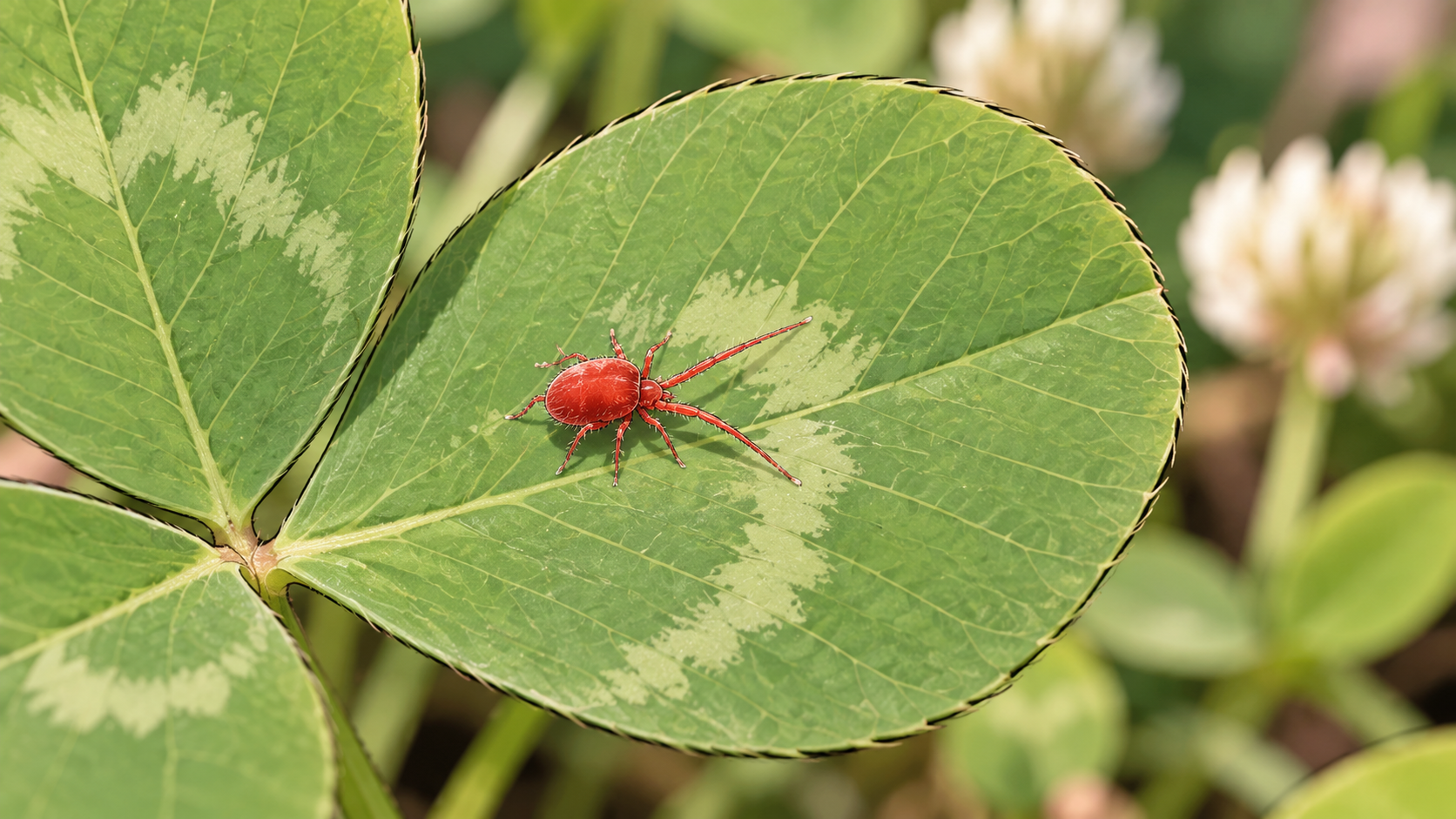
Clover mites do not make webs. Although they belong to the spider mite family Tetranychidae, they lack the conspicuous web-producing behavior associated with familiar species such as two-spotted spider mites. If you find fine silk around leaves, stems, windows, or other surfaces where clover mites are present, the silk has another source.
Why a Spider Mite Does Not Necessarily Make Webs
The name “spider mite” causes much of the confusion. Tetranychidae contains many mites famous for producing silk, but webbing behavior varies within the family. Clover mites, Bryobia praetiosa, are among the exceptions. They are specifically described as spider mites that do not produce webbing. Their classification therefore tells you about their biological relationships, not everything they do. Clover mites remain members of Tetranychidae even though their behavior differs from heavily webbing species in the same family. In the same way, being arachnids related to spiders does not make clover mites miniature spiders.
Two-spotted spider mites show the contrast particularly well. As their populations increase, silk can spread over leaves, flowers, buds, and stems. The mites use this silk as part of their life on the plant. Clover mites manage without it.
Webbing Is a Useful Identification Clue
Finding webbing does not identify a mite species by itself, but it gives you valuable evidence. Fine silk closely covering plant tissue fits several web-producing spider mites much better than it fits clover mites. Heavy spider mite infestations can produce extensive webbing, sometimes making the silk easier to notice than the mites themselves.
For clover mites, physical features provide better evidence. Their unusually long front pair of legs is particularly useful under magnification. Their color can range through several reddish, brown, and greenish shades, so we would put more weight on structure than on whether an unknown mite happens to look red.
A hand lens can make that comparison much easier. Many plant-feeding mites are too small for reliable naked-eye identification, and magnification helps reveal the characteristics needed to separate mite groups.
Something Else May Be Responsible for the Silk
Seeing clover mites and silk in the same place does not mean one produced the other. Plants and exterior surfaces can host several arthropods simultaneously.
Other spider mites are one possibility on vegetation. Two-spotted spider mites, for example, are well-known silk producers, particularly when populations become dense. Spiders can obviously account for larger conventional webs, while some insect larvae also use silk for shelters, trails, or other structures.
The type and placement of the silk can narrow the possibilities. Fine strands tightly associated with damaged foliage are different from a larger spider web stretched between objects. Identifying the organism actually occupying the silk is more dependable than assigning every strand to whichever small arthropod happens to be nearby.
That becomes especially important because clover mites can occur in substantial numbers. Their plant-based diet includes grasses and numerous other hosts, so seeing many of them on vegetation is perfectly compatible with finding silk produced by another resident of the same plant.
Webbing Is Not How Clover Mites Travel
Silk is also unnecessary for clover mite movement. They move by crawling rather than flying or jumping and can cross horizontal surfaces as well as climb vertical ones.
This matters when mites appear on foundations, siding, or other parts of a building. Large numbers can travel from nearby vegetation and spread across exterior surfaces without laying down silk trails. Their ability to move from lawns and plants onto foundations is ordinary crawling behavior.
So if you see a trail of clover mites without any silk connecting them, nothing is missing. They do not need a web to reach those surfaces.
Other Questions About Clover Mites and Silk
Do clover mites build nests?
No. A cluster of clover mites should not be interpreted as a constructed nest. Multiple mites can occupy the same favorable location without building a shared structure.
Do clover mites use silk to protect their eggs?
No protective silk covering is characteristic of clover mite eggs. Females instead place their tiny red eggs in protected locations, such as cracks and crevices.
Are two-spotted spider mites and clover mites the same thing?
No. They are different mites within the spider mite family. One particularly useful behavioral difference is that two-spotted spider mites produce conspicuous silk, whereas clover mites do not.
Should I identify an unknown mite from webbing alone?
No. Webbing can narrow the possibilities, but the mite itself should also be examined. Different organisms can share the same plant, so the presence of silk does not prove which species produced it.