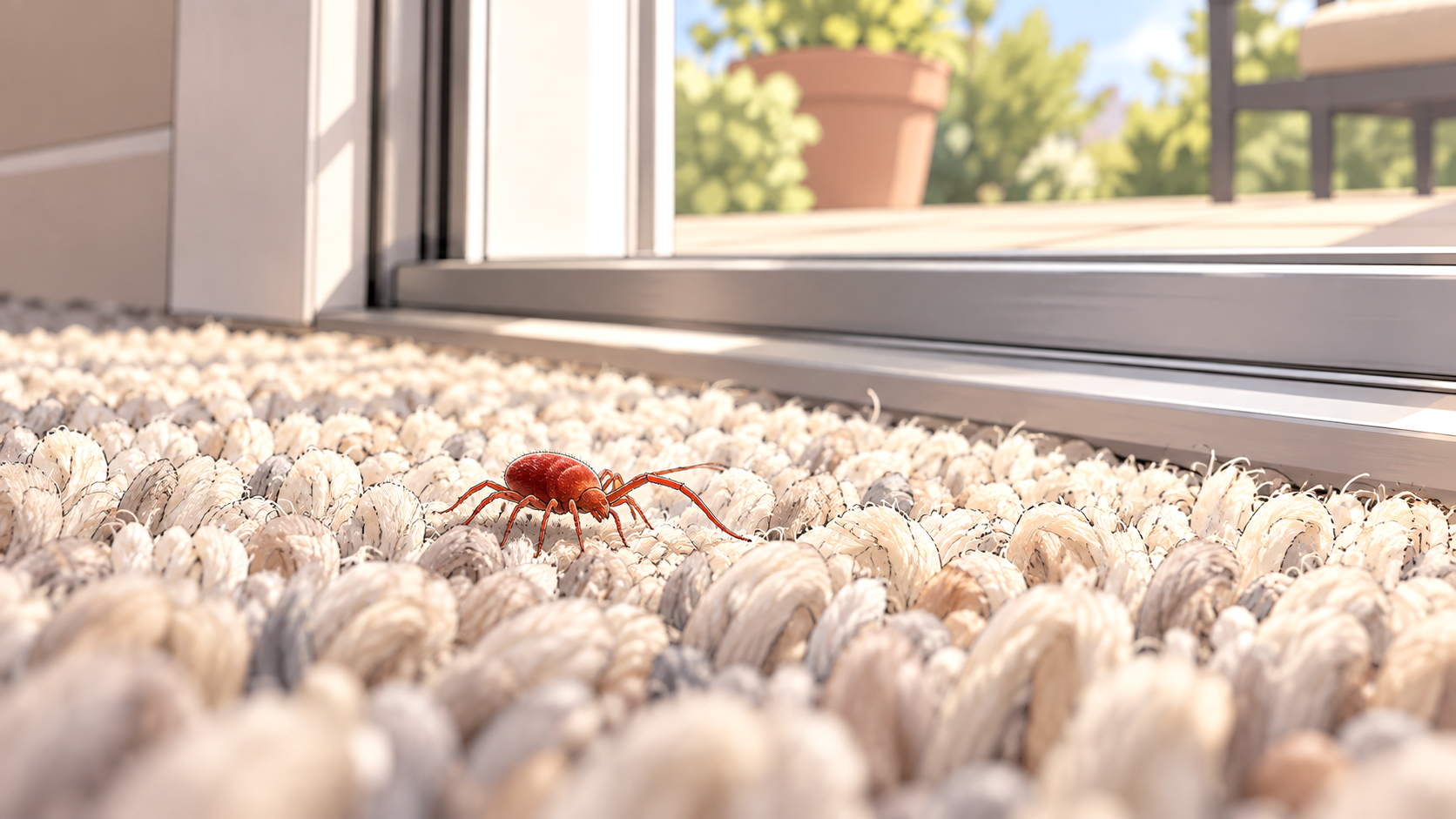
A clover mite can crawl through carpet fibers, disappear into the pile, and turn up again later. It cannot make a living there. Carpet supplies no food for clover mites, and they do not reproduce in it. The practical concern is staining. A mite hidden underfoot can be crushed before you ever notice it, leaving a small reddish mark on light-colored carpet.
Carpet Gives Them Cover, Nothing More
Clover mites are tiny enough to move between carpet fibers with ease. Indoor migrations can spread them across floors, furniture, curtains, and carpeting, so finding one below the visible surface is entirely plausible.
The fibers themselves are useless as food. Clover mites feed on living plants, while carpet, draperies, and clothing are not damaged or eaten by them. Wool fares no differently from synthetic carpet because these mites are not textile feeders. A genuine fabric pest leaves a different trail. Carpet beetle larvae, for example, can damage wool and other animal-based materials. Frayed fibers, holes, shed larval skins, or continuing textile damage call for another identification.
A Carpet Cannot Produce More Clover Mites
Finding mites on the same patch of floor several days apart can look like reproduction beneath the pile. Clover mite biology rules that out. Every clover mite found indoors originates from an outdoor population, and normal indoor conditions do not support another generation.
Their eggs also have particular requirements. Females usually place the small red eggs in protected outdoor crevices, and the species completes its egg-to-adult life cycle in association with its plant-feeding habitat.
A few concealed mites can emerge at different times and create the impression of a growing carpet population. Clover mites cannot establish a lasting indoor population, regardless of how thick the carpet is.
The Red Stain Is the Real Carpet Problem
Clover mites do not chew carpet, but crushing one can leave a conspicuous red or rusty spot. The color comes from body pigments rather than blood. Light-colored carpets and fabrics are particularly vulnerable to visible staining.
Vacuuming is preferable to rubbing, sweeping aggressively, or pressing the mites into the pile. Indoor IPM guidance recommends vacuuming visible clover mites, which removes them without deliberately crushing their bodies against the fibers.
We would not shampoo or replace a carpet simply because clover mites crossed it. They do not damage household furnishings, and treating the carpet as an infested material solves a problem it does not actually have.
When the Carpet Suggests You Have the Wrong Mite
Carpet can host other mites, so persistence deserves attention. House dust mites, for instance, occupy household dust and can occur in carpets and upholstered furniture. Their biology has little in common with that of clover mites.
Check the animal itself when identification is uncertain. A clover mite has an unusually long front pair of legs, a feature that is far more useful than the surface where you found it. Clover mite colors also vary, so a tiny red speck on carpet should not be identified from color alone.
If confirmed clover mites disappear and later return in another wave, the carpet has not regenerated them. That pattern belongs to recurring clover mite activity, not a hidden colony living in the fibers.
Carpet Questions Worth Clearing Up
How long can a clover mite stay alive in carpet?
There is no useful carpet-specific lifespan. Indoors generally, clover mites perish rather than establishing themselves, so finding one alive in the pile only shows that it has not died yet.
Can clover mites live under a rug?
They can temporarily hide beneath one. The rug does not provide the living plant material required for feeding.
Should I spray my carpet for clover mites?
Usually not. Vacuuming removes the mites without unnecessarily applying pesticide to the carpet.
Can clover mites ruin carpet?
They do not eat the fibers. Accidental crushing is the concern because their pigments can leave reddish stains.