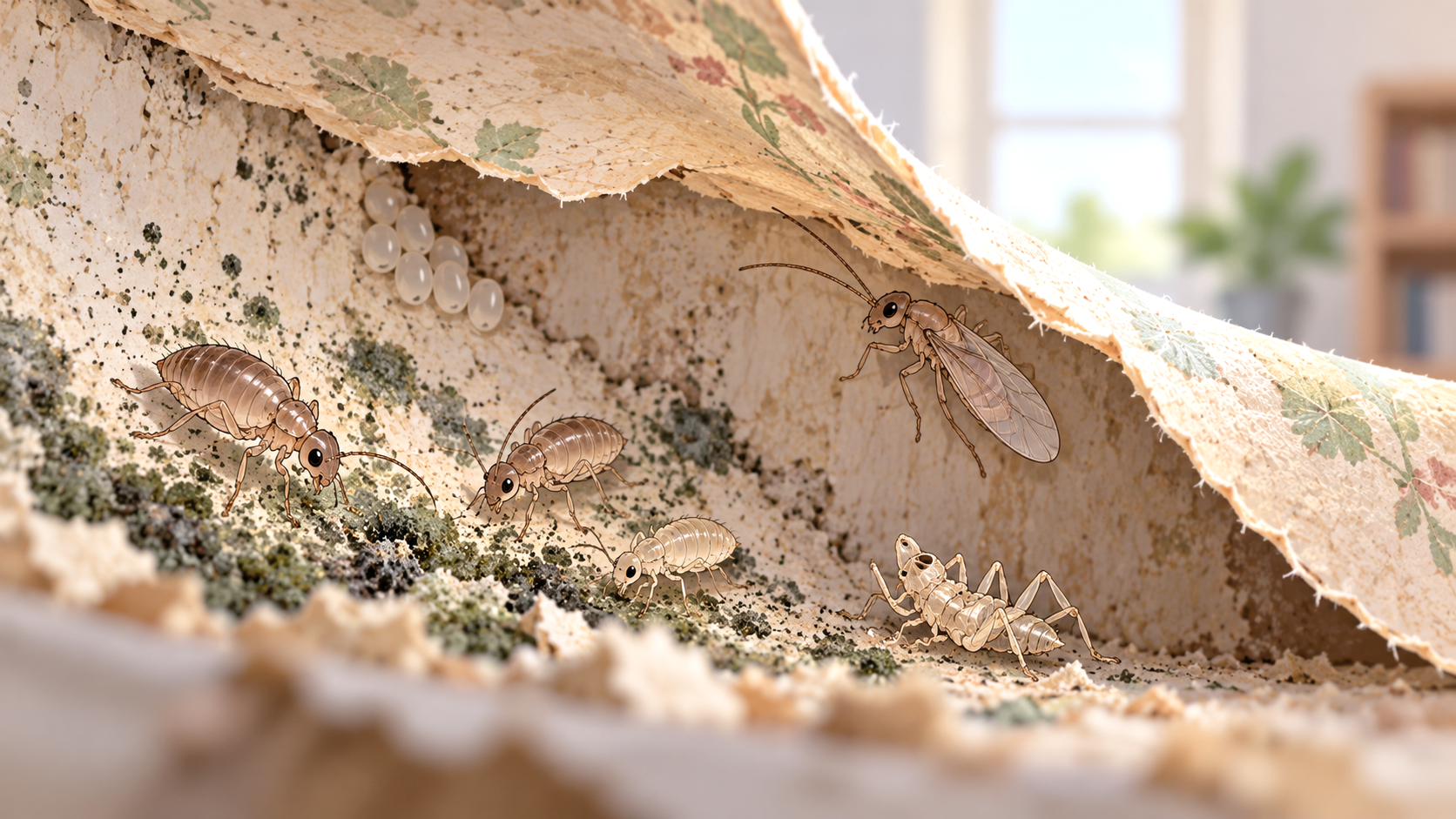
Booklice are easy to dismiss as tiny bugs that turn up around old books, but some of their biology is considerably more interesting than their name suggests. They are not true lice, books are not necessarily their main food, and some species have become surprisingly important pests of stored food.
Booklice are tiny psocids that usually thrive in humid places where microscopic fungi grow. Common indoor species are wingless, do not bite people, and develop from eggs through nymphal stages without a larval or pupal stage. Some species can also reproduce without males, survive on very little food, and infest stored products far beyond books.
Here are some of the most interesting facts about these easily overlooked insects.
Booklice Are Not Actually Parasitic Lice
The name “booklice” creates one of the biggest misconceptions about these insects. Booklice are not the blood-feeding lice that live on humans or other animals. They are free-living insects in the order Psocodea and occupy a completely different ecological niche.
Instead of depending on a host, indoor booklice live around damp materials and feed largely on microscopic fungi, molds, and other suitable organic matter. They do not bite people or transmit disease, which makes finding them in a home very different from discovering head lice.
There is still a taxonomic connection behind the confusing terminology. Booklice and parasitic lice both belong within Psocodea, but their lifestyles have diverged dramatically. Comparing booklice with true lice shows just how little their shared common name tells you about how they actually live.
A Booklouse Can Be Smaller Than a Sesame Seed
Booklice are genuinely tiny. Common indoor species are often only 1 to 2 millimeters long, making an adult substantially smaller than many household insects people commonly notice.
Their size affects almost everything about how we perceive them. A booklouse on a wall may look like a moving speck until magnification reveals its long antennae, relatively large head, six legs, and soft body. Young nymphs are smaller still and can be especially difficult to see.
This also explains why photographs can be deceptive. A macro image can make a booklouse look substantial even though the actual size of a booklouse may be barely noticeable to someone standing nearby.
Booklice Do Not Need Books to Survive
Books gave these insects their familiar name, but booklice are not dependent on books. They can occur in cupboards, cardboard boxes, stored foods, wall voids, bathrooms, damp construction materials, and many other locations.
What connects these places is usually moisture and food rather than paper itself. Booklice commonly feed on microscopic molds and fungi, along with other suitable organic material. A humid book collection can provide those resources, but so can a damp cupboard or poorly ventilated storage area.
That makes the question of what booklice eat more interesting than their name implies. A book may provide habitat and associated food without being the insect’s primary target.
Some Booklice Can Reproduce Without Males
One of the more unusual facts about booklice is that reproduction does not always require mating. Parthenogenesis, in which females produce offspring without fertilization by males, occurs in some psocids.
A particularly well-studied example is Liposcelis bostrychophila, an important stored-product booklouse. Populations of this species are predominantly or entirely female and reproduce parthenogenetically. A female can therefore contribute to a growing population without first locating a male.
This reproductive biology helps explain why a very small introduction can matter when environmental conditions are favorable. It does not mean every booklouse species reproduces this way, however. Booklice encompass multiple species with different reproductive biology, so parthenogenesis should not be treated as universal.
Booklice Skip the Larva and Pupa Stages
A baby booklouse does not hatch as a grub, caterpillar, or maggot. It emerges as a nymph that already resembles a miniature version of the adult.
Booklice undergo simple metamorphosis. Their development proceeds from egg to nymph to adult, without the larval and pupal stages found in insects undergoing complete metamorphosis. Common booklice living in buildings usually pass through four nymphal stages before reaching adulthood.
Each nymph grows and molts as it progresses toward maturity. That means a collection of different-sized booklice in one location may represent several developmental stages rather than several species. The complete booklice life cycle is surprisingly straightforward once the missing larval and pupal stages are understood.
Their Eggs Can Be Camouflaged With Debris
Booklice eggs are difficult to find for more reasons than their tiny size. Females generally lay eggs individually, and the eggs may be covered with debris.
That behavior can make an egg blend into its surroundings rather than sitting exposed as an obvious white object. Current biological descriptions note that booklouse eggs are laid singly and are often covered with debris.
This helps explain why someone can see numerous booklice without ever finding an obvious egg mass. Searching for clusters is particularly unhelpful because booklice do not necessarily deposit their eggs that way. The appearance of booklice eggs is much less conspicuous than the active insects that eventually hatch from them.
Baby Booklice Can Be Nearly Transparent
Adult booklice already occur in several muted colors, but young individuals can take camouflage even further. Some nymphs are so pale that they appear nearly transparent.
As they mature, booklice may become easier to see, with individuals ranging through whitish, gray, tan, brown, dark brown, and orange-brown shades. Their background can alter the apparent color as well. A nearly clear nymph can disappear against pale paint but become obvious when it crawls onto a dark surface.
This is one reason booklice nymphs can be mistaken for entirely different organisms. Size, antennae, body shape, and movement are more dependable identification features than trying to match a tiny insect to one expected color.
Common Indoor Booklice Cannot Fly
The booklice most often encountered inside buildings are wingless. Species of Liposcelis, a genus containing important household and stored-product booklice, lack wings and cannot fly.
That does not mean every psocid is wingless. Many related outdoor species have wings and are commonly called barklice. This creates an unusual situation where two insects within the broader psocid group can have noticeably different silhouettes.
A tiny insect repeatedly flying around a bookshelf therefore does not fit the usual indoor Liposcelis booklouse simply because it happens to be near books. The distinction between wingless household species and their winged relatives is central to understanding whether booklice can fly.
Booklice Cannot Jump Like Springtails
Booklice can move quickly across a surface, but common indoor forms do not have the spring-loaded escape mechanism that gives springtails their name.
Many springtails possess a forked appendage called a furcula beneath the abdomen. When released, it can propel the animal away from danger. A disturbed springtail may therefore seem to vanish from the surface in an instant.
Booklice remain crawlers. This behavioral difference is particularly useful because both organisms can occur in damp environments and may look like tiny pale specks without magnification. Watching whether an insect crawls or suddenly launches itself away can make springtails and booklice much easier to separate.
Booklice Can Tell You Something About Your Home
A few booklice are not evidence that a home is dirty. They can, however, be a useful clue that somewhere nearby is more humid than it should be.
Booklice thrive in moisture-rich environments because humidity supports the microscopic fungi on which they feed. They may become abundant around condensation, leaking or sweating pipes, damp stored materials, and other areas capable of supporting mold. Utah State consequently describes booklice as indicators of excessive moisture.
That makes an infestation diagnostically useful. Killing visible insects without investigating the environment can miss the reason they multiplied. Persistent booklice and high humidity often belong to the same problem.
Dry Air Can Stop a Booklice Population
Booklice are unusually dependent on moisture. Indoor populations struggle when relative humidity becomes sufficiently low, which gives homeowners a control method that does not depend primarily on pesticides.
Indoor psocids cannot survive when relative humidity remains below about 45 to 50 percent. Keeping humidity below 50 percent also restricts the mold growth that provides much of their food.
This vulnerability is why dehumidification, ventilation, repairing leaks, and drying damp materials are central to booklice management. In many situations, changing the environment accomplishes more than repeatedly spraying the insects you can see.
Booklice Can Become Stored-Food Pests
Books get most of the attention, but some booklice are significant pests of stored products. They can occur in grains, flour, cereals, and other dry foods, particularly when storage conditions are warm and humid.
Their presence can contaminate food even though the insects pose little direct threat to people. Large populations of Liposcelis species are recognized as important pests of stored products, making booklice relevant well beyond libraries and old paper.
This is an important practical distinction. A booklouse wandering across a bathroom wall is mostly a moisture clue, while booklice multiplying inside stored food create a contamination problem that requires the affected products and storage conditions to be addressed.
Their Name Exaggerates the Threat to Books
Finding booklice in a treasured book collection understandably sounds like bad news, but their relationship with books is more complicated than their common name suggests.
Booklice are attracted to conditions that allow fungal growth and can feed on molds, microscopic organic material, and starchy substances associated with books and bindings. Their presence therefore often says more about the storage environment than about insects aggressively consuming sheets of paper.
This distinction matters because eliminating every visible insect without correcting dampness leaves the habitat that attracted them intact. Protecting books from booklice damage starts with keeping the collection dry enough that fungal growth and booklouse development are suppressed.
Other Interesting Questions About Booklice
Lifespan varies among species and environmental conditions, so there is no useful universal number for every booklouse. Temperature and humidity influence development, reproduction, and survival throughout the life cycle.
Booklice favor protected, humid environments and can remain hidden in cracks and materials, but describing every booklouse species simply as nocturnal would be too broad. Their activity depends on the species and surrounding conditions.
The tiny indoor booklice found in homes are not responsible for an audible infestation sound. Some larger psocids have fascinating communication behavior, but hearing noises from a wall, bookcase, or cupboard should not be taken as evidence of household booklice.
Do booklice have natural predators?
Yes. Like other tiny arthropods, psocids can be eaten by predatory arthropods in their environments. Predators are part of their natural ecology, although relying on them is not a practical way to control an indoor booklice problem.