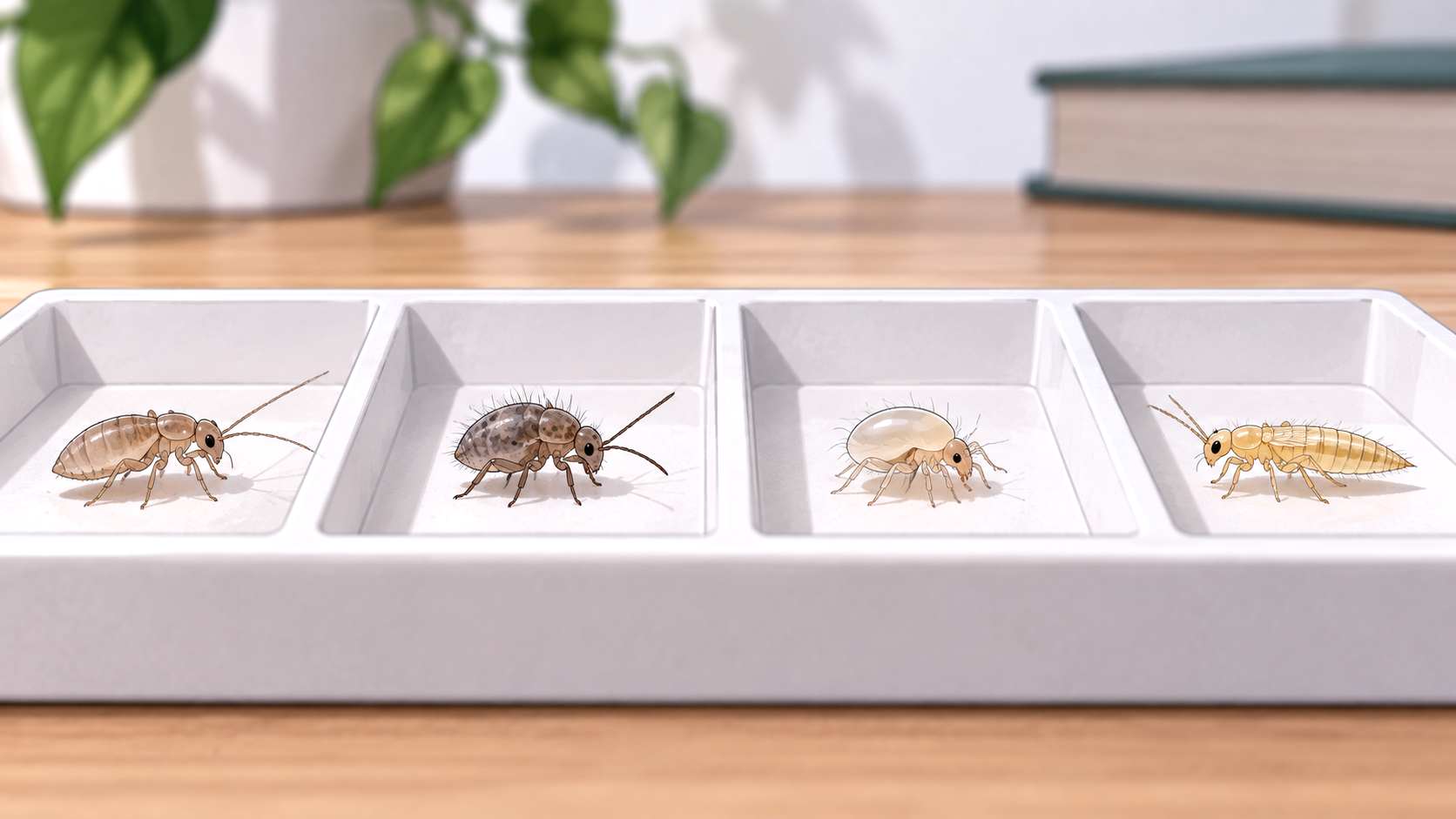
Booklice are so small that identifying them by sight alone can be frustrating. A pale speck on a bathroom wall, a tiny brown insect beside a book, or something crawling through a humid cupboard can fit several different household pests at first glance. Bugs that look like booklice include springtails, mold mites, flour mites and other storage mites, thrips, termites, and true lice. The quickest way to separate them is to look beyond color. Booklice are tiny, soft-bodied insects with six legs, long antennae, a relatively large head, and no jumping ability. Common indoor species are also wingless.
Where you find the insect matters too. Booklice are strongly associated with humidity and the microscopic fungi that develop in damp environments, so the combination of appearance, movement, and location usually gives a much stronger identification than any one feature.
What Does a Booklouse Actually Look Like?
Before comparing look-alikes, it helps to establish what you are looking for. Common indoor booklice are extremely small, typically around 1 to 2 millimeters long, with soft bodies, long slender antennae, and a comparatively large head. Many indoor species in the genus Liposcelis are wingless and flattened from top to bottom.
Their coloration varies more than many photographs suggest. A booklouse may be nearly transparent, whitish, gray, tan, light brown, dark brown, or orange-brown. Young booklice nymphs can be especially pale, so color is rarely enough to settle an identification.
Booklice also crawl rather than jump. Indoors, they favor warm, damp and relatively undisturbed places where microscopic fungi can grow. Finding an insect that matches the anatomy but lives in a completely different environment should make you consider another identification.
Springtails Can Look Like Booklice
Springtails are among the easiest booklice look-alikes to encounter because both can become abundant around moisture. Tiny springtails may be gray, whitish, brown, or dark, and their small size can make detailed body differences impossible to see without magnification.
Movement provides the quickest clue. Most springtails possess a specialized forked structure called a furcula, which can propel them away when disturbed. Booklice do not have this jumping mechanism. If the specks on a damp windowsill or bathroom surface repeatedly spring away as you approach them, springtails are a much stronger possibility.
Their body shapes also differ under magnification. Booklice have a relatively broad head and conspicuously long antennae, while springtails have a different overall body structure. Moisture alone cannot distinguish them because both groups thrive in damp environments. A direct comparison of springtails vs. booklice is particularly useful when the insects are too small for an immediate visual identification.
Mold Mites Can Be Mistaken for Booklice
Mold mites and booklice share two characteristics that cause plenty of confusion: they are extremely small, and they can occur where moisture supports fungal growth.
The major difference is anatomical. Booklice are insects, so they have six legs as nymphs and adults. Adult mites are arachnids and have eight legs. Mites also lack the pair of long, obvious antennae characteristic of booklice. Under sufficient magnification, those differences are much more reliable than color.
A mold mite may look whitish or translucent and can be difficult to distinguish from a tiny particle until it moves. A pale booklouse can create the same impression. When both are plausible, counting legs and looking for long antennae provides a much better answer than deciding whether the animal looks white enough to be a mite. The environmental overlap is explored further when comparing booklice and mold mites.
Storage Mites Can Resemble Pale Booklice
Flour mites and other stored-product mites can also be confused with booklice, particularly when tiny pale arthropods appear in flour, grains, cereals, animal feed, or other stored foods.
Booklice themselves can infest stored products, so location does not settle this comparison. Some Liposcelis species are recognized stored-product pests, and populations can become substantial when food, warmth, and humidity remain favorable.
Again, anatomy is more useful. Adult storage mites have eight legs and no antennae, while booklice have six legs and a distinct pair of antennae. Booklice also have a more recognizable insect body with a prominent head. If the organisms are too small to see these details, a magnified photograph or specimen examination is much more dependable than trying to identify them from the food they occupy.
Termite Workers Can Look Like Oversized Booklice
The resemblance between booklice and termites becomes more believable under magnification. Both can be pale, soft-bodied insects with prominent heads, and a booklouse photographed at high magnification can look much larger than it really is.
Actual size quickly changes the picture. Household booklice are usually around 1 to 2 millimeters long, while termite workers are substantially larger. Termites are also social insects that live in colonies and are associated with characteristic structural or wood-related evidence rather than simply appearing as isolated microscopic insects around humidity.
The antennae provide another clue. Termites have beadlike antennae, whereas booklice have long, slender, threadlike antennae. Booklice are also associated with microscopic fungi and moisture rather than consuming structural wood. This distinction is important because mistaking booklice for termites can turn a minor moisture-related nuisance into an unnecessary structural-pest scare.
Bed Bug Nymphs Can Be Confused With Booklice
Very young bed bugs can be pale and small, which occasionally puts them in the same visual category as booklice. The resemblance becomes much weaker once body proportions and size are considered.
Bed bugs have broad, oval, strongly flattened bodies. Their heads are much smaller relative to the abdomen than the conspicuously large head of a booklouse. Bed bug nymphs also become progressively larger through their developmental stages and may show visible blood in the abdomen after feeding.
Booklice do not feed on blood and do not bite people. They feed largely on fungi and other suitable organic materials. Their long antennae and different body proportions are also apparent under a clear magnified view.
Finding a tiny insect near a bed is not evidence by itself that it is a bed bug. The differences between booklice and bed bugs are substantial once the insects are compared at their real scale rather than through unrelated enlarged photographs.
True Lice and Booklice Share a Name, Not a Lifestyle
The word “lice” makes true parasitic lice an obvious comparison, but the two are difficult to confuse once their biology is considered.
Head lice live on people and are adapted to move among human hairs. Their eggs, called nits, are attached to hair shafts. Booklice are free-living environmental insects associated with moisture, fungi, paper, stored products, and other suitable materials. They do not establish themselves on the human body.
Their anatomy differs as well. Booklice typically have long, slender antennae and a relatively large head, while parasitic lice possess adaptations for remaining on their hosts. Booklice are harmless to people and pets.
If the suspected insects are living in hair rather than crawling around a damp household surface, the shared name should not push booklice to the top of the list. Booklice and true lice occupy fundamentally different habitats.
Thrips Can Resemble Booklice at a Glance
Thrips are another group of extremely small insects that can appear as tiny dark or pale marks on a surface. Some may enter buildings from outdoor vegetation and turn up around windows, doors, or houseplants.
Their shape provides the clearest distinction. Thrips are characteristically narrow and elongated, whereas booklice have a more compact body with a relatively broad head. Adult thrips may also possess narrow wings fringed with long hairs, a feature unlike the wingless Liposcelis booklice commonly found indoors.
Location can support the identification. Tiny insects concentrated around plants and windows may point toward thrips, while repeated sightings around damp cardboard, cupboards, paper, or mold-prone areas fit booklice more closely. Neither clue should replace an examination of the insect itself.
Silverfish Are Sometimes Confused With Booklice
Silverfish and booklice can both occur around paper, books, cardboard, and humid rooms, but the resemblance mostly disappears when you compare their actual size and shape.
Silverfish are much larger and have elongated, tapered bodies covered with scales. Three long appendages project from the rear of the abdomen, giving them a distinctive appearance. Booklice lack those three tail-like structures and are tiny by comparison.
The shared association with books can still cause confusion, particularly when someone notices damage or insects in a stored collection without getting a clear look at the pest. The physical differences between silverfish and booklice make identification straightforward once an intact specimen can be seen.
How to Tell If a Tiny Bug Is Really a Booklouse
Start with size rather than color. A typical indoor booklouse is only around 1 to 2 millimeters long, so an insect several times that size is already a poor match. Next, look for six legs, long threadlike antennae, a relatively large head, and the soft body typical of a psocid. Common indoor forms should not have functional wings.
Then watch the insect move. Booklice crawl. An animal that repeatedly springs away behaves more like a springtail, while an organism with eight legs is a mite rather than an insect. A clearly flying specimen also deserves closer examination because the common indoor Liposcelis booklice are wingless.
Finally, look at the environment. Booklice are strongly associated with excessive moisture and fungal growth. Utah State notes that they occur around damp books, cardboard, leaking or sweating pipes and other mold-supporting areas. A matching insect repeatedly appearing in that environment makes the identification considerably stronger.
A Hand Lens Can Solve More Than a Photo Search
One of the easiest mistakes is comparing a barely visible household speck with highly magnified photographs online and choosing whichever image looks closest. Magnification removes the sense of scale, while lighting can dramatically alter color.
A basic hand lens can reveal the features that matter. Look for antennae, count the legs if possible, examine the shape of the head and abdomen, and note whether wings are present. Utah State specifically recommends using a hand lens to identify these tiny insects.
A phone photograph can also help if the camera captures enough detail, but include something for scale whenever possible. Knowing whether the insect is one millimeter or five millimeters long can eliminate several look-alikes before subtle anatomical differences even need to be considered.
Other Questions About Bugs That Resemble Booklice
What tiny white bugs are most likely to be confused with booklice?
Mold mites, storage mites, springtails, and some other tiny arthropods can all appear pale or whitish. Check the number of legs, antennae, body shape, movement, and location rather than relying on color.
What bug looks like a booklouse but jumps?
A springtail is a strong possibility. Many springtails use a furcula beneath the abdomen to propel themselves when disturbed, whereas booklice crawl rather than jump.
What looks like a booklouse but has eight legs?
A tiny organism with eight legs is not a booklouse. Adult mites have eight legs and can occur in some of the same damp environments as booklice.
Can several different tiny bugs live in the same damp area?
Yes. Moisture can create suitable conditions for fungi and various moisture-associated arthropods, so finding one type of tiny organism does not prove every speck nearby is the same species.