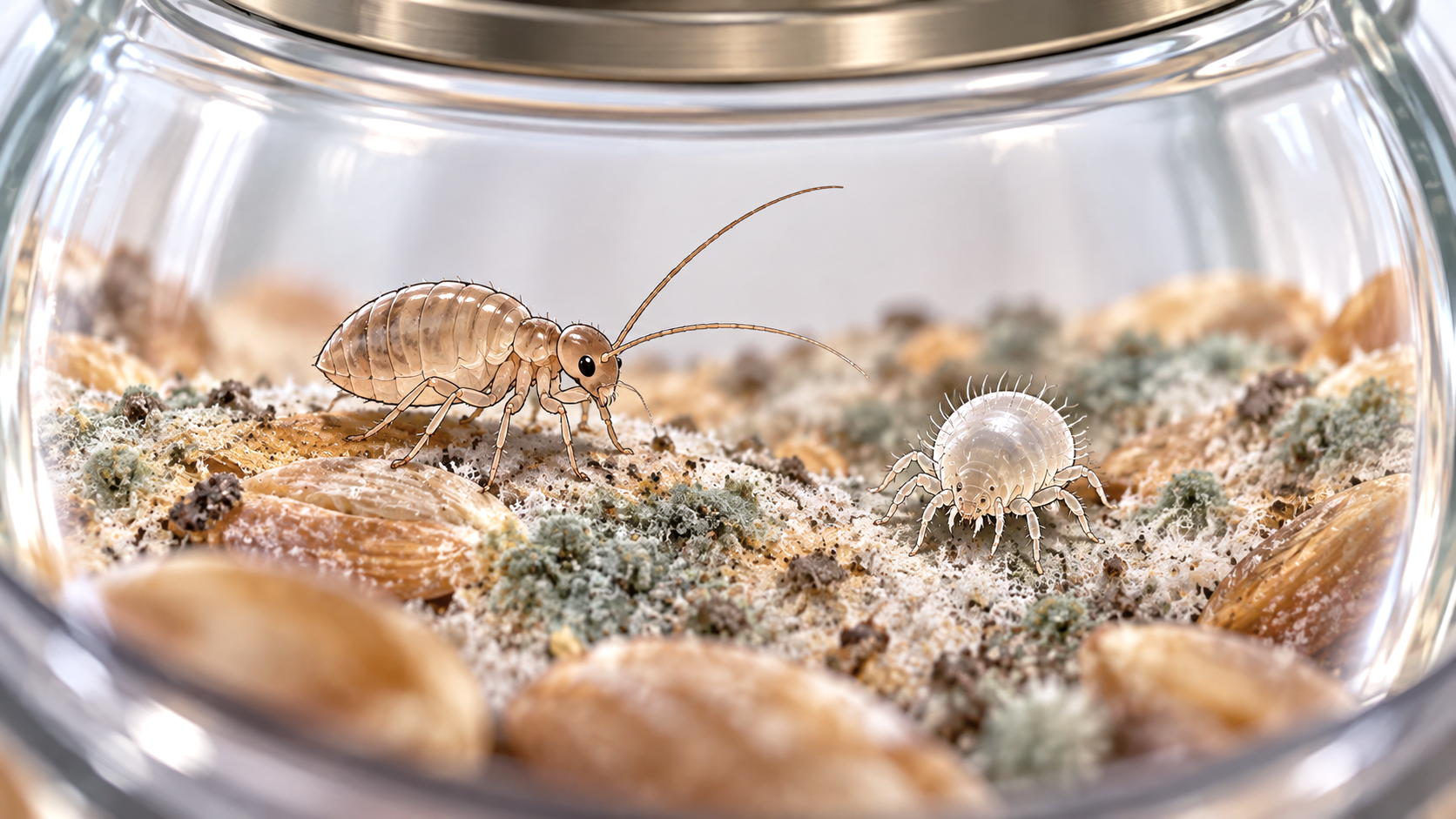
Booklice and mold mites are not the same thing, even though a damp cupboard can support both and both may appear as tiny pale specks around moldy materials. The resemblance is strongest before magnification. Once you can see their bodies clearly, they belong to completely different groups.
Booklice are six-legged insects with long antennae and relatively large heads. Mold mites are eight-legged arachnids without antennae. Both thrive in humid environments and can feed on fungi, so finding either one usually points toward excess moisture. Mold mites are generally much smaller, making individual mites considerably harder to see.
The confusing part is that habitat does not separate them particularly well. Anatomy does.
Booklice vs. Mold Mites at a Glance
FeatureBookliceMold MitesTypeInsectArachnidTypical sizeCommonly 1–2 mmSome common species about 0.3–0.4 mmLegs68 as adultsAntennaeLong and slenderNoneBodyDistinct head, thorax and abdomenMite body without a distinct insect-like headColorNearly clear, gray, tan, brown, orange-brownOften pale or translucentMain food associationMold, fungi and other suitable organic materialMold, fungi and suitable stored foodsHumidity associationStrongStrongStored-food infestationsPossiblePossibleBites peopleNoNot blood-feeding human parasitesMain control issueMoistureMoisture and infested materials
Unlike comparisons involving bed bugs or termites, location is not enough to settle this one. Booklice and mold mites genuinely can occupy very similar environments.
Booklice Are Insects, While Mold Mites Are Arachnids
The clearest biological difference is their classification.
Booklice are insects in the order Psocodea. Common indoor booklice are frequently species of Liposcelis and belong to the family Liposcelididae. Like other insects, adults have six legs.
Mold mites are mites and therefore arachnids. The name “mold mite” can be used for more than one moisture-associated mite rather than representing a single species. One important example is Tyrophagus putrescentiae, a member of the family Acaridae that occurs in stored foods and other fungus-rich materials.
This means there is no biological stage at which a booklouse turns into a mold mite or vice versa. They are separate animals with separate life cycles.
The scientific classification of booklice makes this particularly clear. Their superficial similarity comes from being tiny, pale household arthropods occupying similar habitats, not from being the same pest.
Mold Mites Are Usually Much Smaller
Real-world size is one of the most useful clues.
Common indoor booklice are generally about 1 to 2 millimeters long. They are extremely small, but an individual booklouse can usually be seen moving across a contrasting surface without magnification.
The mold mite Tyrophagus putrescentiae is considerably smaller, measuring approximately 0.28 to 0.41 millimeters long. At that size, identifying an individual mite with the naked eye is difficult. Large populations may become conspicuous because so many tiny mites are moving together.
That size difference matters when people describe “tiny white bugs.” A clearly visible individual with a discernible elongated body is more compatible with booklice than a mite measuring a fraction of a millimeter.
Comparing the specimen with the known size of booklice is more reliable than comparing two enlarged photographs, where both organisms can appear equally large.
Count the Legs if You Can See Them
If you have sufficient magnification, leg count provides a straightforward distinction.
An adult booklouse has six legs because it is an insect. It also has two long antennae extending from the head.
An adult mold mite has eight legs because it is an arachnid. It has no antennae. Those two differences alone can settle the identification when the specimen is clear enough to examine.
The complication is scale. Mold mites are so small that counting eight legs with the naked eye is unrealistic. A hand lens may help with larger specimens, although a microscope or sharp macro image can make identification much easier.
Booklice are more forgiving. Their long antennae and characteristic broad head can become visible with modest magnification, making the appearance of booklice easier to recognize.
Booklice Have Long Antennae, but Mold Mites Have None
The antennae are particularly useful because they change the overall silhouette of a booklouse.
Booklice have long, slender, threadlike antennae. They also have a relatively wide head and prominent clypeus. Together, these features give a magnified booklouse a distinctly insect-like, somewhat big-headed appearance.
Mold mites lack antennae entirely. Their front legs can sometimes create visual confusion in poor photographs, but they are legs, not a separate pair of sensory antennae.
This is one reason a sharply focused photograph is far more useful than color for this comparison. Both organisms can appear whitish or nearly translucent, whereas a pair of conspicuous antennae immediately favors booklice.
Both Can Be Found Around Mold
This is where the confusion becomes understandable.
Booklice commonly inhabit warm, damp, undisturbed areas where mold and fungi are growing. They feed on fungi and can become numerous when indoor humidity remains high. Damp books, cardboard, stored foods, cupboards, wall voids, and moisture-affected building materials can all support them.
Mold mites can occupy remarkably similar conditions. Tyrophagus putrescentiae, for example, develops only where sufficient moisture or high humidity is available and feeds on molds and fungi. It can infest flour, grain, cheese, seeds, dried fruits, nuts, mushrooms, animal nests, and other suitable materials.
So finding tiny pale arthropods beside visible fungal growth does not distinguish booklice from mold mites.
The shared connection explains why booklice eat mold and why mold mites can appear in the same type of moisture problem.
Mold Is Often the Food Source, Not Just a Hiding Place
A common mistake is to treat the visible organisms and the mold as two unrelated household problems.
For both booklice and many mold-associated mites, fungal growth can provide food. A damp package of flour, cardboard box, wall surface, or cupboard can therefore create a small ecosystem in which moisture supports fungi and the fungi support tiny arthropods.
Booklice feed chiefly on fungi and mold indoors, although their diet can include other suitable organic and starchy materials. Mold mites such as T. putrescentiae also consume fungi while exploiting suitable stored products.
That is why booklice feeding on mold is more than incidental behavior. It helps explain why infestations persist until the moisture problem changes.
Simply wiping away the insects without correcting damp conditions can leave the environment that supported them intact.
Both Can Infest Stored Food
The kitchen or pantry is another place where these pests overlap.
Booklice can occur in flour and other stored grains. Their presence in stored foods is associated with damp conditions and fungal growth, and contaminated food should be discarded.
Mold mites can also become stored-product pests. Tyrophagus putrescentiae has been recorded from products including cheese, flour, grain, seeds, dried fruits, nuts and cereal foods. Under favorable moisture conditions, populations can become extremely large.
This makes “I found them in flour” insufficient for identification. Both possibilities remain open.
Instead, examine the organism itself and the condition of the product. A visible 1-to-2-millimeter insect with long antennae supports booklice. Much smaller pale mites moving through a damp or mold-affected product support a mite infestation.
Booklice and Mold Mites Can Appear in the Same Home
There is no reason a building must have one or the other.
A moisture problem can create conditions favorable to multiple organisms simultaneously. Mold growth provides food for booklice and can also support mold-feeding mites. Other tiny arthropods may be present as well.
Predators can even take advantage of these populations. For example, pseudoscorpions can feed on both psocids and mites, along with springtails and other tiny arthropods.
That means two specimens from the same damp cupboard should not automatically be assumed to represent different life stages of one species. If one has six legs and long antennae while another has eight legs and no antennae, you may genuinely have more than one type of arthropod.
Mold Mites Are Not Dust Mites
“Mite” is a broad category, and mold mites should not automatically be treated as house dust mites.
House dust mites are associated particularly with household dust, bedding, upholstered furniture, carpets, and shed skin scales. Mold mites such as Tyrophagus putrescentiae are strongly associated with fungi and suitable stored products under moist conditions.
The distinction matters because a visible population around moldy flour or damp cabinetry is a very different situation from ordinary house dust mite exposure.
If the concern is specifically bedding and indoor allergens, the comparison between booklice and dust mites is more useful. If tiny pale arthropods are actually visible around fungal growth, mold-associated mites become a more relevant possibility.
Booklice Do Not Bite
Booklice are harmless to people and pets. They do not bite, suck blood, or transmit disease.
Mold mites such as T. putrescentiae are also not blood-feeding human parasites. However, treating the two pests as medically identical would go too far. Heavy occupational or environmental exposure to some storage mites, including T. putrescentiae, has been associated with allergic reactions and dermatitis sometimes described as grocer’s itch.
That is different from being bitten in the way a bed bug, flea, or mosquito feeds.
If visible skin marks are the main concern, a booklice infestation should not automatically be blamed. The same applies to finding tiny mites in a damp food product. Neither situation establishes that the organisms are feeding on the person.
For the booklice side of the comparison, the answer to whether booklice are harmful to humans is reassuringly straightforward.
Humidity Can Support Both Populations
Moisture is the practical link between booklice and mold mites.
Booklice thrive in humid environments, and keeping relative humidity below approximately 45 to 50 percent makes conditions unsuitable for their continued survival. Reducing moisture also suppresses the fungal growth on which they commonly feed.
Mold mites similarly require moisture or high humidity. T. putrescentiae becomes established where conditions allow molds and fungi to flourish.
A dehumidifier can therefore be useful when excessive room humidity is contributing to the problem, but it should not substitute for finding a leak, condensation problem, wet building material, or contaminated food source. The role of a dehumidifier in controlling booklice depends on whether excessive ambient humidity is actually driving the infestation.
If one cabinet contains a leaking pipe, lowering humidity elsewhere in the house will not repair the leak.
Their Body Shapes Become Obvious Under Magnification
When color and location fail, magnification usually resolves the basic booklouse-versus-mite question.
A booklouse looks recognizably insect-like. You can distinguish its head from the rest of its body, see six legs, and usually notice the long antennae. The broad head is particularly characteristic.
A mold mite looks much more like a tiny mite. The body is compact, there are eight legs in the adult stage, and the long paired antennae of booklice are absent.
This is more dependable than trying to identify them as “white bugs.” Booklice come in several colors, including nearly clear forms, while many mold mites are also pale or translucent.
When dealing with something only a fraction of a millimeter long, anatomy beats color.
What to Do if You Cannot Tell Which One You Have
Do not start by spraying an unidentified population. Capture several specimens instead.
Clear adhesive tape can sometimes preserve very small crawling specimens for examination, while larger booklice can be collected in a small sealed container. A sharp macro photograph beside a scale can also help, although extremely small mites may require stronger magnification for reliable identification.
Then investigate the environment. Check for leaking pipes, condensation, wet cardboard, damp drywall, spoiled stored foods, excessive room humidity, and visible fungal growth.
For booklice, moisture correction is the primary control method, and insecticides are normally unnecessary. The same underlying moisture investigation is useful when mold-associated mites are present, although contaminated food or other heavily infested material may also need to be discarded.
If the specimen does not match either group, compare it with other bugs that look like booklice before deciding on treatment.
Other Questions About Booklice and Mold Mites
Which is smaller, mold mites or booklice?
Common mold mites can be substantially smaller. Tyrophagus putrescentiae measures roughly 0.28 to 0.41 millimeters, while common indoor booklice are generally around 1 to 2 millimeters long.
Can booklice and mold mites live together?
Yes. Both can benefit from humid conditions and fungal growth, so the same moisture problem can potentially support both. Individual specimens still need to be identified separately.
Are tiny white bugs around mold always mold mites?
No. Booklice can be nearly clear or pale and commonly occur around mold. Springtails and other small arthropods may also occupy damp environments, so color and location alone are insufficient.
Will removing the mold get rid of booklice and mold mites?
Removing fungal food helps, but the moisture that allowed the mold to grow must also be corrected. Persistent dampness can allow fungal growth and moisture-associated arthropods to return.